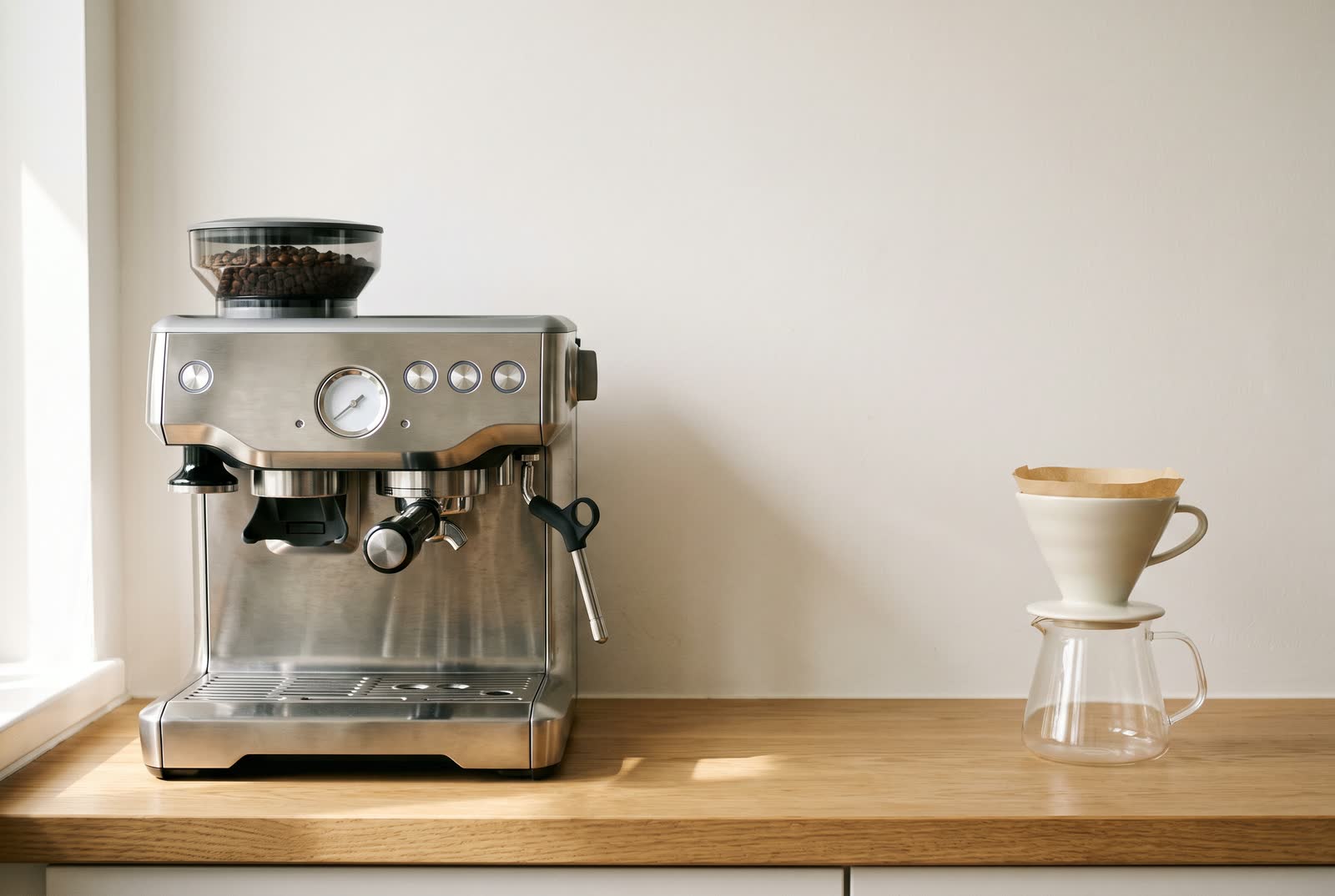
The same bean, two different rooms
Espresso and coffee start from the same roasted bean and end up as two drinks that do not look alike, do not weigh the same in the cup, and are made by machines that have almost nothing in common. Every difference between them comes down to two things that happen before the water touches the coffee: how fine the beans are ground, and how hard the water is pushed through them.
A pour-over cone, a French press and a drip machine let water fall through coffee under its own weight. An espresso machine forces it through with a pump. That is the whole distinction, and the rest of this page is what follows from it.
What the pressure does
Water under pressure moves through a bed of ground coffee much faster than water that is only falling, and it moves through a bed packed far more tightly. An espresso shot is a small amount of water, pushed through a compressed puck of fine grounds, in a short time. The result is concentrated, thick, and topped with the layer of foam called crema, which is dissolved gas coming out of the coffee as the pressure drops at the spout. Nothing made in a cone or a press has crema, because nothing in a cone or a press is under enough pressure to make it.
The figure makers publish for this is the pump's pressure, in bar. On the machine pages read for this site, the entry machines that state it say the same thing. The Bambino page states a 15 bar Italian pump with low-pressure pre-infusion followed by 9-bar extraction. The Stilosa page states 15 bar pump pressure. The two numbers on the Bambino's line are two different things: 15 bar is what the pump can make, and 9 bar is what the machine holds the shot at. Why both are true of the same machine is worked through in nine bars, and what the number means, and the part that makes the pressure is in how an espresso machine makes pressure.
Not every maker prints a pressure figure. Of the fifteen espresso machines whose maker pages were read for this site's own figures on 6 September 2026, nine state a pump figure and six state none, among them machines at the expensive end of this lineup. A missing figure is not a missing pump; it is a page that does not say. This site states no pressure for a machine whose maker states none.
What the grind does
Pressure only works on a bed that resists it. Water pushed at nine bar through coarse grounds would run straight through in a second and make something thin and sour. Espresso needs a grind fine enough, and packed evenly enough, that the water has to work its way through. That is why an espresso grinder is a different purchase from a grinder for a cone, and why the adjustment on it matters so much more.
The Encore is the grinder with the most figures here. Its maker states 40 mm conical burrs, 40 grind settings, a range of roughly 250 to 1200 microns and a 550 RPM direct-drive motor. That range is the whole story of the two drinks in one line: the fine end is where espresso lives, the coarse end is where a press lives, and a pour-over cone sits between them. Among the figures read on 6 September 2026, nine of the ten grinders we have read state how their adjustment works, and they state three arrangements: stepped settings, where the collar clicks between fixed positions; stepless adjustment, where it turns continuously; and a macro ring with micro steps inside each macro position, which three of the nine grinders state. The one grinder that states none of the three is a hand grinder whose page states none of the four figures read here about a grinder's burr and collar: no burr type, no burr diameter, no burr material and no adjustment type, all four recorded as absent at source on 6 September 2026.
A blade grinder has no setting at all. It chops for as long as the button is held, and the result is a mix of dust and chunks. Coffee made from that in a cone will be uneven, and espresso made from it will not extract at all, because the fine dust blocks the puck while the chunks let water through beside it. This is the reason a grinder is usually the second thing an espresso buyer has to buy, and it is the reason the Encore's maker publishes a micron range at all.
What the water does that the machine does not
A pour-over set is a porcelain cone, a glass server and a stack of paper filters. Its maker states the server's capacity and the kit's dimensions, and nothing else, because there is nothing else to state: no pump, no boiler, no pressure. The water does the work by gravity, the paper holds back the oils and the fines, and what comes out is a clear cup that carries more of the bean's acidity and none of its body. That is not a lesser drink. It is the drink the cone is for.
The difference in the cup, then, is not quality. It is concentration, body and crema on one side, clarity and volume on the other, and the reader choosing between the two is choosing which of those they want in the morning.
What this means for the first purchase
The reader who wants espresso is buying two things: pressure and a fine, even grind. The pressure comes with the pump, whether or not the maker prints a number for it: the Bambino's is the one page here that prints a nine-bar extraction figure, and six of the fifteen machines this site tracks, the expensive end among them, print no pressure figure at all. The grind is the purchase that separates a cup from a disappointment, and it is the one most first buyers underspend on.
The reader who wants coffee is buying a kettle, a cone and a grinder that goes coarse evenly. No pressure figure applies to them.
Where the money goes between those parts is a separate question, and this site answers it on the bands it uses rather than on prices it does not check.



