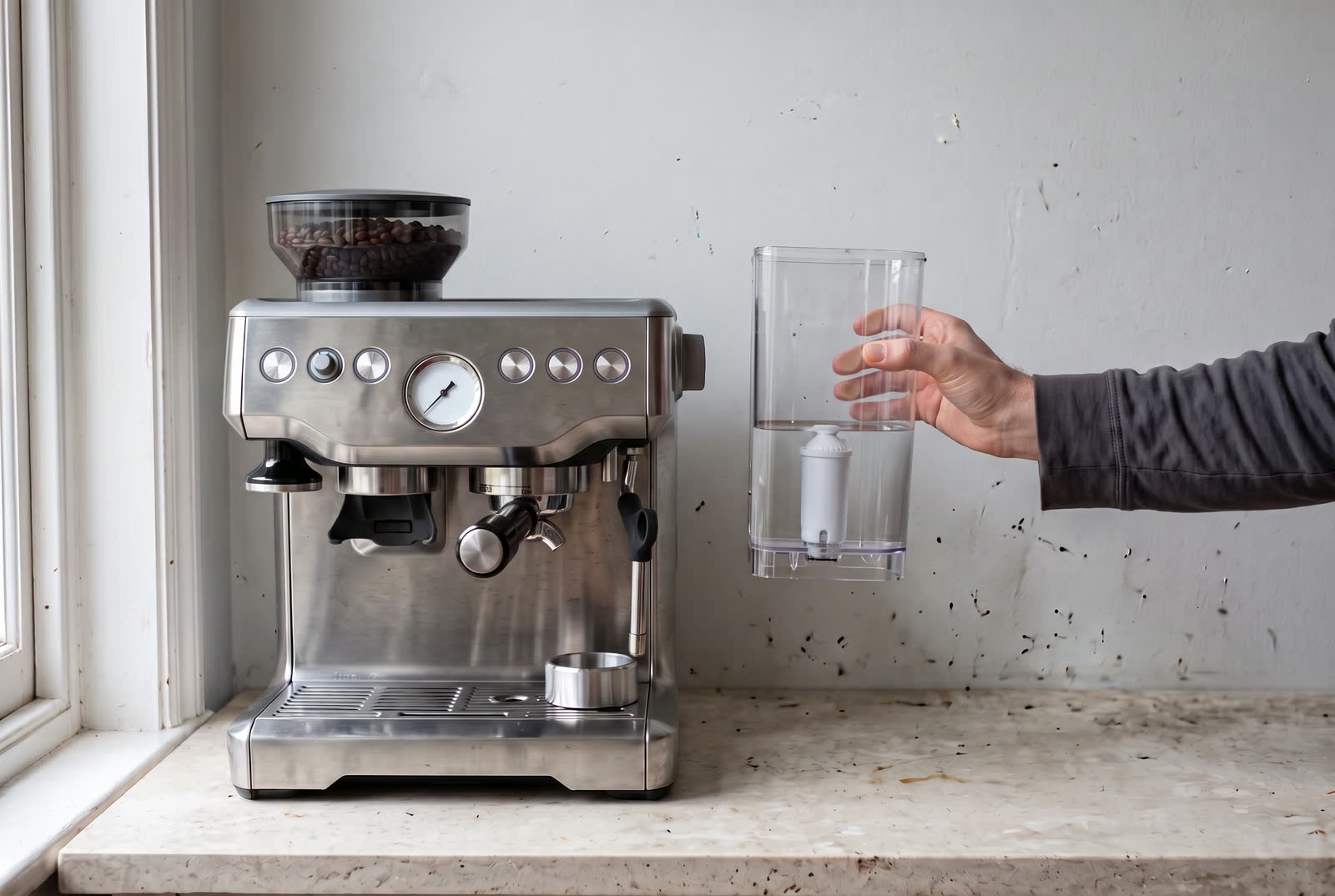
The small plastic part in the water tank
Open the tank on a mid-range espresso machine and there is often a little plastic cartridge clipped into a holder, sitting in the water. The maker sells replacements for it. Forums argue about whether it does anything. This page answers the question from the makers' own documents and accessory lists, read on the dates given, not from hands-on testing, and it is honest about where those documents stop.
What water does to a boiler once it is inside is water, and what it does to a boiler. This page is about the part and the paperwork.
What the cartridge is
It is a small canister of activated carbon, sometimes with an ion-exchange resin alongside it, sitting in the tank so that every drop drawn by the pump passes through it on the way to the heater. The carbon takes out chlorine and the taste and smell that come with it. The resin, where a cartridge has one, swaps some of the calcium and magnesium in the water for ions that do not form scale.
That is two different jobs in one part, and the split matters. The taste job works from the first cup. The scale job is a slowing of a process rather than a stopping of it: a filter reduces what goes in, and descaling removes what has already built up. A filter is a taste part first and a scale part second, which is this site's own framing rather than any maker's claim.
It is also a consumable: a spent cartridge sitting in warm water is worse than none at all.
What the accessory lists we have read state
The clearest evidence available on the subject is not in the manuals, it is in the maker's own accessory lists, read on 10 September 2026 from the pages' own specification blocks. Nine Breville espresso machines were read that day, and their lists are not the same as each other.
Seven of the nine name a water filter in the box, three of those name a water hardness test strip alongside it, and the two that name no filter are the two Bambinos. That census is already set out in water, and what it does to a boiler, and this page takes it from there rather than counting it again.
What that page does not take up is the part this one is for. One of the seven names the filter by brand rather than by category, and that is the only place here where a maker identifies the cartridge it sells instead of the slot it fits, which makes a brand on an accessory line the nearest thing to a filter specification these pages state. The Bambino's list names descaling powder and no filter at all, so a buyer of the smallest machine is handed a dose of descaler and left to answer the filter question themselves.
What the manuals we have read state about it
This site's own figures carry a manual link on twenty-three of its thirty-six products, with ten products whose maker publishes none and three not yet read. The three machines on this page all have one, all downloaded from the maker's own site and all searched in full on 6 September 2026: the Bambino's runs to 64 pages, the Stilosa's to 40 and the Classic Pro's to 64.
Here is the limit, stated plainly. Those searches were run for the same six figures on all three, and they are named here: the boiler's volume and material, the heat-up time, the temperature control, an automatic frothing statement, the body material and the warranty. A water filter is not one of the six, on any of the three. A second run of maker documents, read from the makers' own pages and manuals on 11 September 2026, covers eleven products and twenty-eight pages and documents, including five separate Gaggia documents, and what it records for each is what that document printed for the fields that run was after. A water filter statement is not among them either.
So we have not read what these three manuals say about a filter. That is a gap in the reading rather than a silence in the documents, and saying so is the difference between a page that is short and a page that is wrong.
What we know about these three tanks
The Stilosa's maker states a removable water tank of approximately one litre, and its manual, page 7, states that the tank can be filled in place: "the water tank can also be filled without extracting it, by pouring the water directly from a jug."
The Classic Pro publishes its operating instructions as a manufacturer PDF manual, and page 17 of it gives the filling instruction in its own words: "Remove the water tank cover (Fig.2) and fill it with cold water up to the MAX level of the tank (Fig.1-13)." The same machine is carried on this site with a removable tank in the 2 to 2.1 litre range, a figure that reaches this page through the way the line is described rather than off the maker's own page for this model, so it is written here as the size of the thing rather than as a measured capacity.
Both of those are filling instructions, and a tank that fills in place is the tank most likely to be topped up from whatever jug is nearest. That is exactly where the water question gets decided in practice.
Working it out for your own machine
Read the accessory list on the maker's page first. It is one line and it settles whether a filter shipped, which settles whether there is a holder in the tank to put one in.
Read the maintenance section of your own manual second. If a maker fits a filter, the maker states a replacement schedule, and that schedule is the only interval worth having because it is written for that cartridge in that tank.
If nothing shipped and nothing is stated, the intervention moves outside the machine. Filtered water poured into the tank does the same job as a cartridge in it, and a machine that was never designed around a cartridge loses nothing by being fed water that was filtered in a jug.
And keep the two jobs apart. A filter in the tank is not a reason to skip descaling, and descaling is not a reason to leave a spent cartridge where it is.



