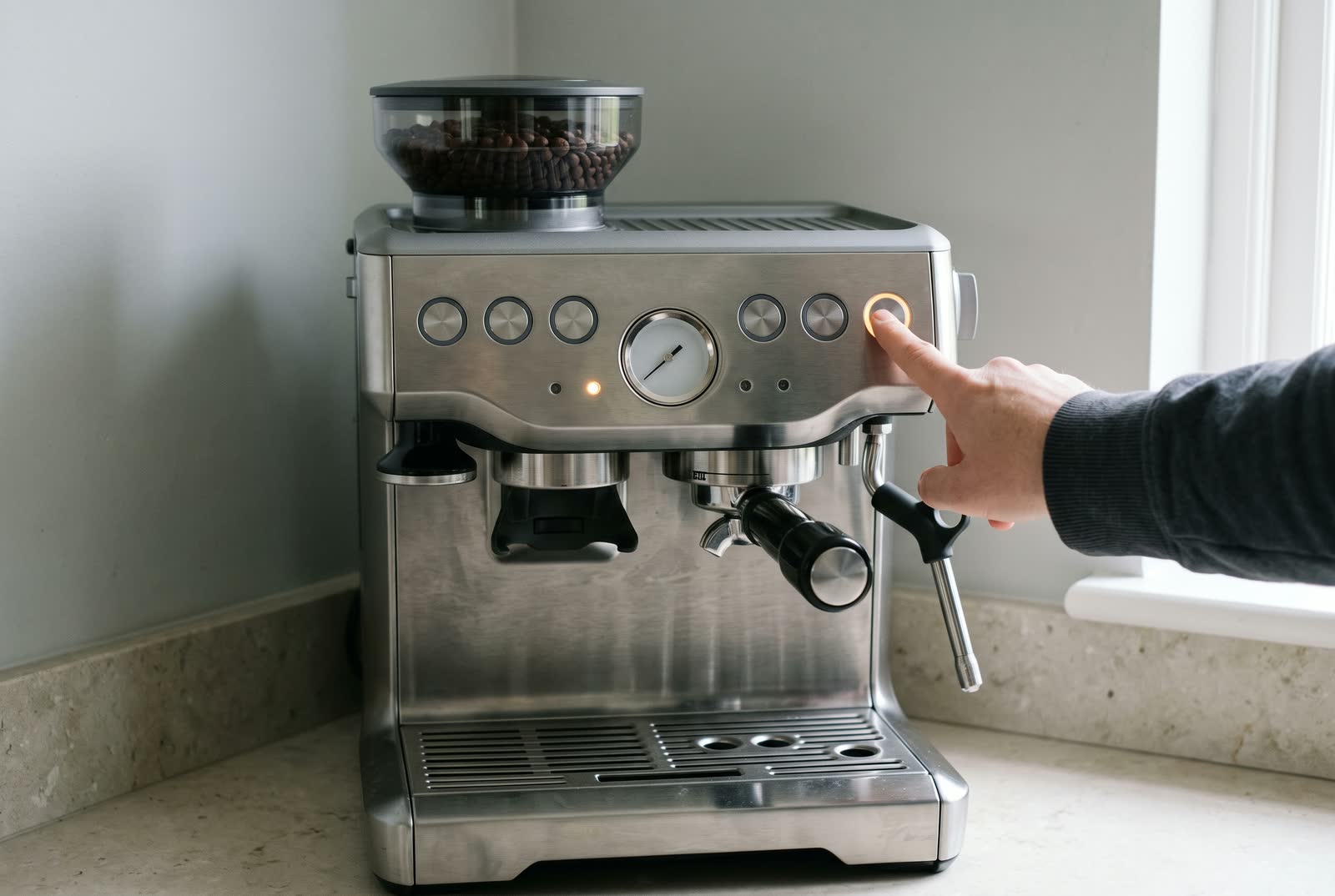
The eight minutes
The specification that decides whether you use a machine is not on the specification sheet. It is how long you stand in the kitchen between switching it on and having a drink in your hand, and it is the reason perfectly good machines end up in cupboards. A morning has a shape: you have the minutes between the alarm and the door, or you have a child, and a machine that has to be on for most of them before it can do anything has already spent the whole budget.
So it is fair to expect the number to be published. It is not published, by anybody, for anything on this site.
What the makers claim, which is not a heat-up time
Two of the four machines here carry a maker's speed claim and it is worth reading precisely. The Bambino is stated by its maker to reach extraction temperature in 3 seconds, and the Bambino Plus carries the same claim for the same heating system. Both are on the maker's own product pages.
Three seconds is a claim about the heater, not about the morning. It describes how fast the element brings water to temperature as it passes through, which is the property a thermocoil has and a boiler does not. What it does not describe is the machine from cold: the group head, the portafilter and the cup are all metal and all at room temperature, and none of them is heated in three seconds by anything.
And two makers who claim nothing
The other two are silent. The Stilosa is published with a stainless steel boiler and a 15 bar pump and no time of any kind, and the Classic Pro is a brass boiler machine whose maker publishes operating instructions and no duration. The two machines compared properly is where the difference between those two boilers is set out.
What the manuals say, which is nothing
The obvious next place to look is the manual, and all four have been looked at. Each of the four documents was downloaded from the maker's own site and text-searched in full on 6 September 2026: the Stilosa's forty pages, the Bambino's sixty-four, the Classic Pro's sixty-four and the Bambino Plus's seventy-two. Not one of the four prints a heat-up time.
That is a complete search of the primary documents rather than a failure to find the page. When four manuals from three makers all decline to state the same figure, it is not an oversight in any one of them.
What we have read across all of it
Among this site's own figures, no heat-up time is stated for twelve products and it has not been checked for three, and every product that is still open states none. The three not checked are machines the site no longer carries, so the honest summary is the harder one: there is no open product here with a published heat-up time.
This page therefore states no duration. Not in seconds, not in minutes, not as a range, and not as the sort of round number that reads like experience and is a guess. If you have seen such a number on another page, ask what it was measured on and from what starting state, and notice that the answer is almost never there.
What a measurement would need
A stopwatch, which is the cheap part, and then the definitions, which are the whole job. A written start: from cold at room temperature, plugged in, or from the machine's own standby, and those are three different numbers on the same machine. A written end: the first drop out of the portafilter, or a full double at a stated temperature in the cup, and those are different again by a wide margin.
Ambient temperature recorded with every run, because a cold kitchen and a warm one are not the same test. A repeat count, because the first heat-up of the day and the third are not the same event. And the same protocol on every machine without exception, because a figure measured to first drop on one machine and to a full double on another is two numbers in a table rather than a comparison.
What to do about a morning you cannot measure
Two things are true without the figure. A thermocoil machine is designed around a fast start and a boiler machine is not, and both makers are open about which they are building, so the boiler type on the specification sheet is the best proxy you have. And every machine of either kind is faster on its second shot than its first, so the number that governs your morning is the cold start.
If your morning is genuinely eight minutes, the fix is not a machine, it is a switch. A plug timer that powers the machine on before you are in the room removes the whole question for any machine, at the cost of leaving it heating unattended, which is a decision about your kitchen rather than about coffee. Where the money goes first is the page that costs the rest of the corner.



