The short answer
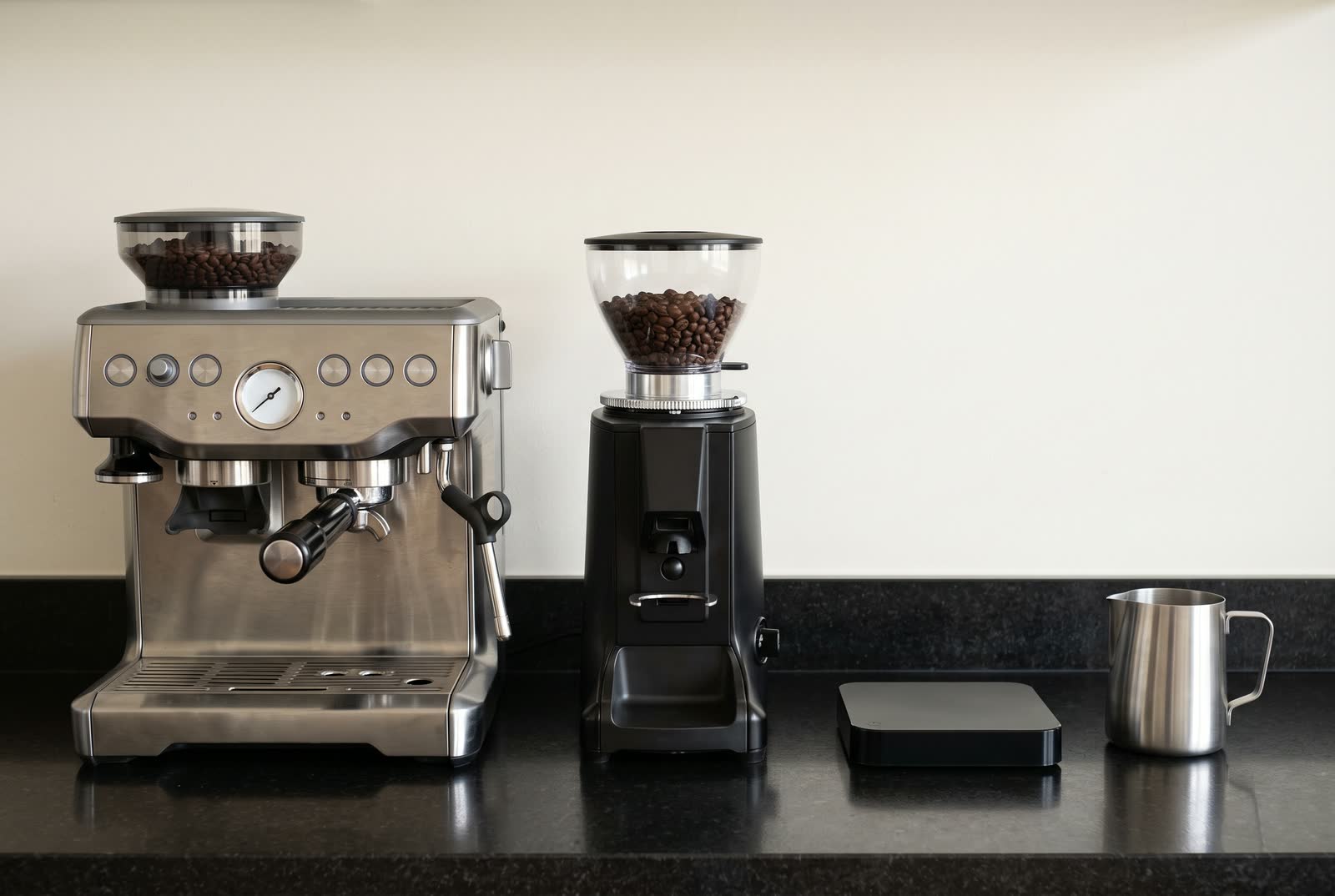
The machine takes the money first and the grinder second. Start with the Bambino, in the open band of two hundred and fifty dollars and up, and the Encore, in the hundred to two hundred and fifty band. The canister set, at fifty to a hundred, and the mug tree, under fifty, come after both.
The shape of the spend before any part of it
The question a reader asks first is how much a home espresso setup costs, and the answer here is a shape: what the setup is made of, and which of its parts takes most of the money, in bands rather than shop prices. That is worth knowing before any one part is chosen, because the part people price first is rarely the part that decides the total.
A working coffee corner has four jobs in it, and the page about a hundred-dollar ceiling names them in these words: something that brews, something that grinds, somewhere the beans live, and somewhere the cups live. At espresso the four are the same four. What changes is which of them takes the money.
A band, said plainly
Every figure about money on this page is a band. A band is a range this site drew for its own framing, four of them (under fifty, fifty to a hundred, a hundred to two hundred and fifty, and two hundred and fifty and up) and it is not a price read at a shop on any day. It says which shelf of the shop a thing sits on, and nothing more exact than that. The bands below are the ones the catalog uses for each product today.
The job that brews
The Bambino is the entry machine with the most figures here, and its listing sits in the open band, two hundred and fifty and up, with no top. Its page states a 15 bar Italian pump with 9-bar extraction, a 54 mm portafilter and a heating system its maker says reaches temperature in 3 seconds. The Stilosa is the other entry machine this site tracks, positioned by retailers below the Bambino line, with 15 bar pump pressure and a stainless steel boiler on its page; its listing carries no band, and this page states none for it rather than guessing one.
So the brewing job starts in the open band here, and that is the first thing the shape says: for espresso, the machine is where the money starts, not where it ends.
The job that grinds
The Encore sits in the hundred to two hundred and fifty band. Its page states 40 mm conical burrs, 40 settings, a range of roughly 250 to 1200 microns and a 550 RPM motor. It is the grinder this site names on most pages, and it is worth being clear about what its band means: the grinder is the second-largest spend of the four, and among these figures it is the one part where the band and the job are matched, because a grinder that goes fine and even is the difference between a shot and a disappointment. The page about pressure and grind says why.
Two jobs, then, take the money: the machine in the open band and the grinder in the band below it. The other two jobs this page gives a band to, where the beans live and where the cups live, sit below both.
Where the beans live
The canister set sits in the fifty to a hundred band, and its maker's page, read on 6 September 2026, prints three containers at 5.2, 3.3 and 1.5 quarts with push-button airtight lids. The same page prints a weight line with no number in it, which is a published, empty field, and this site states no weight for it. A bag of beans is the cheaper answer and it is a fine one; a canister is the answer for a reader who buys more than a week of coffee at a time.
Where the cups live
The mug tree sits under fifty, and its maker's page, read on 6 September 2026, prints an iron rotating tree holding eight mugs at 15 inches high and 8 inches across. It stands on the counter; the same job goes on the wall, and the page about the wall above the counter is where that choice is made.
What the four bands say together
Read as one shape: the machine in the open band, the grinder in the band below it, the beans' home in the band below that, the cups' home in the lowest. The money runs downhill from the brewing job, and the two jobs at the top take nearly all of it. A reader who has priced a machine and thinks the setup is priced has not yet priced the grinder, and the grinder is the part that decides the cup.
What comes after the four
A scale and a jug. Neither is one of the four jobs and neither is grouped into a kit on this page: a scale is the thing that makes a shot repeatable and a jug is the thing milk is steamed in, and both are the first purchases after the four are filled. They are small, and they are the subject of other pages here.
No price on this page is a price. Every band is the site's own framing, drawn on its own rules, and the open band is written as a floor with no top because that is what it is.



