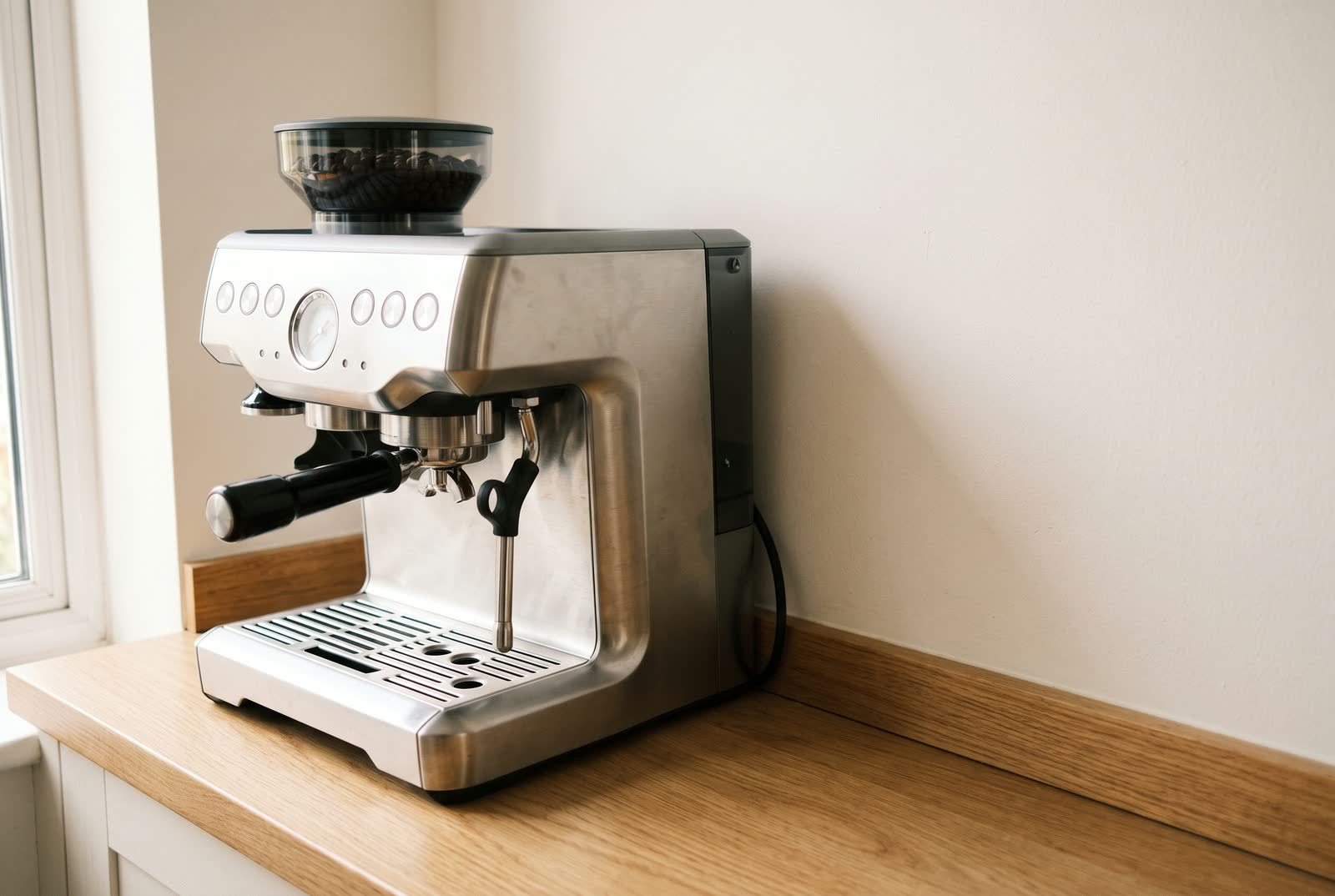
The short answer
For a standard 18 in gap between counter and wall cabinet, buy the Gaggia Classic Pro. Gaggia's own page, read on 11 September 2026, gives the Classic Pro a height of 355 mm (14.0 in), which leaves 4.0 in above it, and its manual says to lift off the tank cover and fill the tank in place, so the machine stays under the cabinet every morning.
For a tight 15 in gap, buy the Bambino. The Bambino stands 12.0 in tall (305 mm), a figure Target and Williams Sonoma agree on, which leaves 3.0 in above it. Its tank lifts out of the top, per Breville's manual, so slide the machine forward to refill it; Breville does not say how much lift the tank needs.
The Bambino Plus fits both gaps as well, with a published height that runs from 11.8 to 12.2 in depending on the source. In a 15 in gap the Classic Pro clears by 1.0 in, and Gaggia does not say how far its tank cover lifts, which is why the Bambino takes the tight gap.
For a 16 in gap, the Classic Pro leaves 2.0 in above it. Two more machines stand under 16 in on their makers' own figures: the Rancilio Silvia at 340 mm (13.4 in), per Rancilio's page and manual read on 6 September 2026, which leaves 2.6 in, and the Profitec GO at 381 mm (15.0 in), per Profitec's page and manual, which leaves 1.0 in. Top clearance is absent from both makers' figures, so check how each tank comes out before counting on the gap.
The room around the machine
You have measured the counter and the machine fits. Then the tank lid will not open under the wall cabinet, or the back panel is against the tiles and the machine runs hot, or the steam wand swings into the kettle. The width, depth and height you looked up did not answer any of that, because the figure you needed was the room around the machine rather than the machine.
What the makers print, which is a rule
Two of the four entry machines here carry a placement instruction in their own manuals, and both of them are rules rather than figures. The Stilosa manual, read on 6 September 2026, says that the coffee maker must not be placed inside a cabinet or kitchen unit during use. The Gaggia Classic Pro manual, read the same day, says that the machine shall not be placed in a cabinet when in use, on page 13.
Both of those are worth obeying. They rule out a closed cabinet and leave the open shelf above the machine, the wall behind it and the toaster beside it to your own tape measure, which is the situation almost every kitchen is in.
Rear, side and top clearance are absent at source for all thirty-six products this site keeps figures for, because the makers do not print them. For these four machines that was checked in each maker's own manual on 6 September 2026.
The two Bambino manuals: one line about the top
The Bambino manual and the Bambino Plus manual were both read in full on the same day. Their placement sections carry no instruction against use inside a cabinet, and the one line each prints about the space above is "Do not place anything on top of machine." Treat the silence on cabinets as silence rather than permission: the enclosure rule the other two makers print is the safe reading for all four machines.
Across four machines from three makers, that comes to two written prohibitions, two silences and one line about the top surface.
The outer dimensions, which do exist
This site has width, depth and height for twenty-seven of its thirty-six products. On the machines here it reads: the Bambino at 6.3 in (160 mm) wide, 13.8 in (350 mm) deep and 12.0 in (305 mm) tall, per Target and Bi-Rite Home Appliances, and the Bambino Plus at 7.7 in (196 mm) wide (Seattle Coffee Gear, agreeing with Whole Latte Love) and 12.6 in (320 mm) deep (Seattle Coffee Gear, agreeing with Target); Breville's own pages, read on 6 September 2026, print their dimensions without saying which figure is which, so this page uses the retailers' measurements. Its height is not settled: Seattle Coffee Gear and Whole Latte Love read 11.8 in, Breville's own page 11.9 in, and Target 12.2 in, so this page gives the range, 11.8 to 12.2 in. The Classic Pro is 200 mm wide, 270 mm deep and 355 mm high, from gaggia.com read on 11 September 2026, which this site ranks above the distributor's page.
Those are the outer dimensions of the object and nothing more. The tank lid's arc above that height, the depth the steam wand adds when it is swung out, and the space the portafilter needs in front are all outside the box and none of them is published. The four lines on a spec sheet is what those dimensions do tell you.
The Stilosa, and a number with no label on it
The fourth machine is the interesting one. Its maker's page prints "Dimensions 13.5x8.07x11.22" with no unit and no axis label, and its forty-page manual, read in full, prints no dimension table at all. So no width, no depth and no height is stated for it: three figures exist, and which of them is the width is a guess, which means no width can be assigned.
That is the standard this whole page is written under: a number that is nearly a measurement stays empty until a labelled source settles it. Under a cabinet the Stilosa has one thing its manual does state, on page 7: the water tank can also be filled without extracting it, by pouring the water directly from a jug.
What a measurement would have to carry
For this page to state a clearance of its own, a measurement programme would have to exist, and it would have to be specified before it started rather than after. The machines would have to be in hand, physically, all of them. There would have to be a written protocol defining what counts as the rear face, the cabinet line or the widest point of the body, because on some of these machines those are two different planes.
It would have to define where the tank lid's arc ends and whether the steam wand is measured at rest or at its stop, since both change the answer by more than the tolerance. It would have to name the instrument and its tolerance, state how many repeats per machine, and, most importantly, state a refusal for every machine not held rather than estimating it from a photograph. Absent all of that, a clearance figure published here would be this site guessing in a confident voice, which is the one thing it is built not to do.
What to do this afternoon
Measure the space, not the machine. Put a book the height of your tallest cabinet-clearance on the counter where the machine will go, open an imaginary lid, and see what hits. Then measure the gap from the back wall to the front edge of the counter and subtract the depth above, which is a figure you do have.
Two rules survive the absence of every number. Nothing goes in a closed cabinet while it runs, because two of these four makers say so in writing, and leave the machine able to come forward, because every task that is not making coffee happens from in front of it or behind it. What water does to a boiler is the page that explains why filling, descaling and cleaning keep recurring.



