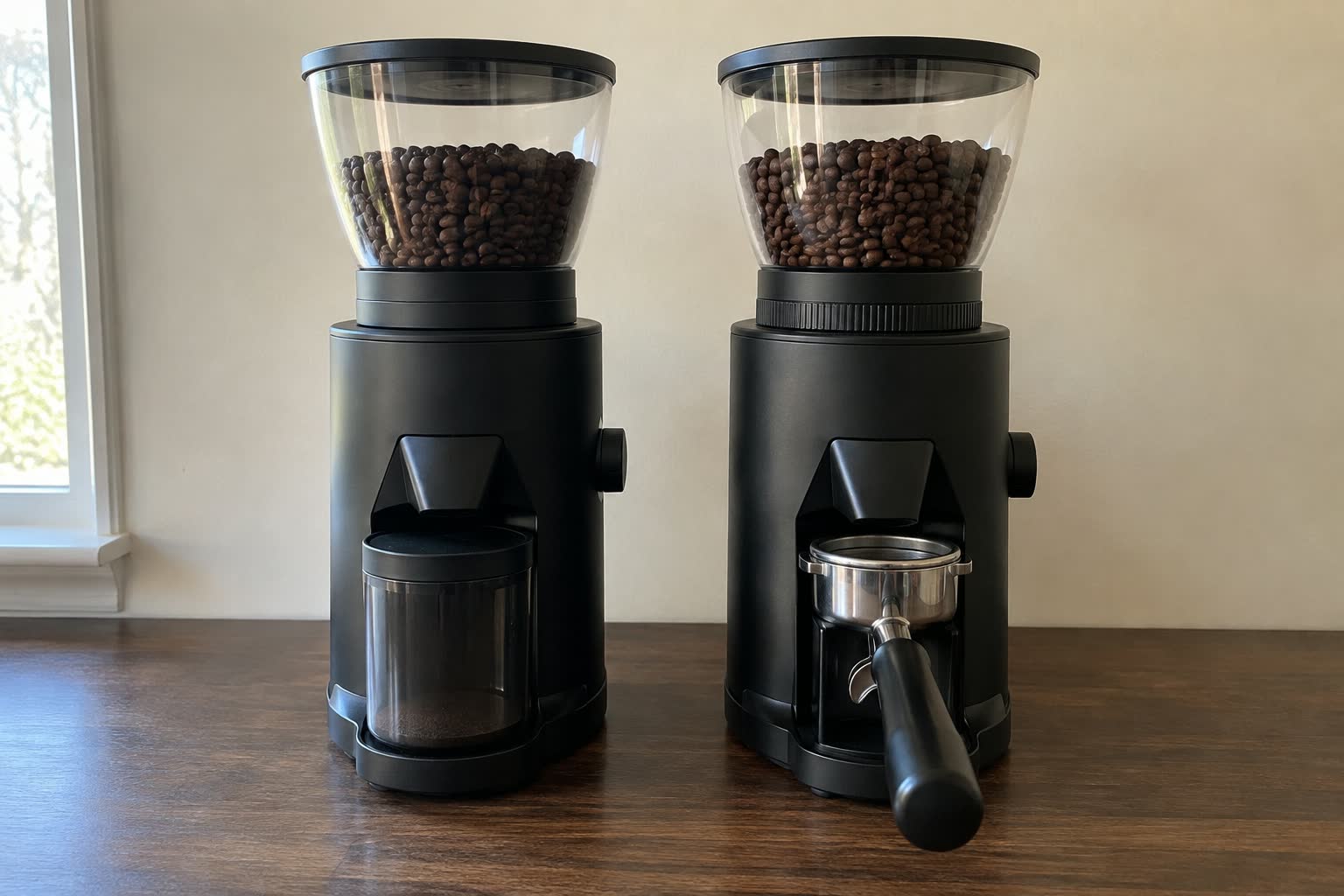
This comparison is based on the sourced specification tables both makers publish, read on the dates given below, not on hands-on testing. Where we have read two readings of the same figure, the figure is not compared at all and the page says so.
The short answer
Buy the Encore ESP if an espresso machine is on the counter, and the Encore if the brewer is a pour-over, a press or a drip machine. Both grind with 40 mm conical steel burrs, M3 on the Encore and M2 on the ESP, at the same motor speed. What differs is where the 40 steps sit: the ESP puts 20 of them in the espresso range, the Encore spreads its 40 from roughly 250 to 1200 microns, out to French press.
If you drink both, pick the grinder for the brewer you use every day, and read the section on the burr mount below before you decide.
Two grinders that are the same machine until they are not
The Encore and the ESP look alike because on their own maker's published specification tables they mostly are alike. Both tables were read here on 10 September 2026, and of the thirteen lines each one prints, eleven are identical and two differ: the burr, and the way the burr comes out. A third difference sits on the two product pages read on 27 August 2026 rather than in those tables, and it is the one that decides most purchases: where the forty settings are placed. This piece takes each of the three and says which brewer it is for.
The lines that are identical on both pages
Read side by side, the two tables agree on eleven of their thirteen lines. Both state 100-120 V at 70 W, a burr speed of 550 RPM, a grounds bin of 120 g, a one-year manufacturer warranty and the same grind rate at the same two settings: 1.3 g per second at setting 10 and 2.2 g per second at setting 30. The machines are, in the maker's own published terms, one body with two different burrs in it.
Two of those lines change how the grinder is used. At the printed rates an 18 g dose, which is an example and not a maker figure, takes about 8 seconds at 2.2 g per second and about 14 seconds at 1.3 g per second, and both grinders dose by hand: the maker prints the dosing feature as manual on each. And a one-year warranty on both means the warranty cannot be the reason to pay the difference.
How much counter each one takes
Baratza prints 13 by 15 by 34 cm on the Encore page, on the ESP page and on its Virtuoso+ page alike, so that triple names the family and does not measure either grinder. Retailers that label each axis give a narrower picture. Seattle Coffee Gear lists the ESP at 4.72 in wide, 6.29 in deep and 13.77 in tall, which is 120 by 160 by 350 mm, read on 26 September 2026. For the plain Encore the retailer readings, also read on 26 September 2026, run from 120 to 127 mm wide, 152 to 160 mm deep and 330 to 350 mm tall.
So plan on a footprint of about 12 cm by 16 cm and a height of 33 to 35 cm for either one. Under a cabinet the height matters more than the footprint: both manuals say the hopper lifts straight up off the top, and neither prints how much room the lift needs, so leave room above the 35 cm for the hopper to come off. The same sizes mean the ESP does not take more counter than the Encore, so anyone choosing on size can stop here and choose on the next section.
Where the settings sit, which is the actual difference
The Encore's page states 40 grind settings covering a range of roughly 250 to 1200 microns. The ESP's page states 40 total stepped settings as well, split 20 for espresso and 20 for filter. Same count of steps, distributed differently: the ESP spends half its range in the fine end where espresso lives, and the Encore spreads the same 40 across a range that reaches out to French press.
The consequence is the one sentence this whole comparison exists for. A grinder that puts 20 steps inside the espresso range can be dialled in by steps rather than by luck; a grinder that spends most of its range coarser than espresso has fewer usable steps exactly where a shot needs them. Neither page states a micron range for the ESP, so how fine its finest setting actually is, is not a figure either page states.
The burrs, and the one word that separates them
Both pages state 40 mm conical steel burrs. The Encore's is printed as M3, on the page read on 6 September 2026 and again on the table read on 10 September, and the ESP's is printed as M2 on both of its reads; those are the maker's own designations for two different burr sets in the same size. What the designations mean for particle distribution is not stated on either page, and it is not inferred here.
The same read prints one more difference, and it is the practical one: the Encore's burr mount is stated as threaded and the ESP's as quick release. A threaded burr comes out with a tool and a quick-release burr comes out by hand, which is a cleaning question rather than a coffee question, and it matters more to someone who switches between beans often than to someone who buys one bag at a time.
What each one arrives with
The ESP's maker states a 54 mm anti-static dosing cup with a 58 mm adapter in the box. That is an espresso accessory and nothing else: a dosing cup catches the grounds from the spout and is tipped into a portafilter, and the two figures name the two portafilter sizes it is meant to serve. The Bambino and the Bambino Plus state a 54 mm portafilter, and the 58 mm adapter covers the machine you might buy next, such as the Classic E24, whose distributor, Gaggia North America, lists a 58 mm portafilter (read 6 September 2026).
No box list for the Encore appears anywhere here. That is an absence rather than a statement that the box is empty, and it is written as one.
The hopper, read three times
The hopper is one of the eleven lines the two tables agree on, and it still does not enter the comparison, because Baratza's Encore page has printed two different capacities. It read 8 oz on 27 August 2026 and 300 g, given as 10.6 oz, on 6 September 2026, and the table of 10 September 2026 prints 300 g for both grinders. Both earlier readings are kept and neither overwrites the other, so the Encore's hopper is an open figure on this site whatever a single later table prints. The ESP's hopper has been read once.
If the hopper decides your purchase, read both pages yourself on the day you buy and note which date you read.
Which one to buy
Buy the ESP if espresso is the drink, because 20 steps inside the espresso range is the difference between adjusting a shot and guessing at it, and because the dosing cup is a real part of that workflow. Buy the Encore if the brewer on the counter is a pour-over, a press or a drip machine, because the wider stated range is where those brews actually sit and the espresso steps would go unused.
The mistake this page saves is the mismatch in either direction. An Encore bought for an espresso machine leaves most of its 40 steps coarser than the shot needs, and an ESP bought for a French press leaves 20 of its steps unused.
If the house makes both, the honest answer is that both pages describe a grinder built for one of the two. Nothing on either page says the other one is unusable, and nothing on this page says one grinder is better than the other, because the maker publishes no figure that would settle it.
Where to go from here
For the machine side of a first espresso setup, the Bambino against the Barista Express shows what a built-in grinder replaces, and Dialing In on a Breville Bambino shows where each handle sits once the grinder is chosen. Hand Grinder or Electric Grinder for Espresso covers the cheaper route, Conical Burrs and Flat Burrs covers what the burr shape changes, and One Bag, Two Brewers covers the household that brews both. If you expect to outgrow either, The Encore and the DF64 Gen 2 shows the step up.



