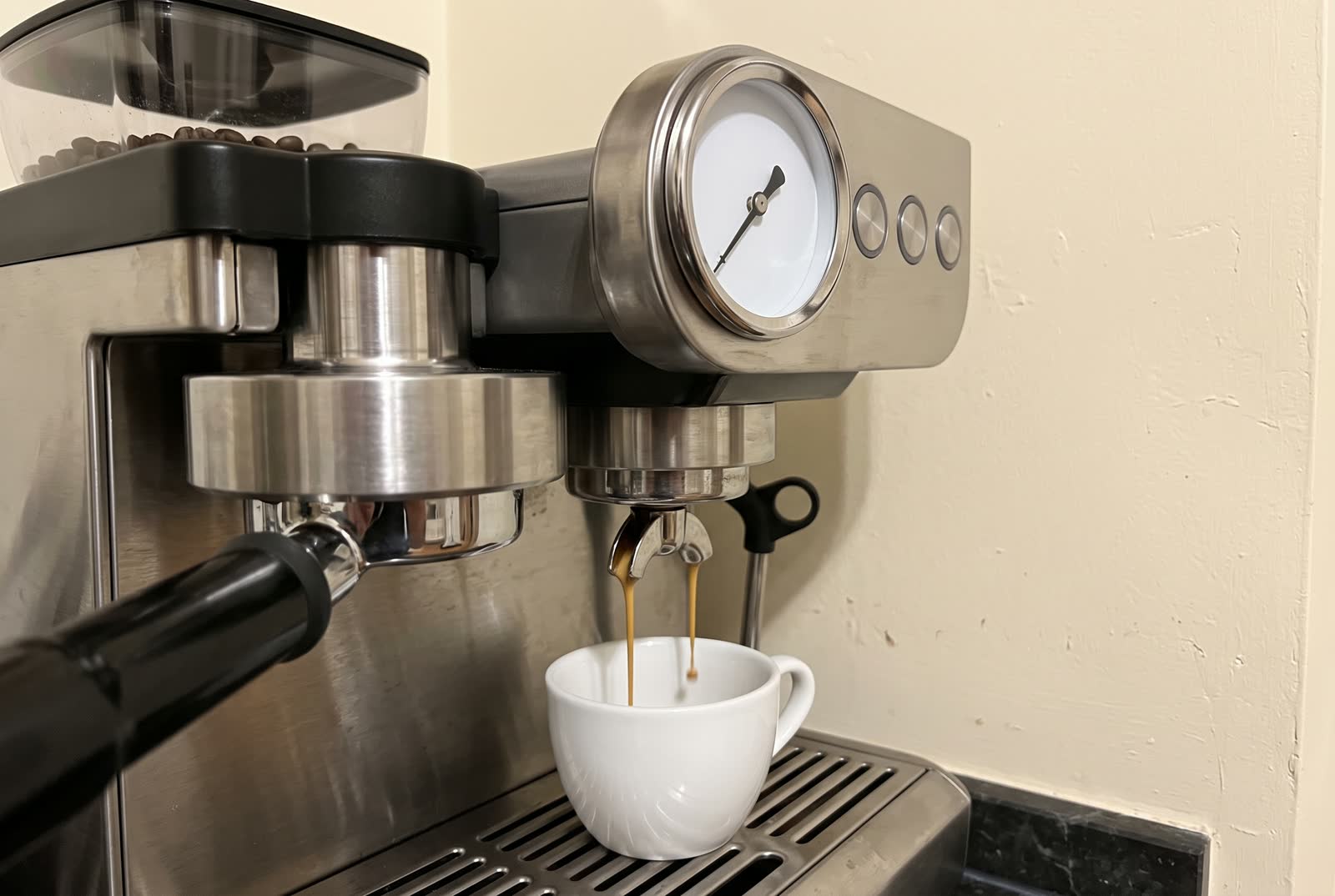
The pressure is made by one part, and the number on the box describes that part
Water arrives at an espresso machine at whatever pressure a tap or a tank gives it, which is nowhere near enough to make espresso. One component raises it, and the bar figure printed on the front of most boxes is a rating of that component rather than a reading taken at the coffee. What that figure means, where it is measured, and why nine and fifteen can both be true of the same machine in the same second is settled on its own page here: nine bars, and what the number means. This page is about the part itself, what kinds of it exist, how each one moves water, and which of them the pages we have read actually name.
Three kinds, and what differs between them is what moves
Home espresso is built around three ways of raising water to espresso pressure, and they differ in which thing inside the machine is moving. In a vibratory pump a small piston is pulled back and forth inside a coil by an alternating magnetic field, so the water leaves in rapid pulses rather than in a stream; the stroke happens once per cycle of the mains supply, fifty or sixty times a second depending on the country, which is a figure commonly given for the type and not one measured here. In a rotary vane pump an electric motor turns a disc carrying sliding vanes inside an off-centre chamber, and the water leaves as a continuous flow. In a lever machine there is no pump at all: a spring is compressed by pulling a handle, and it then pushes a piston down onto the water, with the pressure falling away across the shot as the spring relaxes, which is the behaviour the kind is known for rather than anything measured here. Everything else in a machine, the boiler, the valve and the group, sits downstream of whichever of the three is doing the pushing.
The pages here name a kind on three machines out of fifteen
This site lists fifteen espresso machines, and each one has a pressure line stated for it. Three of those lines name the pump as an object rather than only rating it, and the other twelve name no part at all. Two name a kind outright: the Rancilio Silvia's maker page, read on 6 September 2026, and the Profitec Go's, read the same day. The third, the Gaggia Classic Pro's, names the firm that made the pump instead of the kind of pump it is. Not one of the fifteen is a lever machine, so the third kind above appears on no page we have read, and nothing on this page about it is sourced from anything here.
What those three pages actually say
The Silvia's page names a vibration pump and prints no bar figure beside it, which is a maker describing the part and declining the number, the opposite of the usual trade. The Profitec Go's describes a rotary vane pump with no bar or PSI figure anywhere in the sections read, and the same page states a single brass boiler of 0.3 litres with a ring brew group and a rotary valve. The Classic Pro's line was read from its distributor's storefront rather than from Gaggia's own page, and it reads fifteen bar at an Italian-made Ulka pump with a nine-bar over-pressure valve. Ulka is the company that makes the pump, not a kind of pump, so that line tells a reader who supplied the part and leaves the kind to be inferred from the name, which is not the same as being told.
Everything else is a number, and a country
Every other pressure line here is a rating with no part attached to it. The Bambino's page states a fifteen-bar Italian pump, a low-pressure pre-infusion and then a nine-bar extraction, which is a sequence and a rating and still not a kind. The Stilosa's states fifteen bar of pump pressure beside a stainless steel boiler, and stops there. "Italian pump" is the closest any of these pages comes to describing the part, and it is a statement about where something was made. A reader who wants to know which of the three kinds is inside has to reach the manual, the service parts list or the machine itself, and a specification page is none of those.
What the kind changes, and what it leaves alone
The pump kind changes the machine around it far more than it changes the cup. A vibratory pump is small, light and cheap, which is why it sits inside almost everything built for a home counter; it is also the loud one, and it is made for short runs rather than continuous ones, both of which are properties commonly given for the type rather than figures anybody measured here. A rotary pump is heavier, quieter and content to run continuously, and it usually arrives in a machine with a bigger body to put it in: the one machine here that names one is 210 mm wide and 362 mm deep on its maker's own page, which is a narrow machine that has given up bench depth instead. What no pump decides on its own is the pressure standing over the coffee, because that is set by the valve downstream of it and by the grind, the dose and how flat the bed is. Read the pump line for what it is, then: a statement about one component, worth knowing for what the machine will sound like and how long it will run, and silent about the shot.



