The number on the box and the number in the cup are not the same number
Two pressures get called the pressure of an espresso machine, and only one of them is about the coffee. The first is what the pump is rated to make, which is a property of the pump on its own. The second is the pressure standing in the water above the coffee while the shot runs, and that one is decided by the grind, the dose and how flat the bed is at least as much as by the pump. A machine sold on the first number has told you nothing about the second, and the number on the front of most boxes here is the first one.
What the makers here actually print
This site lists fifteen espresso machines, and the sheet this site keeps has a pressure cell for every one of them. Nine of those cells carry a figure and six are empty, each with a note saying the maker's own page prints none. Of the nine, eight come from the maker's own page and the ninth, the Classic Pro's, was read from its distributor's storefront, which this site treats as a retailer rather than a maker; it is reported below as the distributor's figure and not as Gaggia's. Every one of the nine says fifteen bar. A machine named below is linked where it has a product page here, a picture and a price checked at a seller; the Duo Temp Pro, the Infuser and the Anna have no product page on this site, and the Dream PID's page has neither a picture nor a checked price, so those four are named as text.
The fifteen is the pump, and six pages say so themselves
Six of the eight maker pages put a second figure beside the fifteen, and the second one is the one about the coffee: nine bar at the extraction. The Bambino's line is the most explicit about the order it happens in, stating a fifteen-bar Italian pump, then a low-pressure pre-infusion, then a nine-bar extraction; the Bambino Plus's states the fifteen-bar pump and the nine-bar extraction flatly. Four more machines from the same maker carry the same pair in the sheet, which is why six of the fifteen carry a nine on this record and all six wear one badge. The other two maker pages state the fifteen and stop there: the Stilosa, whose line reads fifteen bar beside a stainless steel boiler, and the Duo Temp Pro, a machine this site keeps no page for because its own maker marks the model discontinued. The ninth figure, the Classic Pro's, is the distributor's, and it reads fifteen bar at an Italian-made pump with a nine-bar over-pressure valve, which is the same two quantities named separately and named by the part that sets the second one.
The valve is where the second number comes from
An over-pressure valve is a spring that opens when the water in front of it passes a set pressure and sends the excess back towards the tank. That is the part that turns a fifteen-bar pump into a nine-bar shot, and it is why both numbers can be true of the same machine in the same second. Two pages on this record name the valve instead of the pump: the Infuser's specification table, read on 10 September 2026, states a nine-bar over-pressure valve and no pump figure at all, and the Dream PID's page states an externally adjustable over-pressure valve and prints no bar figure anywhere. The Ascaso's is the more useful of the two absences, because a valve you can adjust is a valve whose set pressure is not a fixed property of the machine, and a maker who hands you the adjustment has a reason not to print one number for it.
Where a gauge on the face is actually reading
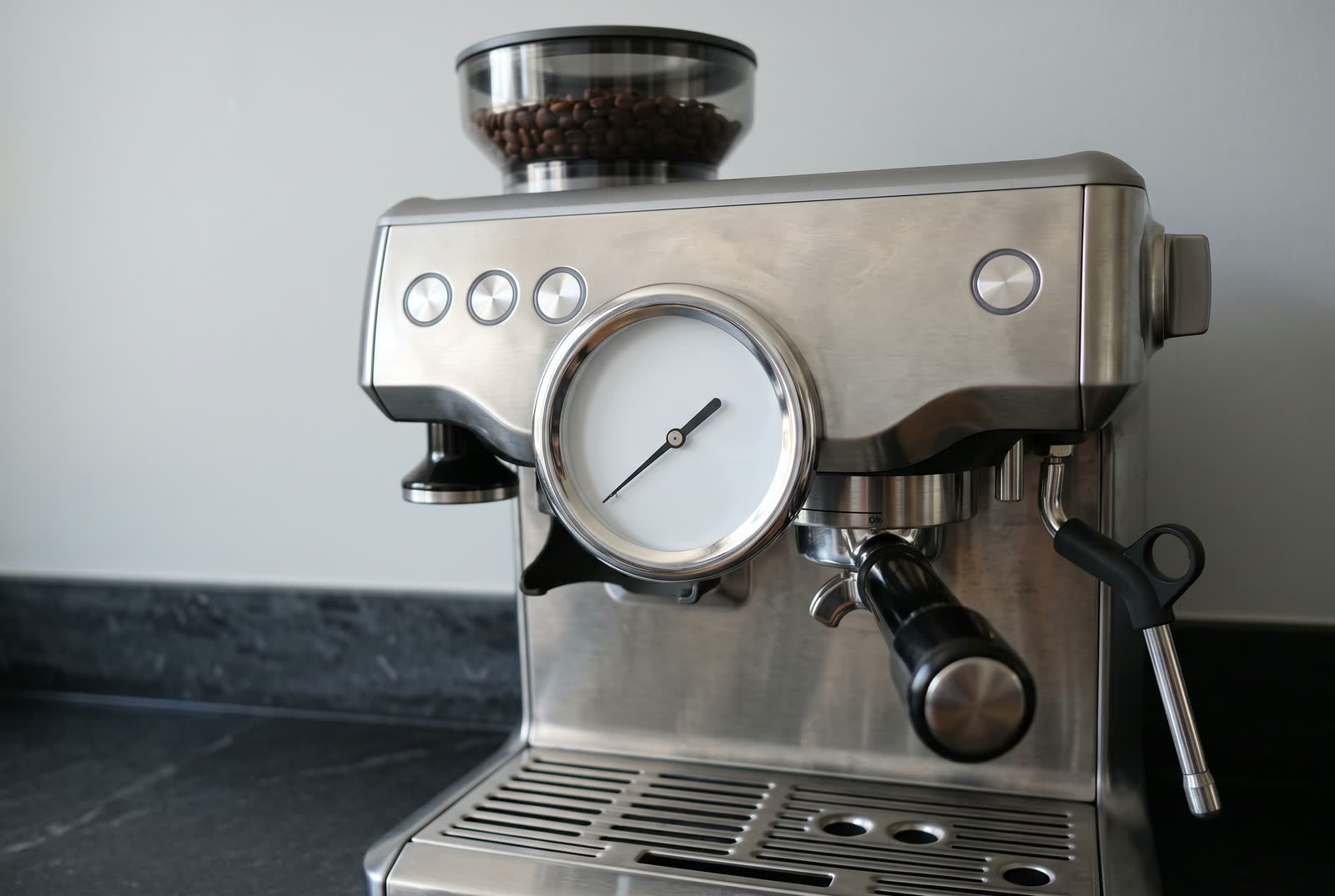
Four of the fifteen carry a pressure gauge in this record, and not one of them puts it in the coffee. Three of the four are Breville machines whose specification tables, read on 10 September 2026, name an "Extraction Feedback pressure gauge", and the Barista Express is one of them; the fourth is the Anna, whose maker's page names a pressure gauge beside its brass boiler and its temperature controller. A gauge in that position sits in the water line ahead of the group and reads what the pump is making against whatever restriction is in front of it, which on a well-packed basket is close to the pressure over the coffee and on a channelled one is not. That makes it an instrument for reading the puck you built rather than a readout of the extraction, which is what the Breville label itself calls it and not what the needle is usually taken for.
What this record cannot tell you, and what would close it
No page this site has read states a pressure measured at the coffee rather than in front of it, on any of the fifteen, so no figure on this page is ours and none is offered as one. For a pressure figure to belong here as a measurement of this site's own, one record would have to exist that does not: a reading taken at the group of a named machine on a stated date, with a named instrument and its own calibration date, against a stated basket, dose, grind and shot time, because the reading moves with every one of those. A second reading at the same moment, taken in the line rather than at the group, is what would make the first one mean anything, since the whole argument above is the difference between those two positions. Until both exist, the only pressure figures this page prints are the makers' own, each with the page and the date it was read from.
What the number is worth when you are choosing
A fifteen-bar rating separates nothing here. Nine machines state it, and the six that state nothing are not weaker for it, they are quieter. A nine-bar extraction line tells you a maker has fitted a valve and set it, which is worth knowing and is not a measurement of your shot. What changes the pressure over your own coffee, on any machine on this page, is the grind, the dose and how flat the bed is, and all three are free and all three change every morning. Choose a machine on its boiler, its group, its tank and the room it takes, and read the pressure line as a statement about a part rather than a promise about a cup.



