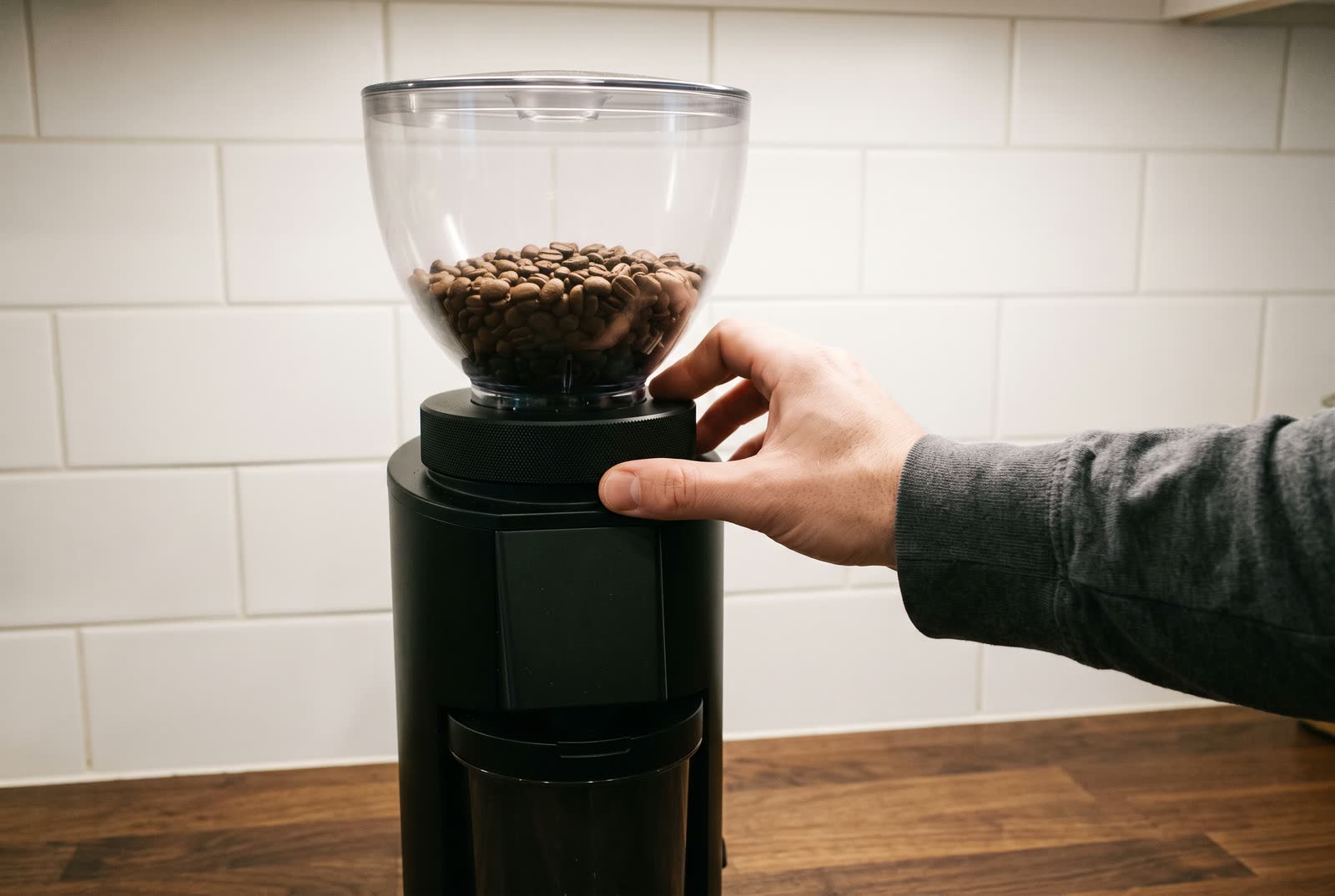
One bag, two positions on the collar
A cone and a portafilter are not two coffees that need two bags. They are one bag and two positions on the same grinder, and the reason a reader ends up buying a second bag is usually that nobody told them which position is which.
This page is written from the manufacturers' own pages and manuals, read on the dates given below, not on hands-on testing.
What a pump does that a kettle does not is the subject of espresso and coffee: what the pressure and the grind separate. This page stays at the collar.
Why the same bag behaves differently in the two brewers
Water falling through a cone under its own weight has a long time to work and a loose bed to work through. Water pushed through a portafilter has a few seconds and a bed packed hard enough to resist a pump. The bean is the same in both. What changes is how much surface the water meets, and how easily it gets past.
That is the whole job of the grind setting. Coarse grounds in a portafilter let the water through beside the coffee instead of through it, and the cup arrives thin and sour. Fine grounds in a cone stall the drip, hold the water too long and turn it harsh. One bag serves both brewers because the grinder moves between them, and for no other reason.
What the collars we have read state
Ten grinders sit among this site's own figures. Read on 6 September 2026, nine of the ten state how their adjustment works and one states nothing about it, and eight of the ten state a burr diameter while two state none.
The nine that describe an adjustment describe three arrangements. Five are stepped, where the collar clicks between fixed positions and there is nothing between two clicks. Three carry a macro ring with micro steps inside each macro position, which is a coarse move and a fine move on the same grinder. One is stepless, where the collar turns continuously and the setting is wherever you left it.
For a reader running one bag across two brewers, the arrangement matters more than the burr. Stepped settings are countable, so the espresso position and the cone position are two numbers written down once. A stepless collar has no numbers to write down, which makes it a better tool for one brewer and a worse one for two.
The grinder that splits the range for you
The Encore ESP does the splitting in the factory. Its maker states 40 mm conical M2 steel burrs and 40 total stepped settings, divided as an espresso range from 1 to 20 and a filter range from 21 to 40, and its manual says so in those words. That is this page printed on a collar: the bag does not change at 20, the brewer does. It also ships with a 54 mm anti-static dosing cup and a 58 mm adapter, which is the maker saying out loud where the grounds are going.
The Encore is the same family without the split. Its maker states 40 mm conical burrs, 40 grind settings, a range of roughly 250 to 1200 microns and a 550 RPM direct-drive motor, and its page, read on 6 September 2026, prints the burrs as 40 mm conical steel in the M3 designation. The micron range is the span this page is about: the fine end is where a portafilter lives, the coarse end is where a press lives, and the cone sits between them. Where exactly the cone sits on a forty-step collar is nearer the middle than the coarse end, and that is a working convention of this site's own rather than a figure read anywhere.
The hand grinder, where the collar is a click
The JX-Pro S states its adjustment as a rate rather than as a list: 10 numbers, 40 clicks per rotation, and 12.5 microns per click. The grinder was renamed from the plain JX-Pro by an owner ruling on 4 September 2026, and this site carries the burr set and the 12.5 microns per click across to the new name on the brand's own J-series page rather than treating them as fresh readings of the S. That carrying across is an assumption recorded here, not a maker statement about the new model.
A rate per click is the most useful number on this page. Two brewers on one bag is a fixed distance along the collar, and a grinder that states microns per click tells you how far. This is also the one grinder of the ten whose page states no burr diameter and no adjustment type in words, so what it publishes is the step and nothing around it.
The cone at the coarse end
The pour-over set is the other half of the bag. Its maker states a V60 Ceramic Dripper 02 in white, a V60 02 glass server and a hundred paper filters, under product number XVDD-3012W. It states a porcelain dripper, a heatproof borosilicate server with a polypropylene lid and handle, overall dimensions of 140 by 121 by 210 mm, a 600 ml server, and manufacture in Japan.
There is no pressure figure on that list because there is no pump on the kit. The paper does the separating, gravity does the pushing, and the only variable the owner sets before the water goes in is the grind. That is why the cone is the honest test of a grinder: nothing else in the brewer can cover for it.
Working both positions and keeping them
Write both positions down in the first week. A stepped collar makes that trivial and a stepless one makes it a pencil mark on the body.
Purge between the two. Grounds from the last setting sit in the chute and arrive in the next dose, and a portafilter dose carrying cone grounds channels.
Change one thing at a time. Moving the brewer and the setting in the same morning leaves a cup nobody can read.
One bag is enough for both. Two brewers, two numbers, and a collar that goes back where it was.



