The short answer
For espresso, buy the Encore ESP. It states 40 mm conical M2 steel burrs and forty stepped settings, twenty of them placed in the espresso range, so a setting you liked yesterday is one click you can return to. If you single dose and want a bigger burr, the DF64 Gen 2 states 64 mm flat burrs, stepless adjustment and a 50 g bellows hopper.
Choose on those two figures, the diameter and the adjustment. The shape is a real mechanical difference, and the section on what the shapes are said to do covers how little any maker page ties it to the cup.
The two shapes, and what each is physically doing
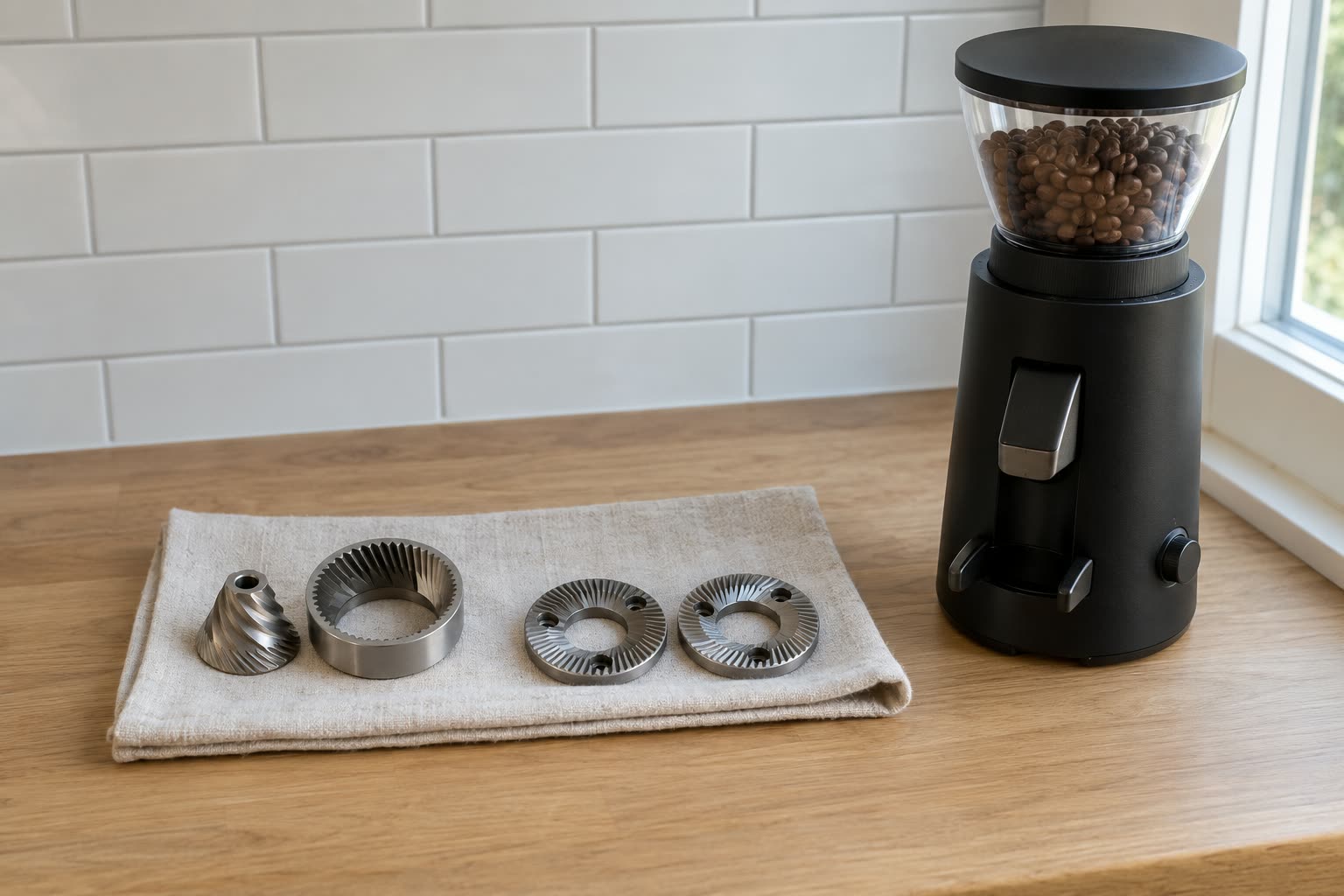
A conical burr is a cone turning inside a matching ring. Beans fall into the gap at the top, get broken as they travel down a narrowing channel, and leave at the bottom under their own weight.
A flat burr is two rings facing each other, one turning, one still. Beans enter at the centre and are thrown outward across the faces, leaving at the rim. Gravity is not doing the work; the rotation is.
That is the mechanical difference and it is not in dispute. What each shape does to the cup is a much softer claim, and the second half of this piece is about how soft.
What the four grinders we have read state
The Encore states 40 mm conical burrs, forty grind settings and a grind range of roughly 250 to 1200 microns, driven by a 550 rpm direct-drive motor. Its page was read again on 2026-09-06 and states the burrs more exactly as 40 mm conical steel, M3.
The Encore ESP states 40 mm conical M2 steel burrs and forty stepped settings, split twenty for espresso and twenty for filter. Same diameter, same shape, a different steel and a different distribution of the same forty steps.
The DF64 Gen 2 states 64 mm stainless steel flat burrs with stepless adjustment and a 250 W motor, in a body of 10 by 5.2 by 12 inches weighing 15 lbs, with a 50 g bellows hopper for single dosing.
The JX-Pro S is the hand grinder in the set, with a stainless conical burr and a top adjustment stated as ten numbers, forty clicks per rotation, at 12.5 microns per click. Its page states a grounds capacity of 30 to 35 g and a weight of 778 g.
Diameter is the figure that travels; the shape is not
Put those four beside each other and the number that separates them is not the shape. It is the diameter, and only three of the four state one: two at 40 mm, one at 64 mm, and the hand grinder's page states no burr diameter at all.
A 64 mm burr is one and six-tenths times the diameter of a 40 mm burr, which is our arithmetic on the two makers' own figures rather than a figure either of them states. In cutting area the gap is larger still, and the consequence a reader actually meets is speed: a bigger burr clears a dose faster at the same motor speed, and spends less time heating the grounds doing it.
The motor figures are worth reading the same way. The Encore's 550 rpm is a slow direct drive; the DF64's 250 W is a power rating rather than a speed, so the two numbers are not comparable and this piece does not compare them. Neither maker states both figures, which is the ordinary state of grinder specifications.
And the hand grinder has no motor figure at all, because the motor is you. Its speed is whatever your arm does.
What the shapes are said to do, and what holds it up
The usual claim is that conical burrs produce a wider spread of particle sizes and flat burrs a narrower one, and that the spread is why one tastes sweeter and the other clearer.
None of the four maker pages we read states any of that. Not a particle distribution, not a taste claim, not a comparison between the two shapes. Every maker page we have read states geometry, diameter, settings and a motor, and stops. So the flavour argument is written here as the trade's working belief rather than as a published finding, and a reader should hold it that loosely.
What can be said from the makers' own figures without stretching them: the two shapes are different mechanisms, they are built at different sizes, and the grinder you buy differs in a dozen ways besides its burrs, any one of which could carry a difference you taste.
If you want the shape argument settled, the measurement that would settle it is a particle-size distribution of the same beans through each grinder at a matched setting, and nobody here has one.
The adjustment is the part you touch every morning
This is the figure worth choosing on, and the four grinders split cleanly.
Stepped adjustment gives you a fixed list. The Encore's forty settings and the ESP's forty, split twenty and twenty, are lists: you go one click coarser and you land on a value you can return to. The ESP's split is the meaningful bit, because forty steps spread across both espresso and filter leave fewer of them in the range espresso actually uses, and twenty deliberately placed there is a different proposition from twenty that happen to fall there.
Stepless gives you a continuous range and no list. The DF64's stepless collar goes anywhere between the ends, which is what espresso wants and also means there is no number to write down and come back to.
The hand grinder is the interesting middle: stepped, but at 12.5 microns per click, and a click is a definite thing you can count. Ten numbers of forty clicks is four hundred positions, which is our arithmetic on the maker's two figures and not a figure the maker prints. A hand grinder is normally the finest adjustment in a beginner's kitchen, which is not what its price suggests.
One example that shows how a figure is carried here
The Encore's hopper has been read twice. The maker stated an 8 oz hopper on one date and 300 g, or 10.6 oz, on another, and this site carries both readings with their dates rather than picking whichever reads better.
That is the method in one line, and it is why some figures on this site are attached to a date. Either statement puts more than a day of beans in the hopper, which is our arithmetic and not the maker's, and the practical instruction that follows is unaffected: grind what you are about to drink, keep the rest in the bag.
The short version
Buy on the diameter and the adjustment, which every maker states. Do not buy on the shape, which every maker states and nobody here can attach a consequence to.
And if the choice is between a better burr set and a better adjustment mechanism at the same money, take the adjustment: it is the one you use every morning, and it is the one that decides whether yesterday's good shot is reachable today.



