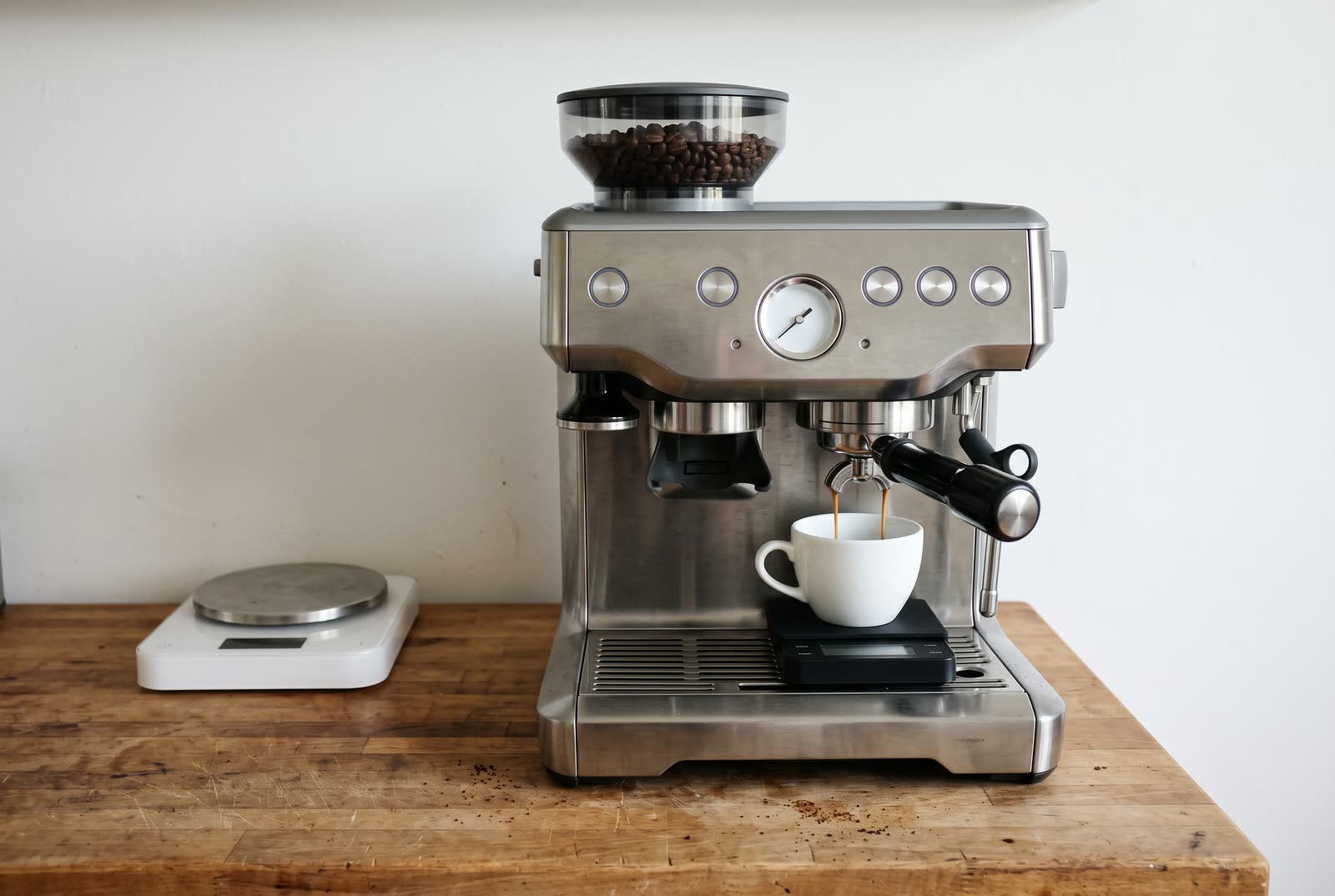
Start with the scale you already own
Most kitchens have a scale. The useful question is not whether a coffee scale is better; it is whether the one in the drawer is short of anything the shot actually needs.
Three properties decide it: how finely it reads, how much room it takes under the portafilter, and how fast it settles. Everything else on a coffee scale's listing is either one of those three in different words or a convenience.
And here is the shape of this piece up front: two of those three are stated on maker pages we have read, and the third is stated on none of them.
Readability, which is the one most kitchen scales fail
A coffee scale reads in tenths of a gram. The maker of the Acaia Lunar states a minimum weight of 0.1 g with a maximum capacity of 2000 g; the maker of the Timemore Basic 3.0 states an accuracy of 0.1 g over a load range of 0.2 g to 2000 g. Both figures were read on the makers' own pages on 2026-09-03.
A general-purpose kitchen scale usually reads in whole grams. That is a statement about the category rather than a figure off any page we have read, so treat it as the common shape of the thing and check the scale in your own drawer, where the readability is normally printed on the back.
Why the difference matters is arithmetic rather than taste. A double basket is dosed around 18 g; the Bambino Plus's own maker page states 18 g for its 54 mm basket. On a scale reading whole grams, a dose anywhere from 17.5 to 18.4 shows as 18, so two mornings that read identically can differ by nearly a gram. That is enough to move the shot, and you would spend the morning blaming the grinder.
If your kitchen scale already reads to 0.1 g, this property is settled and you have not spent anything.
The height under the portafilter, which is a measuring job
The second property is physical. The scale has to sit on the drip tray with the cup on top of it and still leave the cup under the spouts.
The two coffee scales named above are built around that. The Lunar is stated at 105 by 105 mm and 15 mm tall, weighing 265 g plus or minus 5. The Timemore Basic 3.0 is stated at 140 by 120 by 20 mm and 300 g. A 15 mm scale and a 20 mm scale are both thin in a way a kitchen scale with a glass platform and a raised display is not.
What this site cannot tell you is how much room you have, because no maker page we have read publishes the height from drip tray to portafilter spout on any machine. The Bambino is stated on its own maker page at approximately 11.9 by 6.1 by 13.5 inches overall, and that outer envelope says nothing about the gap inside it. Breville does not say which of the three is the depth.
So measure it: tray to spout, with a ruler, before buying anything. Subtract the height of the cup you actually use. What is left is the ceiling for the scale, and a scale thicker than that turns into a scale that lives beside the machine and weighs the cup before and after, which works and is worse.
Response time, which nobody here states
The third property is how fast the reading settles when liquid is landing on it. Espresso runs for a short time, and a scale that lags is a scale you cannot stop the shot with.
Neither the Lunar's maker page nor the Basic 3.0's states a response time. Both makers are silent on it, and this piece supplies no figure in place of that silence.
What can be said without a figure: a scale with an espresso mode is a maker claiming to have thought about this, because that mode is normally a different filter on the same sensor. Some scales pair that mode with a water-resistant housing, though those details often come from a retailer's listing rather than the maker's own page, which makes them an indication rather than a specification.
If response time is the property you care about, the thing to look for on a listing is the word espresso, and the thing to accept is that you will not get a number.
What to do
Check the readability printed on the scale in your drawer. If it reads to 0.1 g and fits under the portafilter with your cup on it, you are done and this page has cost you nothing.
If it reads in whole grams, that is the property worth fixing, and it is the one both scales named here state plainly. Buy on the stated readability and the stated height, measure your own gap first, and expect no response-time figure from anybody.



