This comparison is based on the sourced specification pages both makers publish, read on the dates given below, and not on hands-on testing. Where we have read two different figures for the same thing and neither has been chosen, the figure is not compared at all and the page says so.
Two machines that answer the same morning differently
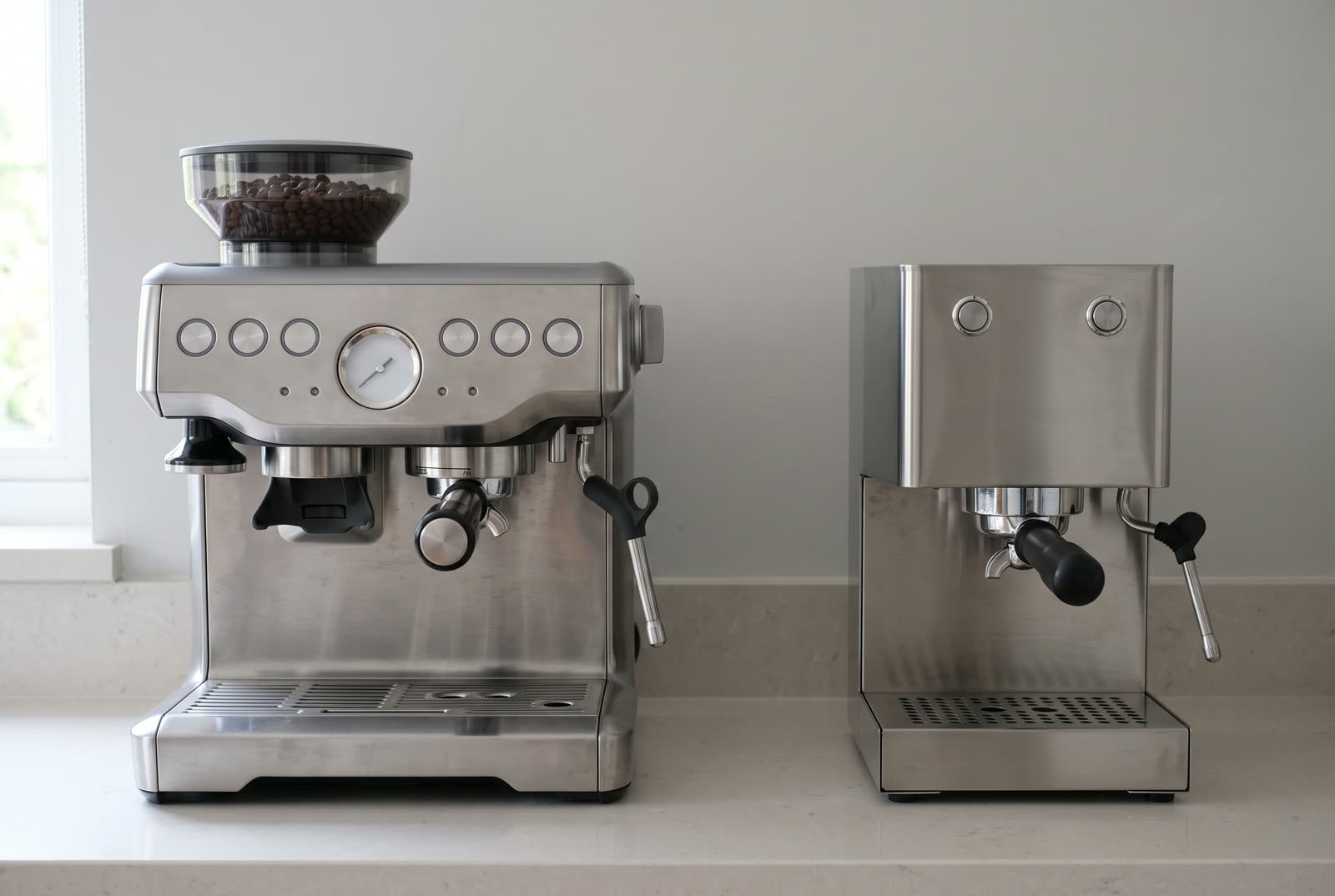
The Bambino and the Gaggia Classic Pro are both entry machines with a portafilter and a steam wand, and they are built on opposite decisions. One heats a little water very fast; the other heats a lot of metal slowly and then stays hot. Everything a reader notices after the first week follows from that one difference, including the two figures that decide what they can buy afterwards.
Both machines sit in the same band here, so this is not a cheaper-against-dearer comparison. It is a comparison of what the same money is spent on.
The heater: three seconds against a mass of brass
The Bambino states a thermocoil, marketed as ThermoJet, which its maker's page read on 6 September 2026 says reaches extraction temperature in 3 seconds. A thermocoil heats water as it passes through a tube, so there is almost nothing to warm up and almost nothing to hold heat once the shot is pulled. The Classic Pro states a single lead-free brass boiler, described on the distributor page read the same day as single-boiler and dual-use, which is a tank of metal that has to come up to temperature and then carries its own heat.
The trade is symmetric and neither side wins it. Three seconds means coffee on a weekday without planning; a brass boiler means the second shot is as hot as the first and the steam does not collapse halfway through a jug. A reader who makes one drink and leaves is buying the first; a reader who makes two milk drinks back to back is buying the second.
The portafilter: 54 against 58
The Bambino states a 54 mm portafilter and the Classic Pro states 58 mm, both read on 6 September 2026, the second from the distributor page. This is the line that outlives the machine. Baskets, tampers, distribution tools and bottomless handles are made in both sizes, but 58 mm is the size most aftermarket accessories are built around, and 54 mm is the size one maker uses across its own range.
Neither diameter makes better coffee. One of them simply has a larger market attached to it, and that is a real cost or a real freedom depending on how much a reader intends to buy later. The page on 54 mm and 58 mm tampers follows that through, and the page on baskets is the other half of it.
The envelope, the weight and the tank
The Bambino measures 6.3 in wide, 13.8 in deep and 12.0 in tall, per Target and Bi-Rite Home Appliances, and weighs 4,725 g, read on 3 September; Breville's own page, read on 6 September 2026, prints its dimensions without saying which figure is which, so this article uses the retailers' measurements. The Classic Pro states 200 mm wide, 270 deep and 355 high at 8,100 g, read on 11 September 2026 from gaggia.com, which is the page the owner's ruling of 13 September 2026 set above the distributor storefront readings it overruled. Two hundred millimetres is the narrowest of the espresso machines this site compares, and 8,100 g is nearly twice the Bambino's weight, which is the brass showing up as a number.
The tank splits by unit rather than by absence now. The Classic Pro states 2.1 litres, printed on the distributor page as 72 fluid ounces; the Bambino's maker states 47 fluid ounces on its own page, read 10 September 2026, with no published conversion to litres, so this page sets the two side by side in the units each maker actually prints rather than converting either one. Both pumps state the same thing, a 15 bar pump held at 9 bar for the shot, so pressure is not where these two differ and the page on nine bars is where that number is unpacked.
The figures this page does not compare
Three of the fifteen espresso machines this site compares carry two wattage readings from the same maker that disagree, and where that is the case this site states no figure at all. Neither of these two machines is one of the three. The Bambino states 1560 W, read from its maker's instruction manual on 1 September 2026. The Classic Pro states 1350 W under the ruling named above; those two figures are compared, unlike the disputed entries elsewhere, which are named as disputed and left blank.
One more absence belongs here because it affects both machines equally. Every one of the thirty-six products this site tracks states no side clearance, no rear clearance and no top clearance, and for most of them that is after the maker's own manual was downloaded and read end to end. So the width figures above are the objects and not the space they need, and the gap around each one is a quantity no page here will supply.
Which one to buy
Buy the Bambino if the machine has to be ready when you are, if the counter run is deep enough for 350 millimetres (13.8 inches) and you would rather not lift 8 kilos, and if you do not intend to collect accessories. Buy the Classic Pro if you make more than one milk drink at a time, if 200 millimetres of width is the constraint your counter actually has, and if the 58 mm handle and the larger tank are things you expect to use.
The honest summary is that the first is a machine that gets out of your way and the second is a machine you grow into, and the figures here support that sentence with the boiler, the weight and the portafilter rather than with an opinion about the cup.
No price on this page is checked at a seller. Both machines sit in the same band this site draws, which is a range of its own framing rather than a figure read at a shop.



