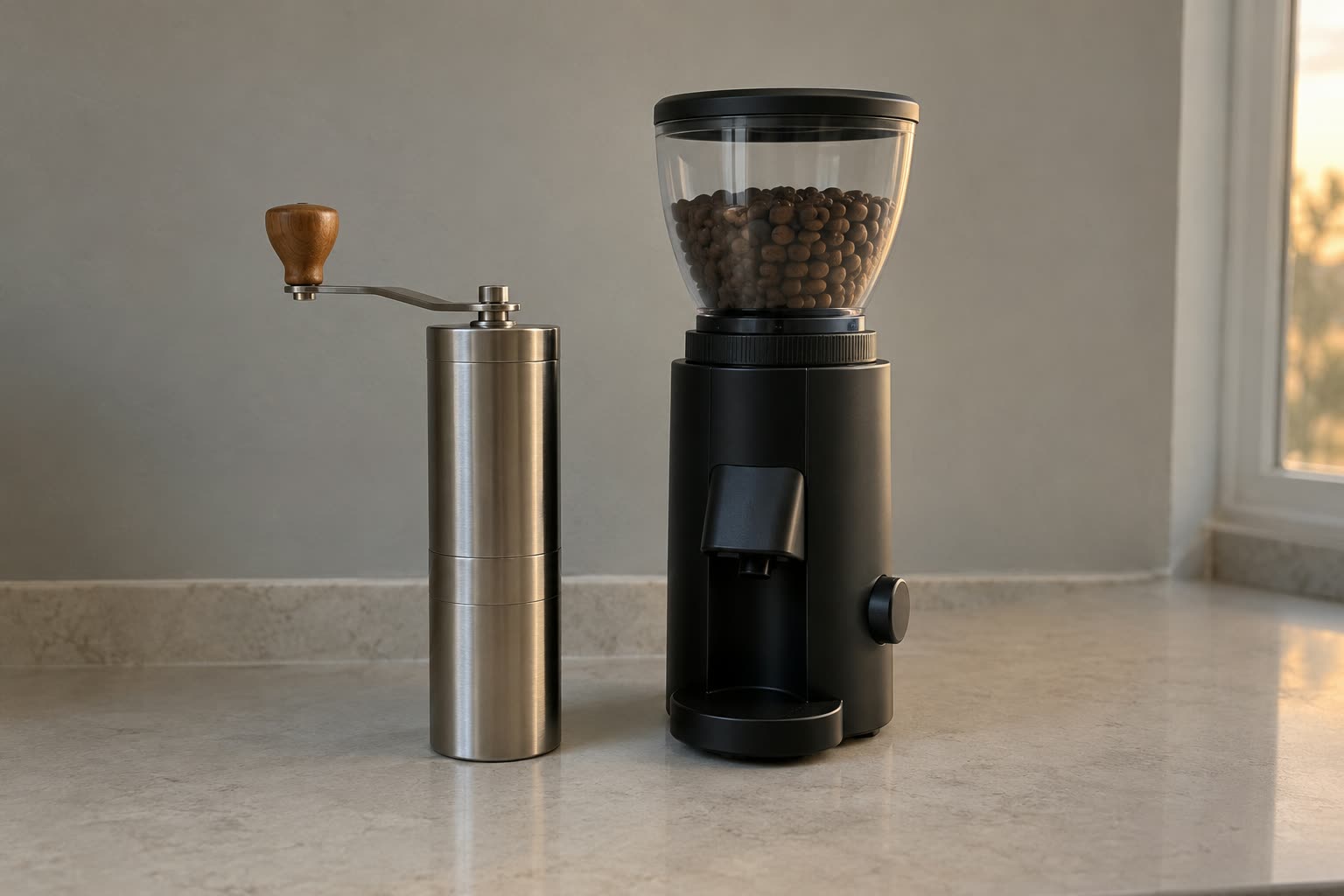
One figure separates them, and it is the step size
For espresso, the thing that decides a grinder is how small a change you can make. A grind that is slightly too coarse runs fast and sour; slightly too fine and it chokes. The useful question about any grinder is therefore: what is the smallest move it lets you make?
Both grinders read here publish enough to answer that, and the answer is not the one the prices suggest.
What the two state
The JX-Pro S is the hand grinder. Its maker states a top adjustment of ten numbers at forty clicks per rotation, at 12.5 microns per click. It holds 30 to 35 g of grounds and weighs 778 g.
The Encore is the entry electric. Its maker states forty grind settings across a range of roughly 250 to 1200 microns, 40 mm conical steel burrs and a 550 rpm direct-drive motor.
Put those two statements together and the comparison falls out. Ten numbers of forty clicks is four hundred positions on the hand grinder, which is our arithmetic on the maker's two figures rather than a figure the maker prints. And forty settings spread across 950 microns of range averages a little over 24 microns a step, which is again our arithmetic and not the maker's.
So the published step on the hand grinder is roughly half the average step on the electric one. For espresso that is the whole argument, and it runs the opposite way to what most people expect from a crank.
What a hand grinder actually costs you
Time and arm, every single morning. A dose ground by hand is work you do before anything else happens, and that cost never amortises: it is the same on day one and day four hundred.
Capacity, too. The stated 30 to 35 g is a dose or two, not a hopper. There is no "fill it and forget it", which is a discipline if you like grinding fresh and an irritation if you are making four cups.
And it is a two-handed object. At 778 g it is heavy enough to want holding rather than clamping, and if anybody in the house has a wrist that objects, that is the end of the argument regardless of any figure above.
What it costs in counter is nothing. It stands in a drawer.
What an electric grinder costs you
Counter, power and noise, in that order. It is a fixed object in the line, it needs a socket, and it announces itself at whatever hour you make coffee.
It also costs you a hopper full of stale beans if you use it the way hoppers invite. The Encore's hopper has been read twice, stated by its maker as 8 oz on one date and as 300 g, or 10.6 oz, on another, and this site carries both readings with their dates rather than choosing. Either figure is more than a day of beans, which is our arithmetic on the maker's number, and beans standing in a clear hopper in daylight are beans going stale where you can watch it happen.
What it buys is the thing the hand grinder cannot: the dose is ground while you do something else. If your morning is four minutes long, that is not a convenience, it is the difference between making espresso and not.
The honest position on this hub's own number
This piece sits under a coffee bar built to a ceiling of about a hundred dollars, and it would be dishonest not to say the obvious thing: neither grinder above is in that band. Both are carried here in the $100-250 band, and no grinder on record here is placed in a lower one.
That is a limit of what this site has rather than a statement about the market. The bands here are editorial framing and not quotes; no live price source stands behind them, and no set on this page is claimed to cost under any figure today.
What that means for a reader with a hundred dollars: the choice this page describes is a real one, and it may be a choice you make one purchase later than you wanted to. Buying a grinder below both of these is possible and this site cannot tell you which one, because it has no figure for one.
How to choose, in one paragraph
If espresso is the point and the mornings are unhurried, take the hand grinder: the published step is finer, the capacity matches a single dose, and it takes no counter at all.
If the coffee has to happen while something else is happening, take the electric one, accept the coarser average step, and buy only the beans you will drink in a few days so the hopper never becomes a storage jar.
And if you brew filter as well as espresso, the electric one's stated range of 250 to 1200 microns is the figure to weigh, because it is the one that says the same grinder covers both.



