What this comparison is, and what it is not
This comparison is based on sourced manufacturer specifications and decision criteria, not on hands-on testing. Nobody here has stood in front of either machine. Every figure below was read off the maker's own product page or its own instruction book, on a recorded date, and where the two documents disagree the piece says so instead of choosing.
There is a second thing to say before the figures. Both machines have a product page here, with a picture and a price checked at a seller, so both are linked: the Barista Express and the Barista Pro. The other shape of the same decision, two boxes instead of one, is the last section.
The two machines, side by side, on figures their own maker publishes
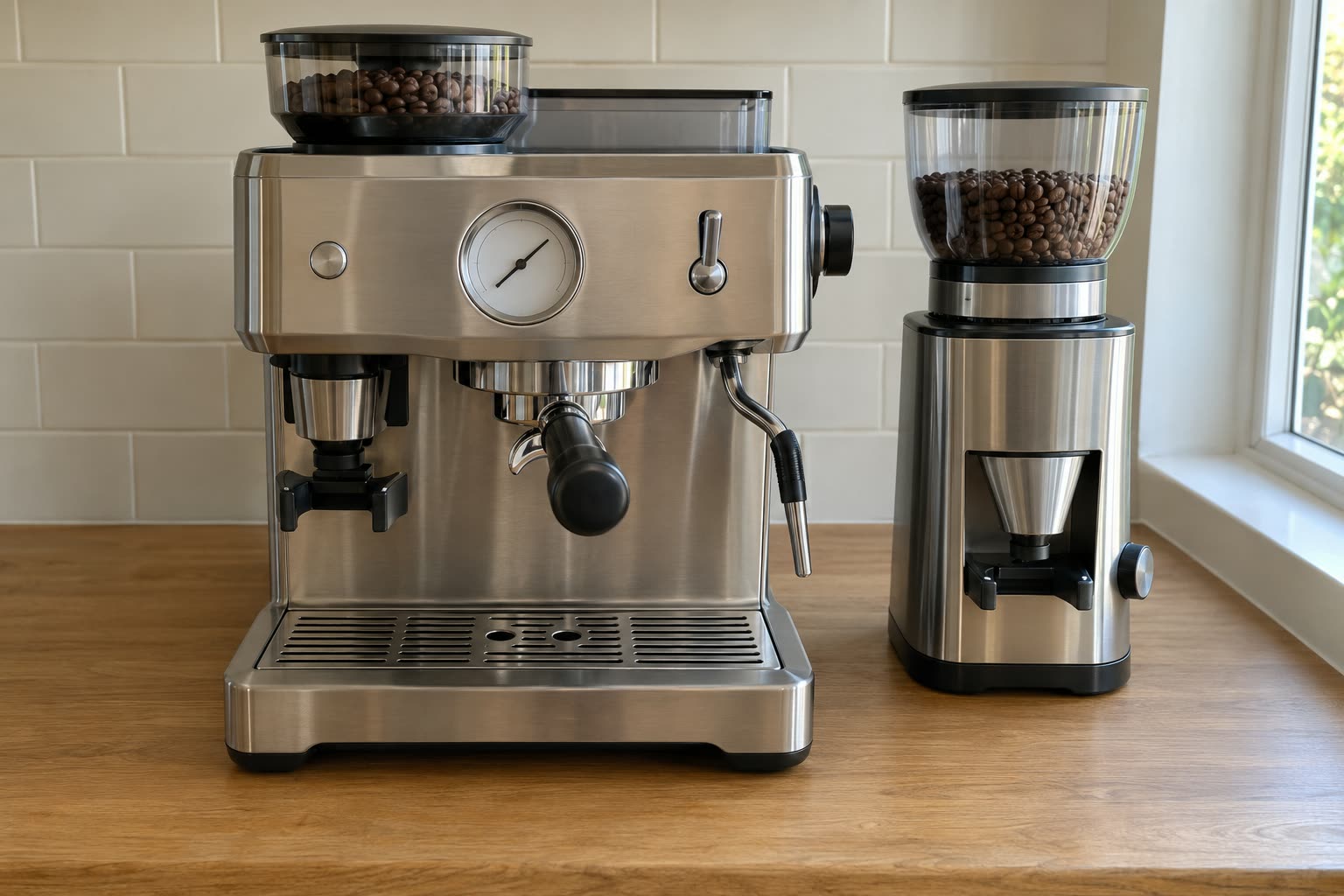
Both are all-in-one machines: an espresso machine with a burr grinder built into the body, a bean hopper on top and a grind chute over a cradle for the portafilter. Both state a 54 mm portafilter and a bean hopper of half a pound.
The Barista Express BES870XL states an envelope of 15.9 by 13.1 by 12.4 inches, a weight of 22.09 lb, a water tank of 67 fl oz and a one-year limited warranty. Its instruction book adds a 54 mm stainless portafilter and an integrated 54 mm tamper, and states the tank is removed by lifting it out by its handle at the back.
The Barista Pro BES878 states 16.1 by 13.8 by 13.1 inches, a weight of 20.92 lb, 1680 W at 120 V, a two-year limited warranty, and a heater its maker calls ThermoJet. Its book states the tank as 68 fl oz, or 2 litres, and names extra-tall cup clearance.
So the Pro is the larger machine in all three dimensions and the lighter one on the scale. That is the pairing a reader is least likely to guess.
One small disagreement, carried rather than resolved: the Pro's page prints the tank as 67 oz and its own instruction book prints it as 68 fl oz, 2 litres. Two litres is the figure both documents state, so that is the one worth holding.
The grinder, which is where the question usually starts
The short answer, and it is not the answer the question expects: on the pages we have read, the grinder is not what separates these two machines. Both state an integrated conical burr grinder. Both state a hopper of half a pound. Neither page states a burr diameter, a burr material or a number of grind settings, so there is no figure here to put side by side.
That is a gap in what we have read, not a finding that the grinders are the same. Grind adjustment is the part of an all-in-one a reader touches every morning, and the one place to settle it is each machine's own instruction book, read for its grinder section, which is a job nobody has done here yet.
What the two pages do separate is the heater and the warranty. The Pro's page names a ThermoJet heater and a two-year warranty against the Express's one year, and those are both stated figures rather than impressions.
The figure this piece will not print
The Barista Express's rated power appears here twice, with two different values. Its maker's product page states 1600 W; the rating plate printed in its own instruction book states 1750 W. Both are the maker's own documents and neither supersedes the other.
A disputed figure is not printed on this site, so no wattage is stated for the Barista Express anywhere on this page. The Pro's is stated, at 1680 W, because its page and its book agree on it.
That is worth a sentence of its own, because a comparison table that prints 1600 against 1680 makes the Pro look like the heavier draw, and the Express's own rating plate would reverse it. Two numbers that disagree are not a small difference between machines; they are an open question about one machine.
The counter, which is the difference you will actually feel
Neither of these is a small machine. The Express needs 15.9 inches of width and 13.1 of depth; the Pro needs 16.1 and 13.8. Both figures are read as the machine with its hopper on, which is how the maker photographs them, and neither maker publishes a clearance figure above the machine, so the space to fill the hopper is yours to measure.
One difference here is stated and is easy to miss: the Pro's instruction book carries a placement warning that the Express's does not. The Pro's says, word for word, "Do not operate the appliance if it is in an enclosed space, or within a cupboard." The Express's book was read in full and carries no such instruction, which is recorded here as an absence rather than as permission.
If the machine is going under a wall cabinet or into an appliance garage, that single line is a harder constraint than any figure above it.
The other shape of the same decision
An all-in-one puts the grinder in the machine. The alternative is two boxes, and this site covers that too.
The Bambino is the machine without a grinder: its maker states a 15 bar pump, a low-pressure pre-infusion followed by a 9-bar extraction, a 54 mm portafilter and a ThermoJet heater that reaches extraction temperature in three seconds, in a body that measures 6.3 in wide and 13.8 in deep, per Target and Bi-Rite Home Appliances (Breville's own page prints its dimensions without saying which figure is which). Its width is the real gap next to either all-in-one machine; its depth is not.
The Encore ESP is the grinder: 40 mm conical M2 steel burrs and forty stepped settings, twenty for espresso and twenty for filter, with a 54 mm dosing cup and a 58 mm adapter in the box. Those are the grinder figures the two all-in-one pages do not state, and they are the reason a separate grinder is easier to compare than a built-in one.
The Bambino against the Barista Express puts that choice on one table, and the Baratza grinder comparison covers the grinder half. Two boxes take more counter in total and less depth in the line that matters. They also fail separately, which cuts both ways: a broken grinder does not take the machine with it, and there are two things to keep clean instead of one.
Where this leaves it
On the pages we have read, the Pro states a heater, a longer warranty, a slightly larger envelope and a slightly lower weight, and a placement warning the Express does not carry. The Express states the tamper in the body and a one-year warranty, and its power draw is an open question rather than a figure.
The grinder, the thing the question is usually about, is not separated by anything either maker has published on the pages we have read, and this piece would rather say that than invent a difference.



