The one failure that ends a machine early
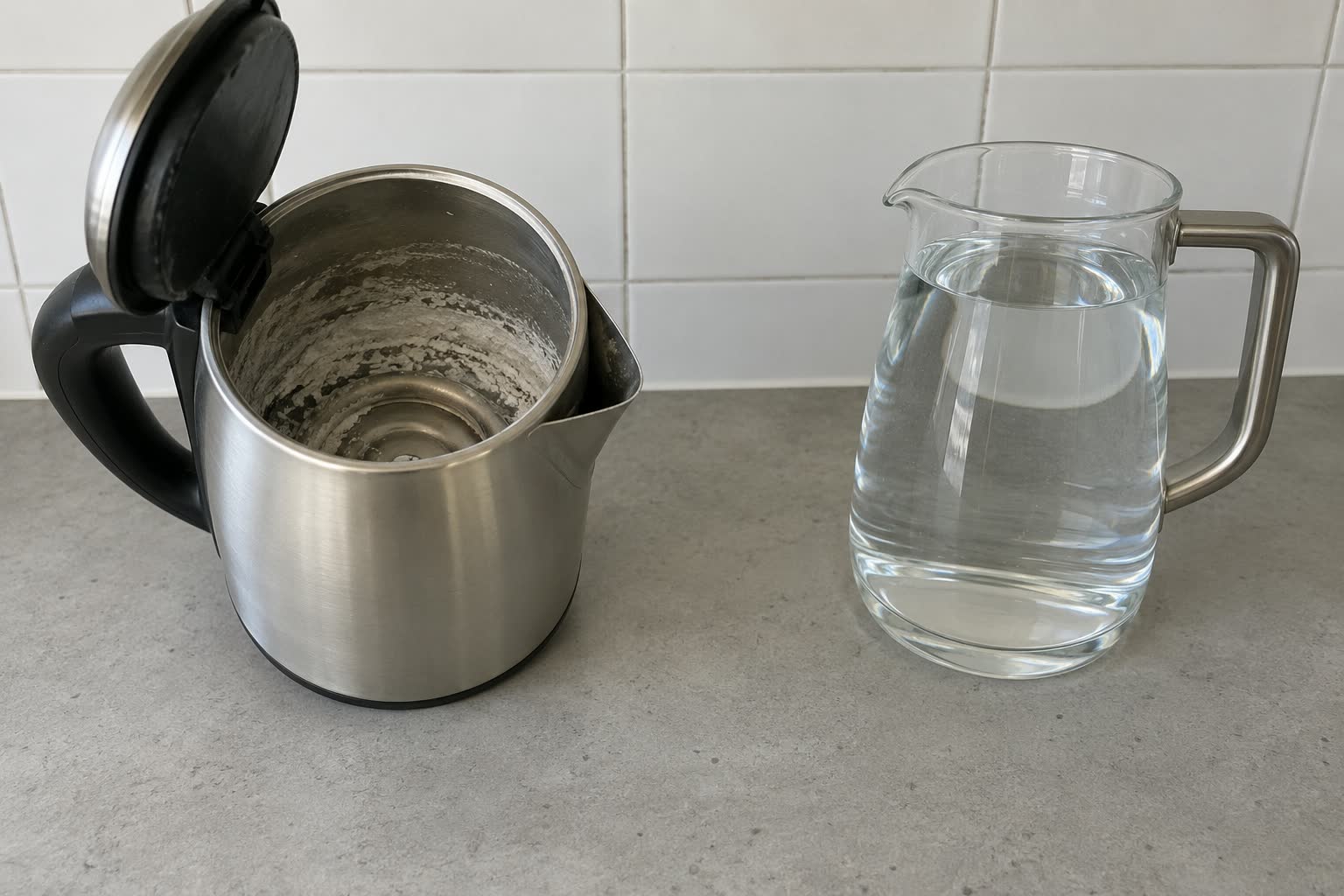
An espresso machine is destroyed by water far more often than it is destroyed by coffee. Tap water carries dissolved calcium and magnesium, and every time the machine heats that water some of it comes out of solution and stays behind as a hard grey deposit on the heating element, inside the boiler and in the narrow passages between them. The deposit insulates the element, so the machine works harder for the same heat, and it narrows the passages, so the flow drops, and the end of that road is a machine that trips out or leaks. This piece states no hardness figure of its own, because nobody has published one: what it does instead is set out exactly what the makers here state, exactly what they do not, and what a measurement would have to carry before any number belonged on this page.
What the makers here actually state about water
Four machines are covered here and the water column is thin on all four. The Stilosa states a removable tank of approximately 1 litre, printed as 33.81 fluid ounces on the maker's US page when it was read live on 6 September 2026, and its manual on the same day states that the tank can be filled where it stands: "the water tank can also be filled without extracting it, by pouring the water directly from a jug."
The Gaggia Classic Pro carries a tank in the 2 to 2.1 litre range on this site as a proxy rather than as a statement read off the maker's own page for this exact model, and it is written here with that caveat rather than as the maker's figure. Its manual, read on 6 September 2026, is more specific about the water than about the tank: "fill it with cold water up to the MAX level of the tank."
The Bambino and the Bambino Plus publish a specification table that was read here on 10 September 2026, and those tables state a tank capacity of 47 fluid ounces and 64 fluid ounces respectively. Both manuals were also read in full on 6 September 2026, for a clearance question rather than this one, and that reading turned up an absence rather than a water instruction, so nothing about water is taken from either manual here.
The figure none of them states
Not one of the four states a water hardness limit anywhere on any page we have read. There is no maximum, no recommended range, no unit and no test method: the column is empty for all four, and it is empty because the makers do not publish it rather than because nobody looked. That is the honest answer to the question this piece is named for, and the rest of the page is written around it rather than over it.
Two of the four do say something adjacent, and it is worth reporting exactly. The Bambino's own accessory list, on the table read on 10 September 2026, names descaling powder in the box; the Bambino Plus's list on the same day names a cleaning tool and a cleaning disc and no descaling powder at all. A maker who ships descaling powder with a machine is telling you scale is expected; it is not telling you at what hardness, or how often.
What the same maker does elsewhere, which is the most interesting thing this piece found
The 10 September read covered nine Breville espresso machines, not two, and the accessory lists across them are not the same. Seven of the nine name a water filter in the box, and the two Bambinos are the two that do not. Three of the nine go further and name a water hardness test strip in the box, and again neither Bambino is among them.
So the same maker, on the same day, on its own pages, treats water as a thing to be measured and filtered on some of its machines and says nothing about it on these two. That is a fact about what is published rather than a fact about the machines, and it is the strongest thing this piece can say on the subject. What it suggests is that a reader of a smaller machine has to answer the water question themselves, because the maker has not answered it for them.
What to do about it without a lab test
There are three answers and the first one costs nothing. Find out what your water actually is: most water utilities publish a hardness figure for their supply area, usually in an annual report, and that is a real measurement taken by somebody whose job it is. If that figure is low, tap water is fine and the rest of this page is not your problem.
If it is high, or if you cannot find it, the cheap answer is bottled or filtered water in the tank and nothing else changed, and the expensive answer is a plumbed filter, which is a decision about a kitchen rather than about a machine. Distilled water is the one answer this page pushes back on, and the reason is craft consensus rather than a measurement we have taken: water with nothing dissolved in it is held to be aggressive to boiler metals and to make the coffee taste flat. The target is water with some mineral content in it rather than none.
Descaling, and why this page does not give you a schedule
Descaling is running an acid through the machine to dissolve the deposit that has already formed, and every machine here has a procedure for it in its own manual. What this page will not do is give you an interval, because an interval is a function of how hard your water is and how much coffee you make, and we have neither figure for you. A schedule copied off another site is a schedule written for somebody else's water.
Use the maker's own manual for the procedure and the maker's own interval where one is printed. Where the maker prints none, the practical signal is the machine itself: a shot that runs slower than it used to at the same grind, a steam wand that spits, or a machine that takes longer to come up to heat.
What a measurement would have to carry
For this page to state a hardness figure of its own, one measurement would have to exist that does not: a hardness reading of a named water supply, taken on a stated date with a stated method, in a stated unit, alongside the machine it was used in. That is not a hard measurement to make, which is why it is worth naming precisely rather than gesturing at.
The second thing that would close this properly is a maker statement: any one of these four publishing a maximum hardness, a recommended range, or a filter requirement on a page with a date on it. The moment one of them does, it belongs on this page as their figure, with their date, and not before.



