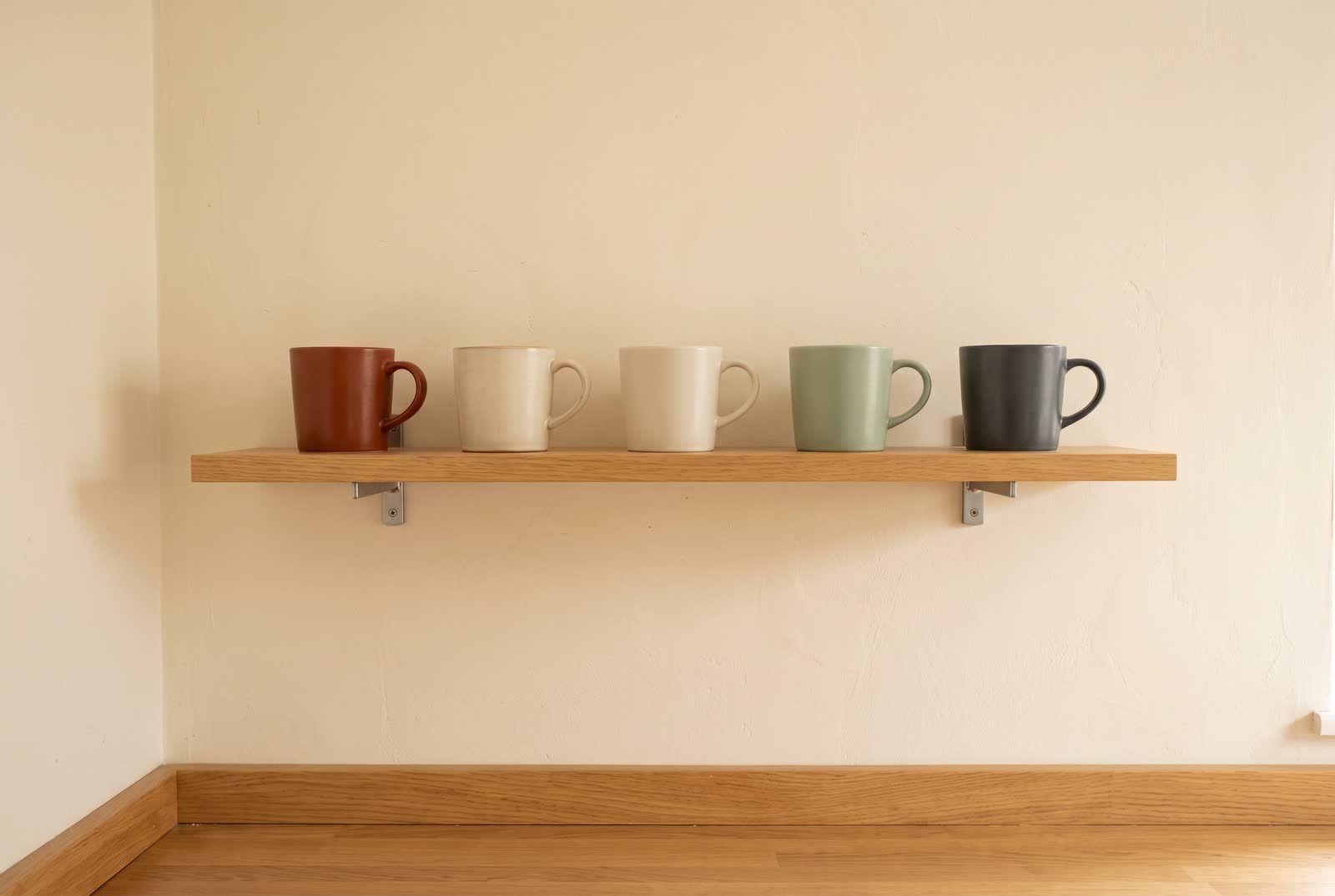
The depth a counter loses
A coffee corner eats a counter from the back forward. The machine goes against the wall, the grinder beside it, and then the mugs, the filters, the jar of beans and the jug arrive one at a time until the working space in front of the machine is a strip too narrow to set a cup down on. The counter did not shrink. It filled from the back.
The wall above it is the one surface in the corner nothing is standing on. This page is about what goes onto it and in what order, and it is deliberately narrow: counter storage, the trays and the caddies and where the grinder stands, is its own page on this site, and this one leaves the counter alone.
The order things go up
The rule is reach. What a hand takes every morning goes where the hand already is; what it takes once a week goes higher.
Mugs first, and lowest. A hook takes one mug and gives it back with one movement, and a line of hooks under a shelf puts the whole morning's cups at chest height with nothing to lift. The wall-mounted mug rack is the plain case: the listings describe wooden racks that combine hooks in a line with a display shelf above them, one of them advertised as holding up to 17 mugs, and a separate metal rack with 12 hooks sold for clearing a cabinet. Both are categories rather than one measured product, and this page says so rather than quoting either as a figure it checked.
Filters, beans and the small things second, on the shelf. A floating shelf is the other object here, and again the listings describe a category: shelves sold for coffee-bar use at widths from about 23.6 to 60 inches and depths of roughly 5 to 11 inches. The depth is the figure to read. Depth and mounting height trade against each other: a shelf deep enough for a canister and a box of filters has to hang higher to keep the head of somebody working at the counter below it clear.
Nothing heavy and nothing hot, third, which is to say never. The machine stays on the counter, the kettle stays on the counter, and the grinder stays on the counter, because a shelf that holds a jar is not the same claim as a shelf that holds a machine full of water, and we have no figure for what a machine weighs.
The three figures nobody publishes
A shelf is only as good as what it is fixed to, and we have no figure about that: no fixing, no stud spacing, no load a given wall will carry. Some listings print a per-bracket load rating, one of them up to 75 lb, and this page does not repeat that as a figure a wall will hold, for a plain reason: those ratings are aggregated from listings across the category rather than read off a single verified product. A rating is a claim about the bracket. What the wall does with it is a claim about the wall, and it is the wall that fails.
What would have to be checked, and by whom: whether the wall is plasterboard, masonry or a stud wall, which the person living there can find out with a knock and a magnet; where the studs are, which a stud finder settles; and what the fixing supplied with the shelf is rated for on that wall, which is on the fixing's own packaging and not on any page this site reads. A rented wall adds one more question, which is whether it may be drilled at all, and that one belongs to the lease.
The mug rack and the mug tree
A wall-mounted rack is a different thing from a freestanding rotating tree, and the difference is the whole of this page: the tree stands on the counter and takes the depth back off it, the rack goes on the wall and gives it up. In a corner where the counter is the scarce thing, the rack is the one that earns its fixing.
What the wall gives back
The depth of a mug, a canister and a box of filters, which on most counters is the difference between a strip and a workspace. The order of reach, so that the morning's first movement is one movement. And a counter that holds the machine, the grinder, the jug and nothing else, which is the corner every page on this site is drawn around.
No price on this page is checked at a seller.



