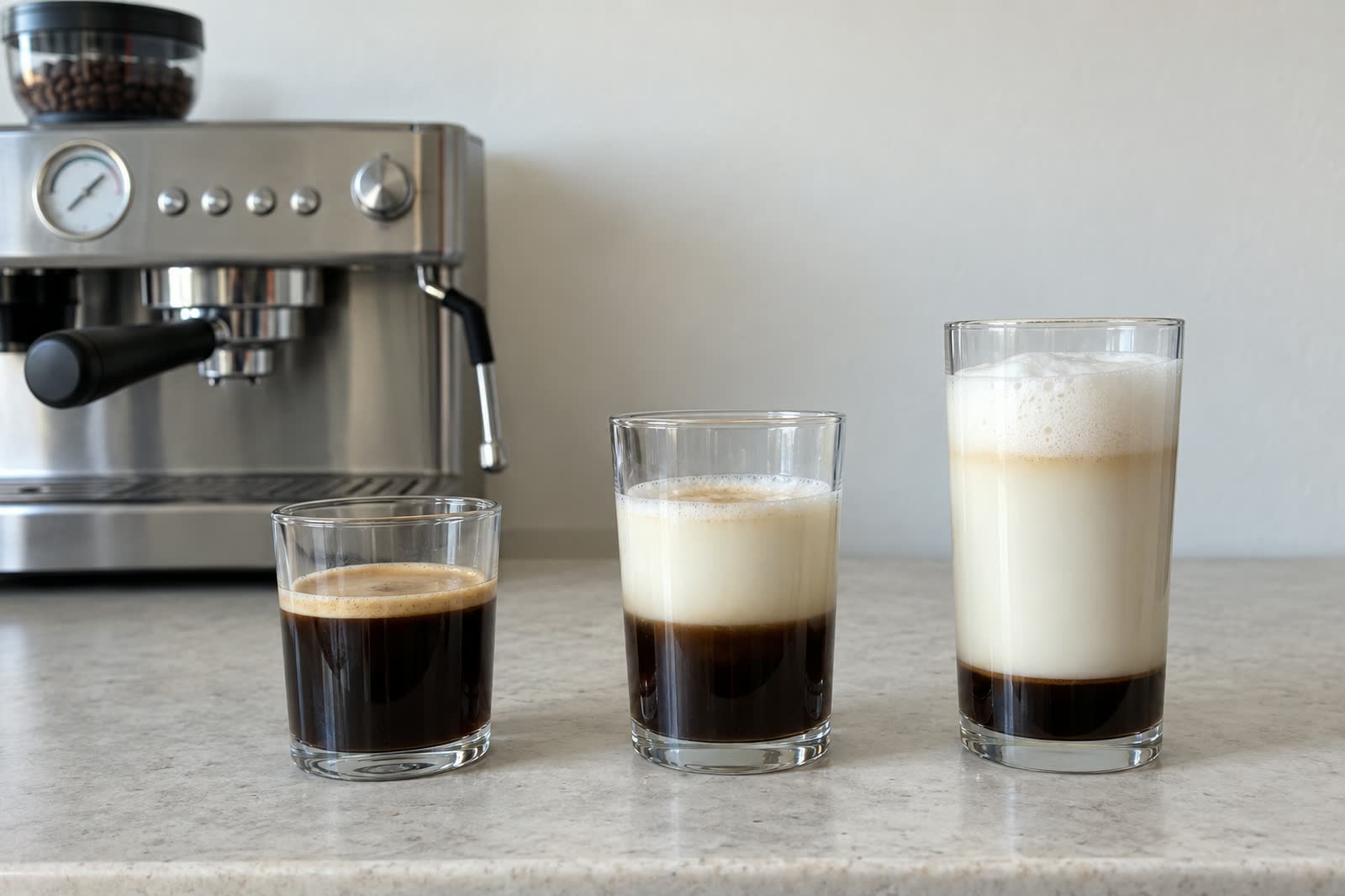
The three drinks are one shot and three proportions
A cafe menu makes a latte, a cappuccino and a flat white look like three separate skills. They are one thing: a shot of espresso and steamed milk, combined in three different proportions and finished with three different amounts of foam. The machine already on the counter makes all three, and the jug already in the cupboard pours all three. The difference between them is how much milk goes in, and how much air went into that milk before it did. Most of the worry about milk drinks turns out to be worry about a menu rather than about a technique.
Cappuccino: the least milk, the most foam
A cappuccino is the driest of the three. Equal parts espresso, warm milk and foam is the proportion the drink is usually described by, a convention rather than a measured figure, and in a small cup it means the shot sits under milk and foam that fill the rest. Because the foam layer is thick, the milk is stretched for longer before it is spun, and it goes into the cup thicker than it does for the other two. The practical test is a spoon: on a cappuccino the foam holds its own shape against it, and on a latte it does not.
If the foam collapses into the cup as you pour, the milk was under-aerated for this drink. That is a stretching fault rather than a pouring fault, and it is fixed at the wand rather than at the cup.
Latte: the most milk, the least foam
A latte inverts the cappuccino. One shot, a long pour of milk, and a thin cap of foam on top, in a taller cup, so the coffee reads as a background flavour rather than the front of the drink. It is the most forgiving of the three to make, because a thin foam is what milk does on its own if you stop stretching early, and because the larger volume of milk covers a shot that came out slightly short or slightly long.
That forgiveness is why a latte is a reasonable place to start, and also why it teaches the least. A reader who can pour a latte still has to learn stretching before a cappuccino works.
Flat white: the middle, poured thin
A flat white sits between the two and is defined by texture rather than by volume. Less milk than a latte, in a smaller cup, with the foam folded through the milk instead of sitting on top of it, so the drink reads as one liquid from the first sip to the last. The milk for it is stretched briefly and then spun for a long time, which is what turns a layer of foam into a texture that pours.
This is the drink that exposes milk handling, because a thin or lumpy texture has nowhere to hide in it. To find out whether your steaming has improved, make this one.
Why a flat white is called a flat white
The name is a description rather than a place. Flat is the foam: there is no standing cap on this drink, because the air is folded through the milk instead of left sitting on top of it. White is the older British and Antipodean way of asking for coffee with milk in it, the same word that makes a black coffee black. Which country served the first one is argued between Australia and New Zealand, and nobody has published a source that settles it, so this piece does not pick a side. The name travelled without being translated, which is the short answer to what a flat white is called in America: a flat white.
Measuring the ratio without buying anything
The ratios above are proportions rather than recipes, so a measure matters more here than a scale does. A jug with fill lines is the simplest way to get the same result twice: the 20 oz pitcher with etched graduations carries its volume marks inside the jug, so the milk is measured where it is poured instead of in a second vessel. Pour the milk to the same line every morning, and the only variable left is the texture.
A jug that is too large for the drink is the common mistake. Milk needs room to climb while it is stretching, and a jug filled much past half leaves it nowhere to go; half is a working rule rather than a measured limit. The milk jug guide shows how to size a jug to your cup with a glass of water.
Milk warmed without a steam wand
Not every machine on a counter carries a wand worth learning, and a household that drinks the occasional milky coffee may not want to learn one. A standalone frother is the alternative: the Milk Cafe frother heats by induction and shuts off once the milk reaches the temperature selected for it, which removes the judgement call a wand asks for. It ships with separate latte and cappuccino discs, and that pair of discs is the same distinction this piece is built on: one for a thin foam, one for a thick one.
What a disc gives up is the middle ground. A flat white's folded texture is a continuous adjustment, and a device that produces one of two fixed textures cannot make it.
Where the drink stops and the equipment starts
None of the three ratios above is a claim about a particular machine, and none of them needs a better machine than the one already on the counter. What they need is milk handled the same way twice, which is a practice rather than a purchase. If the milk is the part going wrong, steaming milk takes the wand apart; if the shot underneath it is the part going wrong, dialing in takes the grinder apart.
Work on one of those at a time. Changing the milk and the grind in the same week leaves a reader with no idea which change did what.



