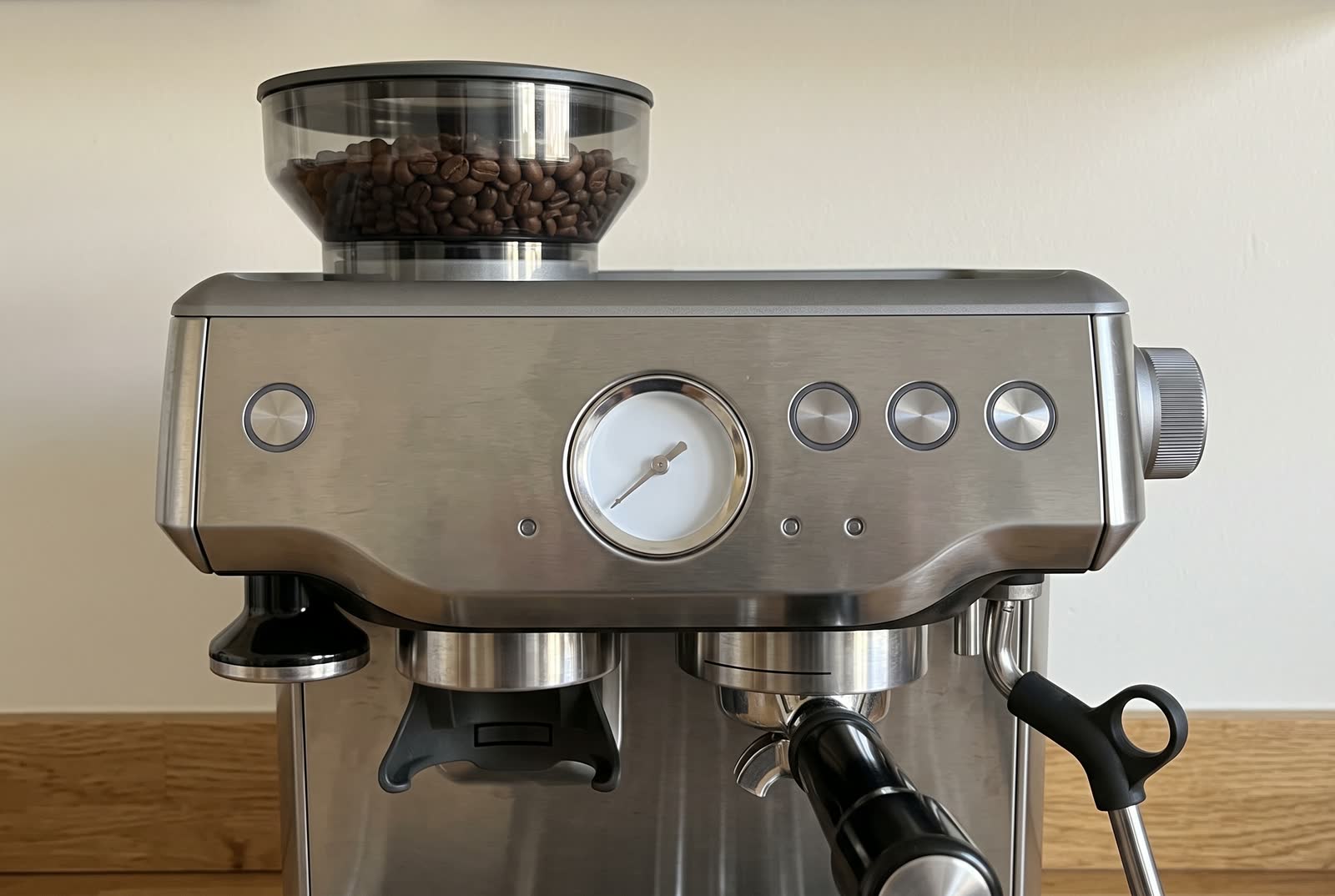
Three letters on a box, and the thing behind them
PID is a badge on a lot of espresso machines and a price difference on most of them. It stands for proportional, integral, derivative, which are the three terms a controller uses to decide how much heat to put in right now, and the reason those words end up on a kitchen appliance is that the alternative is cruder than most buyers realise.
What the controller replaces
A plain thermostat is a switch with an opinion about one number. Water falls below the set point, the heater comes on; water rises above it, the heater goes off. Because the metal keeps giving off heat after the switch opens and takes time to respond after it closes, the temperature does not sit on the set point, it swings across a band around it. Where in that swing your shot happens to land is not something the machine decides and not something you can see.
A PID controller measures the same gap and then does arithmetic on it. The proportional term answers how far off we are, the integral term answers how long we have been off in the same direction, and the derivative term answers how fast the gap is closing. Out of those three comes a continuously adjusted amount of heat rather than a switch, and the effect is a narrower swing and a set point the machine actually sits on.
That is the whole claim. A PID is a steadier temperature, and steadier temperature is one of the handful of variables that decides whether two shots pulled the same way taste the same.
What the controller leaves to the rest of the machine
It does not decide the temperature at the coffee. A controller holds the water in the heater; the puck sits at the far end of a group head that has its own thermal mass and its own losses, and a machine with a perfect boiler and a cold group still delivers a cold shot.
It does not decide flow, pressure or grind. It does not shorten a wait for steam on a machine with one heater, which is a question about how many bodies of water the machine has rather than about how well one is controlled.
And it does not exist on every machine that feels expensive, which is the useful half of this page.
What the makers state, counted
This site lists maker figures for fifteen espresso machines. On temperature control, ten state something, four have a document that states nothing about it, and one has not been checked yet. The boiler type is the one with no gap: all fifteen machines state it.
Those two questions overlap, and the overlap matters here. One of the machines whose temperature control is unread, the Lelit Anna, carries a PID in the boiler-type line instead, which is the same fact reached through a different reading. Two more machines, the Duo Temp Pro and the Infuser, used to need that same route; a reading of their own product pages, dated 10 September 2026, now states a PID directly for temperature control too, so both readings agree for those two rather than only one carrying it. Counting both readings, nine of the fifteen machines name a PID somewhere in what we have read. A second source raises that number. The maker specification sweep of 10 September 2026, taken from Breville's own product pages, read each page's own specification block and found a PID temperature control printed on nine Breville machines, two of which neither earlier reading had already named. Counting the first reading and that sweep together, eleven of the fifteen machines state a PID.
The eleven machines that state one
They are the Ascaso Dream PID Espresso Machine, the Lelit Anna PL41TEM, and nine Breville machines: the Bambino (BES450), the Bambino Plus (BES500), the Barista Express (BES870XL), the Barista Pro (BES878), the Barista Express Impress (BES876), the Barista Touch (BES880), the Duo Temp Pro (BES810), the Infuser (BES840) and the Oracle Touch (BES990).
Seven of the eleven have a product page on this site, a picture and a price checked at a seller, and are linked: the six linked above and the Bambino, which is linked below. The other four are named as text: the Dream PID's page has neither a picture nor a checked price, and the Anna, the Duo Temp Pro and the Infuser have no product page here at all.
One of the eleven states what the control actually gives the owner. The Ascaso Dream PID's page, read on 13 September 2026, states PID temperature control via the display, adjustable from 80 C to 110 C in 1 C steps. That is the difference between a controller that holds a number and a controller that lets you choose the number, and it is the only machine on this site that publishes the range.
The GO Espresso Machine (CM500014) is a heat-exchanger machine at a similar price to the Dream PID, without the digital display - a PID badge is one line item among several a buyer is actually paying for. PID machines side by side: Dream PID against a non-PID machine of the same size and GO against that same non-PID machine keep the rest of what changes visible next to the badge.
The Bambino, the Stilosa and the Classic Pro, and what their pages name
The Bambino makes both claims, on two documents. Its maker states a ThermoJet heating system that reaches extraction temperature in three seconds, and that is what we have on temperature control for it, read on 6 September 2026. Its own product page, read on 10 September 2026, prints a brewing-system block naming a 15 bar Italian pump, the three-second ThermoJet system and a PID temperature control together. Fast to temperature and held at temperature are two different claims, and this maker prints both on the smallest machine it sells.
The Stilosa states a 15 bar pump and a stainless steel boiler. Its 40-page instruction manual was searched in full on 6 September 2026 and prints no temperature-control statement at all.
The Classic Pro is carried on this site with a brass boiler and group head across the current Classic line, which reaches us as a description of the line rather than as a sentence read off the maker's page for this exact model, so it is written here as the shape of the machine rather than as a measured statement. Its 64-page manual, searched in full on the same day, prints no temperature-control statement either.
Paying for the badge, or paying for something else
A reader choosing between two machines where one carries a PID and one states nothing is looking at a real difference, and it is worth roughly what the rest of the machine is worth. On a machine with one small heater serving both coffee and steam, a steadier set point is one variable fixed out of several, and the wait between the two jobs is untouched.
The order that survives contact with a kitchen is grind first, then technique, then temperature control. A PID makes a repeatable shot more repeatable. It does not make an unrepeatable one good, because the thing making it unrepeatable is usually sitting next to the machine rather than inside it.



