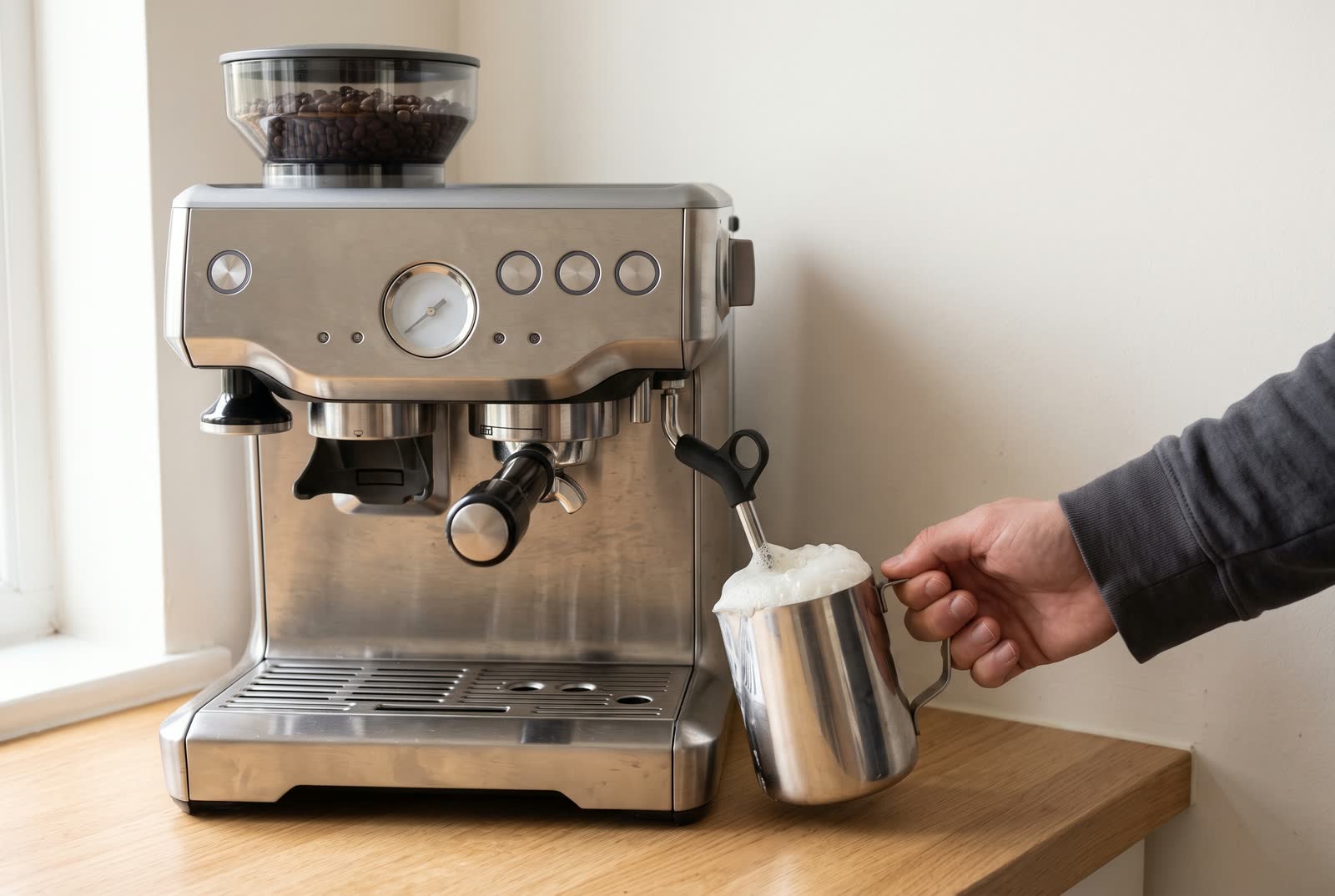
Steamed milk breaks in a small number of ways, and each one has a name and a single cause worth checking before anything else. This page names four: no foam, watery, lumpy and flat. It assumes the mechanics of getting the wand into milk correctly, which live in steaming milk, and adds only the fault-to-fix pairing that page does not carry.
Milk with no foam: air stopped too soon
Milk that comes off the wand as hot liquid with nothing sitting on top never had air worked into it before the surface closed over. Once the tip sinks under a still surface, the pour gets no second chance to draw air in for the rest of the steam. The one change: start with the tip just below the surface and hold it there only until the hiss starts, not after. This is a different fault from the flat pour further down this page: no foam means air never went in at all; flat means air went in but never combined into a cap that lasts.
Milk gone watery: the wand sat too deep
Watery milk, thin on top and thin underneath, points to a wand that ran too deep for most of the pour. Depth spins milk without stretching it, and milk that only spins heats fast without gaining any body. The one change: bring the tip closer to the surface once the hiss starts, so the same jug is building texture and heat together instead of heat alone. Watery is easy to mistake for a machine problem rather than a wand problem, since the milk still gets hot and even shows a little foam on top before it collapses within a minute; the giveaway is how fast that foam falls, not how much of it forms at first.
Milk full of lumps: the jug moved too late
Lumps are foam and liquid that never combined, because the jug held still after the air went in instead of starting the spin that pulls foam through the body. The one change: get the whirlpool going within the first few seconds of the hiss, not after the top already looks foamy. This fault shows up most on a first attempt with an unfamiliar jug, before a hand has learned how quickly that jug's shape starts to spin; a taller, narrower pitcher forms a whirlpool sooner than a wide one, which changes how early the second half of the technique needs to start.
Milk that steams flat: the pitcher never turned
A jug that comes up to temperature without ever showing a visible turn is heating milk without folding it, and flat milk pours the way it steamed, heavy and without lift. The one change: tilt the jug enough that the tip sits off centre and the surface actually rotates, rather than just bubbling in place. A flat pour can look identical to a good one while it is still in the jug, since both start with the same hiss; the difference only shows once it is poured and there is nothing left to hold a shape on top.
Which machines hand you this fault at all
Not every espresso machine leaves a wand for a person to get right or wrong. Of the fifteen espresso machines we compare, five state whether they have a frother at all, four of them read on 6 September 2026 and the fifth on 13 September 2026, and one of those five states a plain steam wand; the rest state some form of automatic milk texturing. The Stilosa and the Bambino both sit on the other side of that count: neither states automatic frothing, per their makers, and both ship with a wand a person runs by hand, which is why the four faults above land on them.
The Milk Cafe is the one appliance here built to remove the fault rather than name it. Its maker states induction heating with automatic shutoff once the milk reaches its set temperature, so the timing decisions above, when to lower the jug and when to stop, are made by the appliance instead of by a hand on a wand. The Milk Cafe against a wand is where that trade gets worked through in full; this page only names it as the exception to everything above it.
A pitcher with etched volume lines, per its maker, at least answers how much milk went in before any of these four faults showed up, which takes one variable out of the guessing before the wand ever goes in. A jug filled too close to the top also makes every one of the four faults harder to catch early, since there is less room left above the milk for the spin the fixes above depend on; a graduated jug at least makes that starting point visible rather than guessed. To pick the size, use the water test in the milk jug guide.
No temperature figure appears anywhere above. We have not measured one we could attach to a fault by feel, and a number here would read as more precise than what is actually known. The same is true of a duration: none of the four fixes above is stated as a count of seconds, because this piece has no source that carries one for any of these machines, and a fault-finder that invents a number is worse than one that names the fault and stops there.



