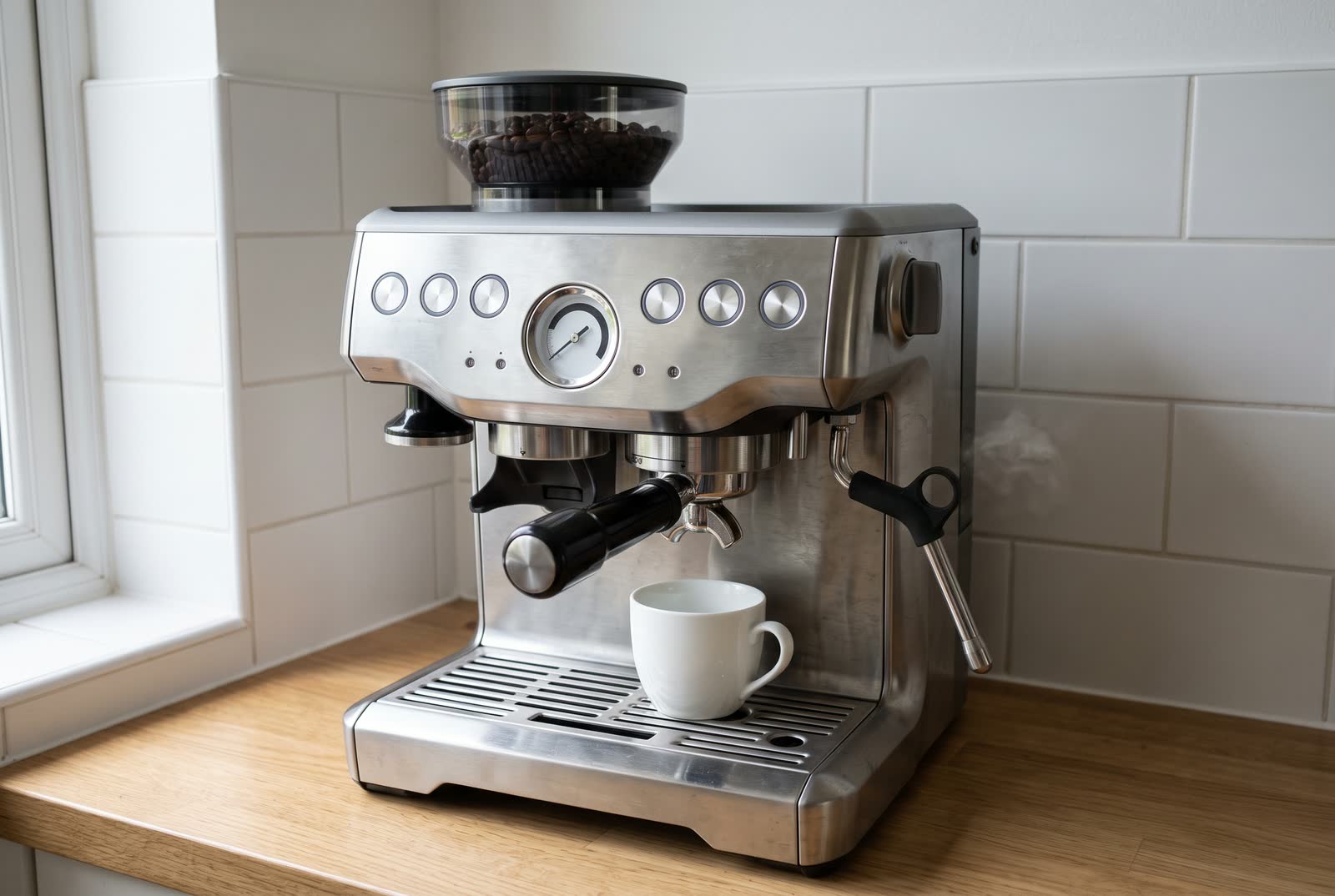
One heater, two jobs, and they do not want the same heat
A single-boiler machine heats one body of water and has to serve both jobs out of it, and steam wants that water a long way above where coffee wants it. So the machine sits at the brewing setting, going to steam means taking the same water up, and making a second coffee means waiting for it to come back down. That is the whole of what one boiler means for anybody making two drinks in a row, and it is why the second one is a different drink from the first.
What the makers here state about it, counted
This site lists fifteen espresso machines, and the sheet this site keeps names the heater on every one of them. Fourteen heat one body of water for both jobs; the fifteenth, the Oracle Touch, states a dedicated espresso boiler and a dedicated steam boiler, which is the whole of what the money buys in that particular machine. On the separate question of a temperature control, eight of the fifteen carry a statement from the maker, four carry an empty cell with a note saying the maker's own manual was read end to end and prints none, and three have never been checked. So what the makers give is eight statements, four silences that were looked for, and three gaps that are ours rather than the makers'. The machines named below are linked where they have a product page here, a picture and a price checked at a seller; the Dream PID's page has neither yet and the Anna has no product page on this site, so both are named as text.
Eight statements, and one number in all of them
Seven of the eight name the control and stop: a PID temperature control, an electronic PID temperature control, a heating system with a trade name on it. The Dream PID's page is the exception, and it is the only page of any maker on this record that prints the range the control moves over: read on 13 September 2026, it states a PID temperature control set from the display, over 80 to 110 degrees Celsius in one-degree steps. One other machine has a figure in the heater line this site recorded off its maker's page on 6 September 2026, the Barista Express Impress, whose line reads as a PID temperature control at 200 degrees Fahrenheit. Two numbers, on fifteen machines, and neither of them is a reading of what the water over the coffee actually did.
What a boiler holds, and why the volume is the interesting figure
Four of the fifteen have a brass boiler, and three of those four state how much it holds: the Silvia and the GO each state 0.3 litres, and the Anna's technical sheet, read on 11 September 2026, states a 250 millilitre brass coffee boiler. That volume is the hot water standing ready when the shot starts, and when it is used up the heater is making more while the pump is still pulling, which is the mechanism behind everything that gets said about a small boiler. The metal matters as much as the water, because a brass boiler is a lump with heat in it and the machine around it is built to match: the Silvia's maker states fourteen kilograms for the whole thing. The Classic Pro is the fourth, and its boiler is listed here as brass with no volume printed anywhere, on readings that come from a distributor's storefront and a published review rather than from Gaggia's own page, so it is the same kind of object with one figure missing and a weaker source under it.
The nine machines that hold nothing at all
Nine of the fifteen have no boiler in that sense. A thermocoil or a thermoblock is a heated channel that warms the water as it passes, so what the machine stores is metal rather than water, and there is nothing to run out of and nothing to wait for either. The Bambino's maker states that its heater reaches extraction temperature in three seconds, and three more machines from that maker print the same three-second line on the specification tables read on 10 September 2026. That is a time to ready rather than a temperature, and it is the honest description of the trade: no warm-up, and no reservoir of heat to lean on when the steam job is over.
Why the second shot tastes different, and what a control actually buys
A thermostat holds a setting by switching the heat on and off around it, so the water is never at one temperature; it is moving inside a band, and where in that band your shot happens is not something the machine reports. Steaming empties the band from the top: the steam job takes the same water far above the brewing setting, and the machine has to fall back before the next shot is a shot rather than a scald. That is the difference a reader tastes between the first drink and the second, and it is a property of one heater serving two jobs rather than a fault in any machine here. A control with a number on it, of the kind the Ascaso prints, is worth what it is worth because you can set the band and read it back, which is a different thing from knowing what your own group did this morning.
What a measurement would have to carry
For a temperature on this page to be ours rather than a maker's, a record would have to exist that does not: a reading taken in the water at the group of a named machine, on a stated date, with a named probe and its own calibration date, and taken through a whole shot rather than at one instant, because the figure moves while the shot runs. A second record would have to sit beside it and it is the one that matters most here: the same reading on the shot immediately after a steam cycle, which is the only way the recovery this page describes stops being an argument and becomes a figure. Neither is hard to make, which is why it is worth naming precisely rather than gesturing at. Until both exist, the two numbers above are the only ones this page prints, and both belong to the makers who printed them.



