Three jobs, and what each one protects
Cleaning an espresso machine is sold as a chore and is really three separate jobs on three separate clocks, protecting three different things.
The daily job protects the taste of the next cup. The weekly job protects the machine's moving parts from the residue the daily job leaves behind. The grinder job protects the consistency of every shot, because a grinder full of old coffee grinds differently from a clean one.
A reader who does only the first two still has a working machine. That is why they are in this order.
One thing about those clocks before anything else: none of the maker pages read for this piece state a cleaning interval for any machine here, so every clock and every count of seconds below is a working routine rather than a published schedule. The section near the end says what would change that.
After every shot: the basket, the screen and the wand
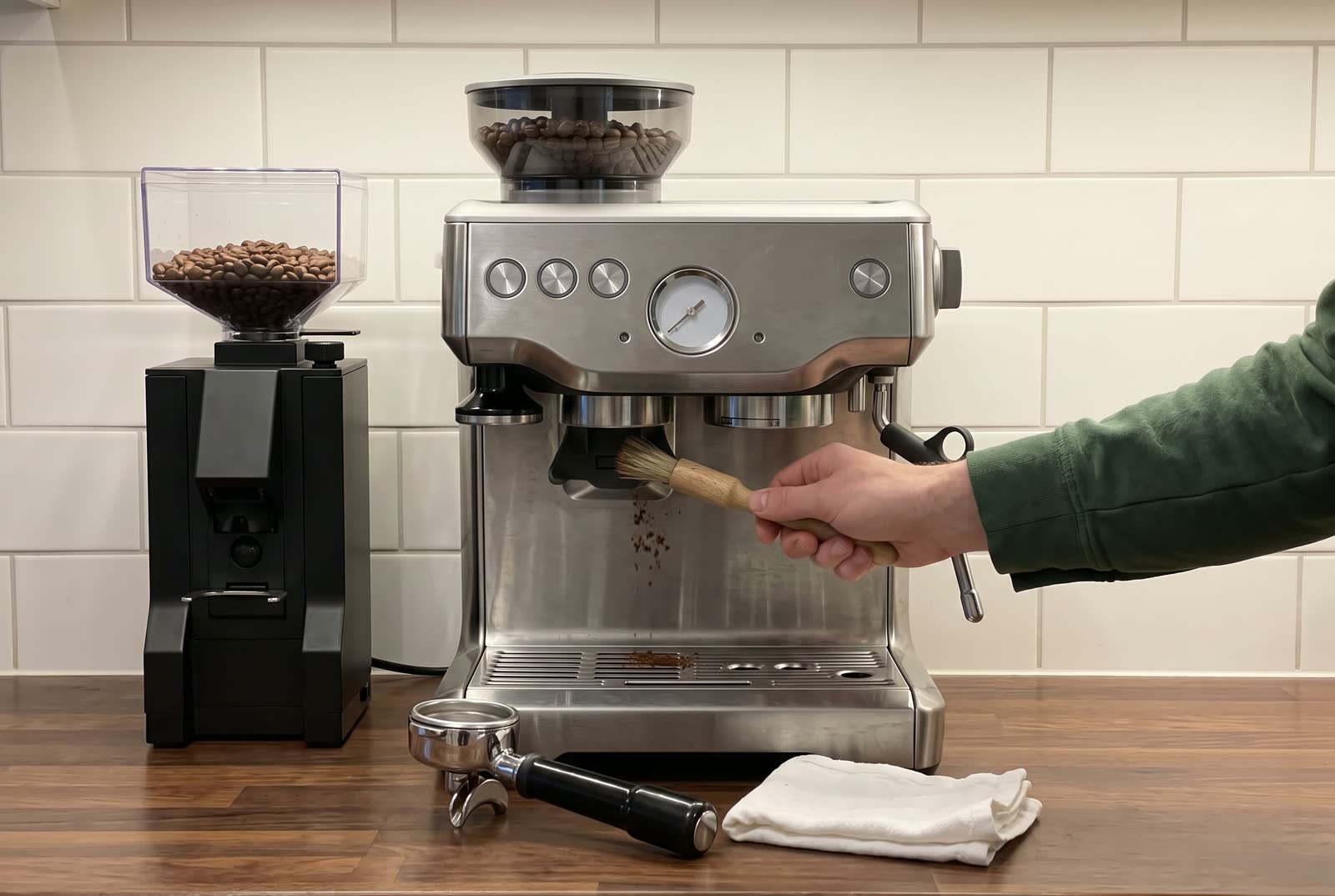
Knock the puck out, wipe the basket with a cloth, and flush the group for two or three seconds with the portafilter out. That last step is the one people skip, and it is the one that clears the grounds sitting on the shower screen.
Then the wand, and the wand is not optional. Purge it into the drip tray the moment the jug comes off, wipe it with a damp cloth while it is still hot, and purge it once more. Milk left on a wand until the morning has to be soaked off; milk wiped off while the wand is still hot comes off with a cloth.
This applies to every machine here that has a wand, and the makers state them plainly: the Bambino is stated with a manual steam wand, and the Stilosa is stated with a manual steam wand for milk frothing. A manual wand is one you steer, and it is also one you clean by hand every single time.
The whole daily routine is short. It is what decides whether the weekly job is a wipe or a scrape.
Every week: the basket out, the portafilter, the tray
Once a week, take the basket out of the portafilter and wash both, separately, in hot water. Coffee oils collect in the groove the basket sits in and nowhere else gets them.
The group head takes a detergent backflush on machines built for it, which means machines with a three-way valve and a blind basket. Not every machine here is one. The Gaggia Classic Pro is described as carrying a three-way solenoid valve, which is the part a backflush needs, but that description reaches us through retailer positioning rather than the maker's own page, so check your own manual before you buy a blind basket for it. On a machine without the valve, a backflush does nothing useful and may do harm.
The drip tray and the water tank come out and get washed in the same session. The tank is worth naming: the Stilosa's maker states a removable tank of approximately one litre, which is small enough that a household using the machine daily empties and refills it constantly, and a tank that is refilled often is a tank that gets rinsed often. A larger tank is more convenient and sits still for longer, which is the opposite trade.
The grinder: the retained dose and the chute
A grinder holds coffee after it has finished grinding. That retained dose is stale and it comes out at the front of the next grind.
Brush the chute out weekly with a stiff dry brush, and brush the exit where grounds collect against the lip. Nothing wet anywhere near the burrs.
The hopper is the other half. The Encore is stated by its maker with 40 mm conical burrs, forty settings and a 550 rpm direct-drive motor, and the same maker states a bean hopper. Worth knowing how this site handles that figure, because it is a small example of the method: the maker has stated the hopper capacity twice, on two different dates, one of 8 oz and one of 300 g, or 10.6 oz, and we carry both with their dates rather than picking the one that reads better. Either way it is a hopper that holds more than a day of beans, which is our arithmetic on the maker's figure rather than a figure the maker states, and beans left standing in it go stale in the light.
Empty the hopper if the grinder will sit for a week. Wipe it with a dry cloth, not a damp one.
How often the makers say
Here is the part this piece will not invent. Of the four maker pages we have read for the machines and the grinder above, not one states a cleaning interval. No daily instruction, no weekly instruction, no schedule of any kind.
So every interval and every timing in this piece is unsourced, written as what a working routine uses rather than as anything a manufacturer has published. They are the consensus of practice, not a citation. The nearest thing this piece has read is another maker's manual, for a machine this piece does not cover, whose wand section is headed "Daily cleaning of steam wand": one line about one wand on one machine, and not a schedule for these.
What would close it is specific and small: each machine's own instruction manual, read for its maintenance section, and recorded here as a maker statement with its page number the way this site records every other maker figure. We have already read three of those four manuals, for other findings; the grinder's maker publishes support articles rather than a manual. So this is a reading job rather than a research programme. Until it is done, the honest label on every interval above is that the maker has not stated one.
Descaling is a different job on a different clock
Everything above is about coffee oils and milk. Descaling is about the mineral the water leaves inside the boiler, and it runs on a clock set by the water rather than by how much coffee you make.
It is a different piece and it needs different sources, because a descaling interval is one thing makers do sometimes publish and the figure has to come from them rather than from a routine. Nothing here should be read as covering it.



