This comparison is based on the manufacturers' published pages and manuals, read on the dates given below, not on hands-on testing. Where a maker states no figure, the page says so rather than supplying one.
The problem this comparison exists for
A reader with a machine whose steam wand defeats them has two ways out: learn the wand, or buy a second appliance that does the milk on its own. This page is about the second one, and about whether it fixes the problem or moves it. It names no winner, because the two subjects do different things for different people, and the honest answer is which of those people the reader is.
What the wand is
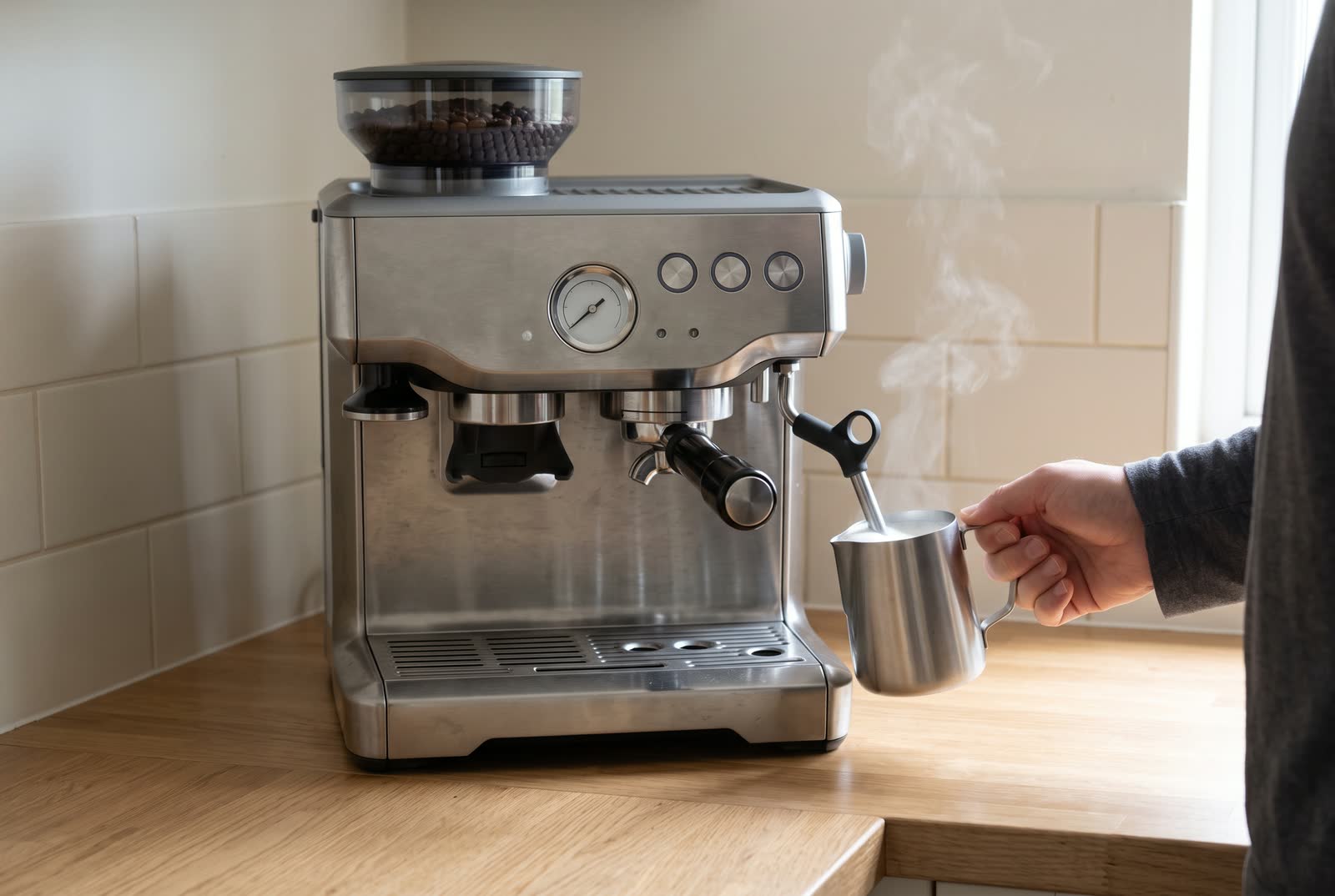
The Bambino states a manual steam wand beside its heating system, which its page says reaches temperature in 3 seconds. A manual wand is a pipe that puts steam into milk in a jug the owner holds. The owner decides where the tip sits, how long the milk stretches, when to sink the tip and when to stop, and every one of those decisions is what the page on the jug, the wand and the sound is about. The result, done well, is milk with the fine texture a flat white needs and the foam a cappuccino needs, from the same jug and the same wand, because the hand chose.
The pages read on 6 September 2026 record no automatic frothing on the Bambino: its manual describes the wand and nothing that textures milk by itself. Five of the fifteen machines we compare state a frother line at all: one of the five is a plain steam wand, and four mention something automatic, one of those four read from a manual's contents page. The Bambino is not among the five.
What the frother is
The Milk Cafe is a jug on an induction base. Its maker states induction heating with automatic shutoff once the selected temperature is reached, and two separate frothing discs, one for a latte texture and one for a cappuccino foam, in a jug that is dishwasher safe. Its US page, read on 3 September 2026, states 500 watts; the rest of its figures were read on their own dates: a body of 163 by 190 by 264 mm read on 11 September, 1,570 g read on 6 September and a one-year limited warranty read on 12 September. One note belongs beside the wattage: a sweep of the same page on 6 September could not read a wattage from it, because the maker renders its specification table in the browser, and the 500 W figure is the one read earlier from the same page.
The frother settles the temperature, because it stops itself. It settles the texture, because the disc chooses it. What it leaves to the owner is which disc to fit and when to pour. That is the trade in one line: the wand hands the owner every decision, the frother takes all but one away.
What each one gives up
The wand gives up consistency until it is learned. A reader who has not learned it gets scalded milk one morning and thin milk the next, and the learning is real work, measured in jugs of milk.
The frother gives up range. Two discs make two textures, and the space between them, the slightly thicker milk a particular cup wants, is not a setting. It also gives up the counter it stands on: the maker's figures put it at 163 mm across and 190 mm deep, which is a second footprint beside the machine's, and it gives up a socket, at 500 W.
The jug belongs in this comparison because it is the part both roads share. Its maker states a 20 oz stainless pitcher with etched graduations for measuring the milk, and the same maker sells a centre-post variant aimed at aeration. A wand needs a jug; a frother is its own jug. A reader who buys the frother and keeps the pitcher has bought the pitcher for the wand they are no longer using. If you keep the wand, the milk jug guide sizes the jug to your cup.
Which problem the second appliance fixes
If the problem is milk at the wrong temperature, the frother fixes it: it stops itself at a set point and the wand does not.
If the problem is texture, the frother moves it rather than fixing it. It makes two textures reliably, and if one of those is the texture the reader wants, the problem is gone; if the reader wants the one in between, the wand is still the only tool that makes it, and the frother has added a second appliance and taken nothing off the learning.
If the problem is time in the morning, the frother runs on its own while the shot pulls, and the wand waits for the shot to finish. That is the one clear win it has, and it is a real one.
What this page does not say
It does not say which milk comes out better. No figure on record measures texture, and this site does not invent one. It does not say what either costs; both sit in the bands this site draws, which are ranges of its own framing and not a price read at a shop. And it does not say that the wand is easy; it says it is learnable, which is a different claim, and the page linked above is where the learning is.



