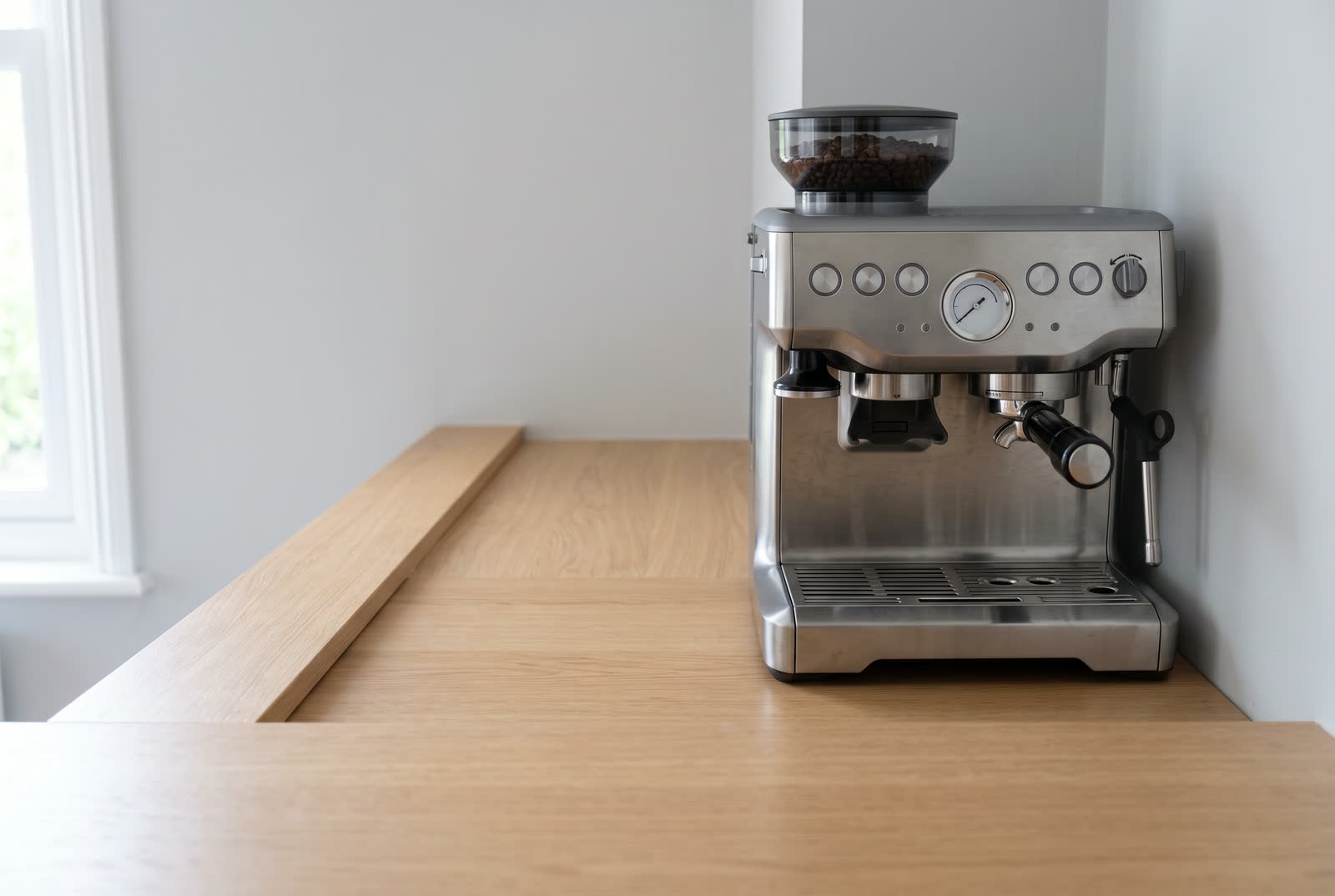
A run is a length, and only half of it is published
The constraint on most kitchens is not how deep the counter is or how much room there is overhead. It is the run: the uninterrupted length of worktop between the sink and the hob, or between the wall and the end of the cabinets, that nothing else has already claimed. A run is arithmetic. It is the sum of the widths of everything that has to stand on it, plus the gap each thing needs beside it, plus a patch clear enough to set a cup down and turn a portafilter. The first of those three is published on almost every product page here, with a date. The other two are published on none of them, and that asymmetry is what this page is about.
What we know, and what we do not
We compare thirty-six products on this site: espresso machines, grinders, scales, kettles and the things that stand between them. Twenty-seven of the thirty-six state a published width, each with the page it was read from and the date it was read. Two are in dispute, because two readings from the same maker disagree and neither was chosen over the other, so no width is used for them. Seven state none at all, and those seven are recorded as absent at the source rather than filled in from a shop listing. Of the fifteen espresso machines, fourteen state a width, and those fourteen run from 200 mm at the narrowest to 422 mm at the widest.
Three things have to stand on the run, and all three publish a width
An espresso corner cut back to what it cannot do without is a machine, a grinder and somewhere to knock the puck out. Taking the narrowest machine here, the Classic Pro at 200 mm on the page read on 11 September 2026, with the DF64 Gen 2 at 130 mm from the page read on 1 September 2026 and the Knock Box 20 at 163 mm, the published widths sum to 493 mm. Swap the machine for the Bambino, whose own page gives its footprint as 11.9 by 6.1 by 13.5 inches and whose width is stated at 302 mm, and the same three sum to 595 mm. That difference of 102 mm between two machines is the single largest thing a reader can actually decide here, and it is decided before anything is bought. The three sums in this paragraph are this page's own addition of published figures and are not numbers any maker prints. The grinder is the surprise in them: at 130 mm it is narrower than the knock box beside it, and its maker's page states 64 mm flat burrs with stepless adjustment and a 50 g bellows hopper for single dosing, so nothing has to stand above it waiting to be ground.
The gaps are absent on every entry, so no run length is stated here
Those sums are not counter lengths, and this page does not turn them into one. Every single one of the thirty-six entries states no side clearance, no rear clearance and no top clearance: the columns are empty across the board. Thirty-three of the thirty-six are empty because the maker's own manual was downloaded and read end to end and prints no such figure, which is a different state from not having been looked at; the remaining three have never been checked. So the distance one machine needs from the next, and the width of the patch a person needs to work in, are quantities no page we have read will supply. A reader measuring a counter should treat 493 mm as the published floor of a run and add their own hands to it, and nobody here can tell them how much to add.
The cabinet is out, and one manual says so in its own words
The usual escape from a short run is to put the machine away, and two of the manuals we have read close it. The Classic Pro's manual carries the instruction "The machine shall not be placed in a cabinet when in use." on page 13, read on 6 September 2026, which is a maker refusing an enclosure rather than a preference about looks. The Bambino's manual was read in full the same day and carries no instruction against a cabinet anywhere in its placement warnings, and that is recorded here as an absence rather than as permission: a manual that does not forbid something has not allowed it. The practical reading is that the run has to be open counter for at least one of these two, so a corner cannot be shortened by hiding half of it, and the length has to come from somewhere else.
When the run is shorter than the published floor
Three moves shorten it and each one moves the problem somewhere else rather than solving it. The tank is the first: the Classic Pro's manual states on page 17 that the tank is filled in place, which means the machine never has to be slid out to be watered, so its 200 mm stays 200 mm every morning; of the fifteen machines, eleven state which way the tank comes out, and eight of those lift it from the top, which asks for room above the machine instead of beside it. The second is the knock box, which holds up to twenty pucks and is the one item on the list that can live in a drawer or on a shelf, taking its 163 mm off the run entirely. The third is a hand grinder, which is the only genuine saving of the three, and this piece cannot price the saving: the hand grinder on file states no width on its maker's page at all, so there is no figure here to subtract. What none of the three changes is the machine itself, which is why the width of that one object is the number worth settling first.



