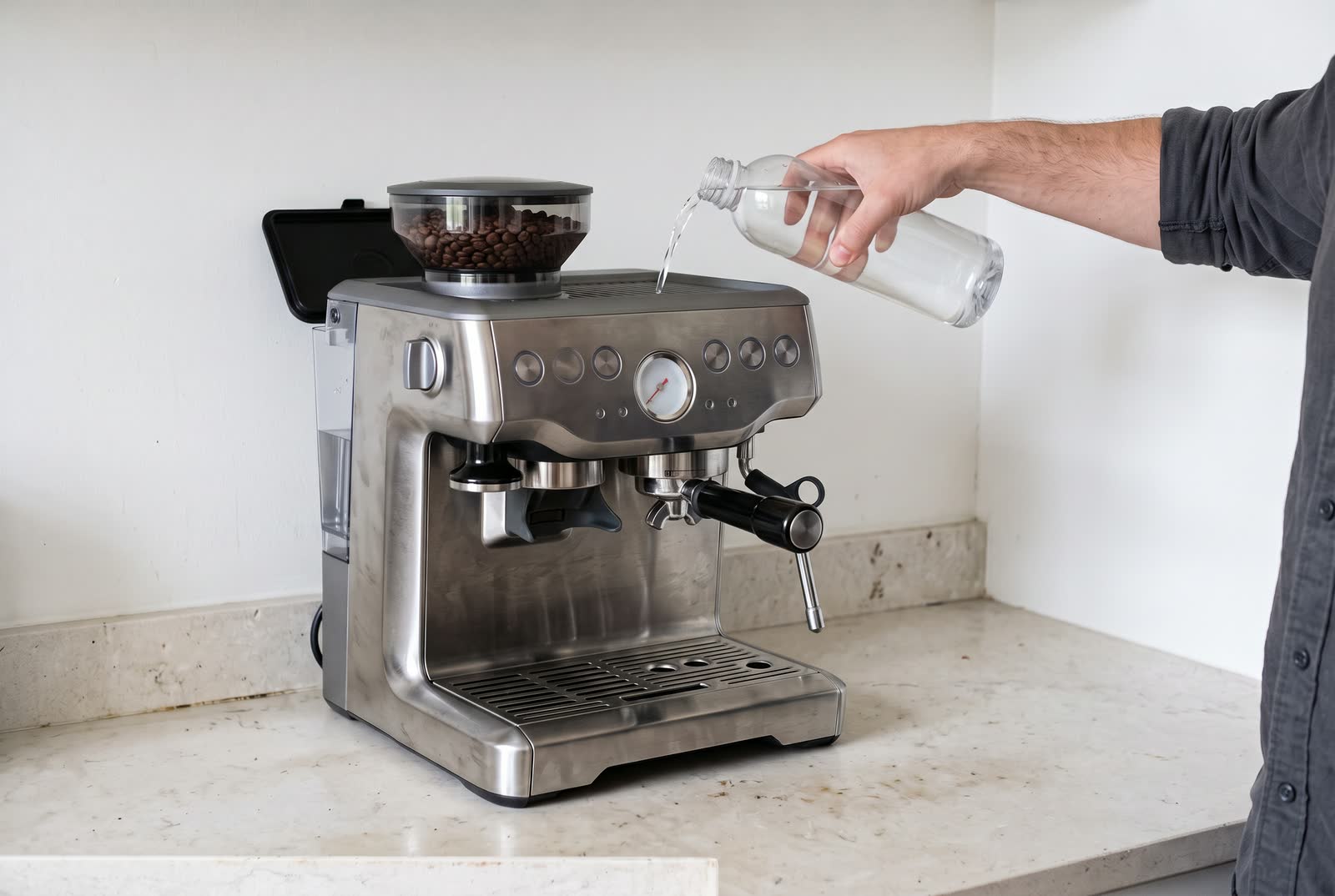
The short answer
Descale when the machine shows the symptoms: flow through the group slows, the machine takes longer to reach temperature than it used to, or steam pressure drops. Mineral scale in the heater or boiler causes all three, and how fast it builds depends on your water, so your machine's own manual, at its maintenance section, is where a maker interval would be printed.
For a first machine that makes the job easy, buy the Bambino. Breville's page, read 10 September 2026, lists descaling powder in the box, so the first dose comes with the machine. To pour the solution straight in, the Stilosa and the Classic Pro both fill the tank in place, per their manuals.
Descaling is one job, and it is not the cleaning job
Descaling removes the mineral the water leaves inside the boiler and the pipe that feeds the group. It has nothing to do with coffee oils, milk or the shower screen, and a machine can be spotless on the outside and furred on the inside.
That matters because the two jobs run on different clocks. Coffee oils build up from how much coffee you make. Scale builds up from what is in the water and how much of it goes through, so two identical machines in two kitchens are not on the same schedule at all.
So the place to get an interval is the maker of your machine, and this piece sets out what the four makers read for it say.
What the four maker pages read for this piece state
Four machines are covered here with their manufacturer pages and with all four of their instruction manuals: the Stilosa, the Bambino, the Bambino Plus and the Classic Pro.
The four pages state what each machine is: the Stilosa's maker states a 15 bar pump and a stainless steel boiler, and the Classic Pro is described as carrying a brass boiler and group head across the current Classic line. None of the four prints a descaling interval in months, litres or shots.
One page does say something adjacent, and it is worth having. Breville's own accessories list for the Bambino, read on the maker's page on 2026-09-10, includes descaling powder in the box. That is a maker telling you the job exists and supplying the first dose for it. It is still not an interval.
The maker's own instruction manual is where an interval would be printed. This site has all four manuals, read for other findings, and none has yet been read for a descaling schedule.
The part of the job the manuals do answer
Descaling means putting a solution through the tank, and two of the four state how the tank behaves.
The Stilosa's manual states that the tank can be filled in place, without extracting it: "the water tank can also be filled without extracting it, by pouring the water directly from a jug." The Classic Pro's manual says the same in its own words, that the cover comes off and the tank is filled to its marked level.
That is a small thing until you are holding a jug of descaling solution. A tank that fills in place is a tank you can dose without lifting a full reservoir across a counter, and it is also a tank that is easier to rinse twice afterwards, which is the step people skip.
Size decides how many rinses that takes. The Stilosa's maker states a removable tank of approximately one litre. The Classic Pro's is described as being in the 2 to 2.1 litre range, and that description reaches this site through retailer positioning rather than the maker's own page, so treat it as the shape of the thing rather than as a measured capacity.
Setting your own interval
First, go and look. Your machine's own instruction booklet is the document this piece cannot read for you, and a maintenance section is where a descaling instruction lives if it exists. It is a short job and it settles the question for your machine rather than for a machine like yours.
Second, use the machine's own signal if it has one. A machine with a descale light is a machine whose maker has already decided the interval and put it in the firmware, and that beats any figure a stranger could give you.
Third, with no instruction and no light, go by the symptoms rather than a made-up number. Descale when the flow through the group slows, when the machine takes longer to come up to temperature than it used to, or when the steam pressure drops off. Those are the symptoms the mineral produces, and they are yours to watch.
And use the maker's own product where the maker sells one. A machine that ships with descaling powder, as the Bambino does, is telling you which chemistry it was designed around.
What would close this, exactly
Four documents, read for one section each. Each machine's own instruction manual, opened at its maintenance pages, with any descaling instruction printed here as a maker statement with the page it came from, the way every other maker figure on this site is recorded.
We already have all four of those manuals, each downloaded from its maker's own site and read in full for other findings. So this is a reading job on documents we already have, not a research programme.
Until that is done, the line on every one of these four machines is the same, and it is not a hedge: the maker has not stated a descaling interval on any page this piece has read, and this piece states none in its place.
Descaling and cleaning are different pieces
Everything above is about mineral and water. Coffee oils, milk and the grinder are the other job, they run on a routine rather than on a published schedule, and they are written up separately.
The one thing worth carrying across: doing the cleaning job well does not slow the scale down by a single day. They are not substitutes for each other.



