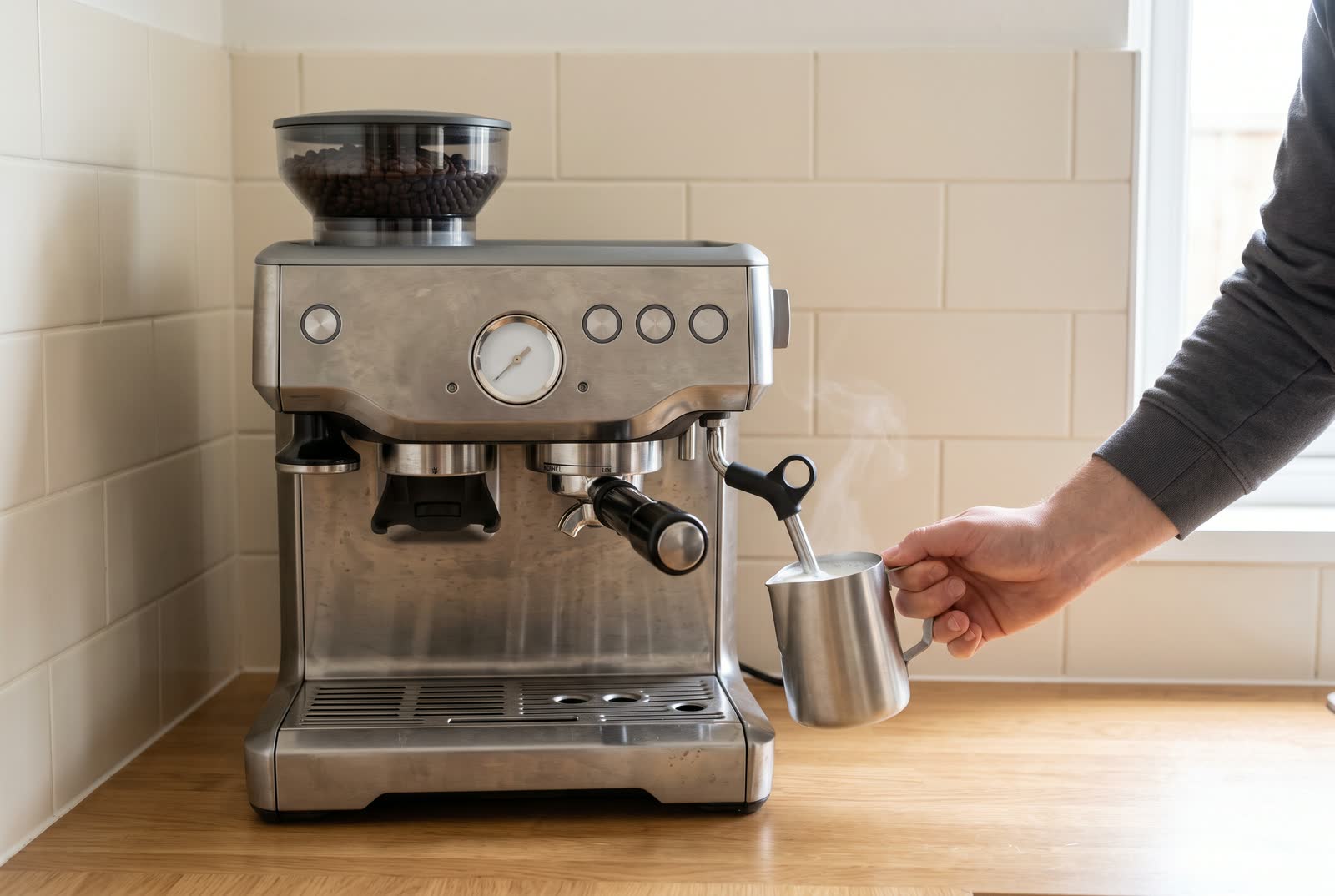
Two stages, and a sound for each
Steaming milk is two things happening in order. First stretching: air is pulled into the milk from the surface, which increases its volume and builds foam. Then spinning: the wand is buried and the milk is turned over on itself until the foam it just made is folded through the liquid and the whole jug becomes one glossy texture, and most bad milk is one of those two stages done for the wrong length of time. Both stages announce themselves with a sound.
Stretching is a light tearing noise, a series of small kisses at the surface, and spinning is a low rumble with no tearing in it at all. A reader who can hear the difference can steam milk in the dark.
What happens to milk when you steam it
Two things at once, which is why the order of the stages matters. The steam carries heat and it carries pressure, so the wand warms the milk and drives air into it at the same time, and the air only goes in while the tip is near enough to the surface to pull it down. What holds that air is the milk itself: the proteins in it gather around each bubble and hold it open, and the fat is what makes the result taste like a drink rather than like warm foam. Heat is also the limit. Past the point where the jug is too hot to hold there is nothing left to gain, and the milk starts to taste cooked, which is a flavour no pour recovers.
The jug: size, fill line and spout
A jug that suits the drink is most of the battle, because milk climbs as it stretches and it needs somewhere to climb to. Fill to about halfway, never past the base of the spout, and pick a jug sized so that halfway is roughly the amount of milk the drink wants. Halfway is a working rule rather than a measured line. The 20 oz pitcher with etched graduations has its volume marks etched inside the jug, which makes the same fill repeatable without a second measure. The milk jug guide turns the halfway rule into a water test with your own cup and lists five jugs by capacity.
A spout matters too, but it matters at the pour rather than at the wand, so it belongs with latte art rather than here. What matters here is the volume and where the surface sits.
Position the wand before opening the steam
Put the tip of the wand just under the surface of the milk, off centre, angled so the milk will turn in a circle rather than churn in place. Off centre is the whole trick: a wand in the middle of the jug pushes the milk straight down and it comes back up the sides in two directions, which cancels the spin. Set the position, then open the steam, and not the other way round.
Purge the wand before it goes in and again after it comes out. Condensed water in the arm goes into the milk as water, and milk left on a hot wand bakes on fast.
Stretching: seconds, not minutes
Open the steam fully and hold the jug so the tip stays at the surface. You will hear the tearing straight away, and as the milk rises you have to lower the jug slightly to keep the tip at the new surface. For a flat white this stage is a second or two; for a cappuccino it is several seconds longer, and that difference in seconds is the entire difference between the drinks in milk drinks by the ratio. Both counts are starting points to adjust by ear rather than timed figures.
Stop stretching while the jug is still comfortable to hold. Once the metal is too warm for a hand to rest against, the milk is close to the end of its useful range and there is no time left to fix the texture.
Spinning: where the texture is actually made
Lower the jug so the wand tip is well under the surface and the tearing stops. The milk should now be turning in a visible whirlpool, and this is the stage that turns the foam from a layer into a texture. Let it run until the jug is too hot to hold, then close the steam before lifting the jug out.
Knock the jug once on the counter to burst the large bubbles, then swirl it until the surface looks like wet paint. Milk that has been spun properly moves as one thing; milk that has not will have a white raft sitting on a thin liquid underneath.
Wands you steer and wands that steer themselves
A manual wand gives you both stages to control and both stages to get wrong. The Bambino is the shape of that arrangement: its manufacturer describes a manual steam wand, so the stretching time, the angle and the spin are all the reader's. The Bambino Plus is the other arrangement, with an automatic wand offering three milk temperatures and three texture levels, where the machine judges the stages and the reader picks the setting.
Neither is the better machine and this piece does not say which to buy. What is worth knowing before choosing is that the automatic one removes the practice and the choices with it: three texture levels are three textures, and a flat white's fold is a continuous adjustment between them.
Reading the jug before you pour
Good milk is glossy, moves as one liquid, and shows no visible bubbles on the surface. Thin milk that never stretched will pour clear and leave nothing white on the crema. Stiff milk that stretched too long will sit in the jug as a raft and drop into the cup in lumps, and no amount of swirling brings it back.
There is no rescue for either, which is worth saying plainly: pour it into something else and steam fresh milk. Reheated milk does not stretch, so the jug has to be emptied and started again.
Why the milk comes out with no foam at all, or dull instead of silky
No foam at all means the air never went in. The usual cause is a tip that started too deep, so the jug went straight to spinning and skipped stretching entirely; the second is steam that was never opened fully, which turns the whole thing into slow heating. Milk that has been steamed once and then cooled will also refuse, because it has been asked already and it does not stretch twice. Dull rather than silky is the other end of the same fault: the spin was cut short, so the foam is in the jug but was never folded through, and it reads as warm milk with a separate white layer on it instead of one liquid. Give the spin the time the stretch did not need, and stop both at the same place, the moment the jug is too hot to hold.



