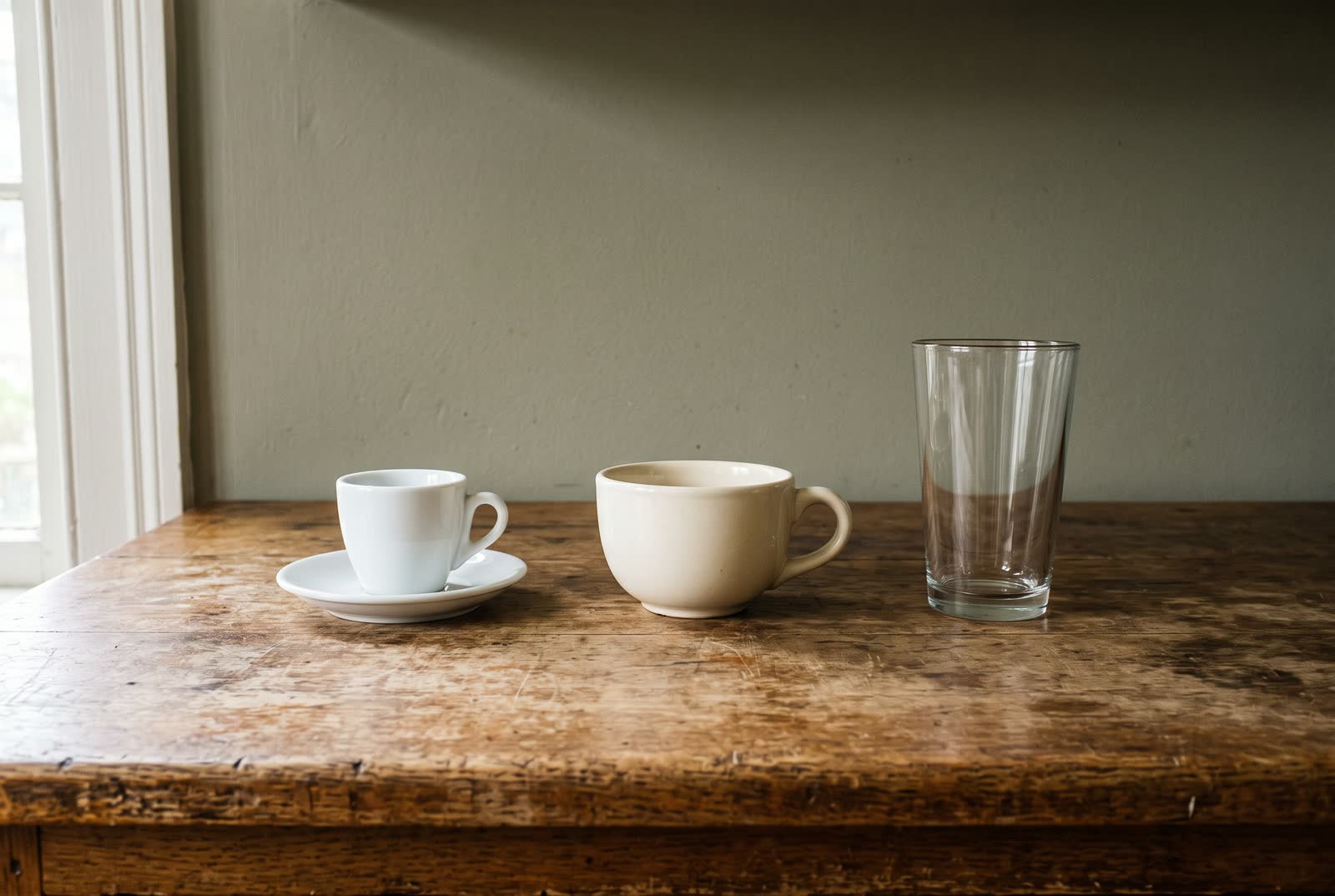
The vessel is part of the recipe
Pour a cortado into a mug and it stops being a cortado. The coffee and the milk are the same, the proportion is the same, and the drink still reads as a weak coffee, because a ratio you can see is half of what makes these drinks what they are. The vessel is not decoration on top of the recipe. It is the last term in it.
This guide is based on the manufacturer and retailer pages this site reads, and on the ratios already published here, not on hands-on testing. Where a capacity is not published, this page names what it is doing instead of printing a number.
What the ratios already settle
Three of the milk drinks are one shot and three proportions, set out in latte, cappuccino and flat white, by ratio: a cappuccino is the driest, described by convention as equal parts espresso, warm milk and foam; a latte is the wettest, one shot under a long pour of milk with a thin cap on top; a flat white sits between them with the foam folded through the milk instead of standing on it.
The fourth is the cortado: one espresso with about an equal volume of warm milk, served in a small glass.
Read those four as vessel instructions and they sort themselves. A cappuccino needs a cup small enough that a thick foam layer reaches the rim. A latte needs height, because the volume of milk is the point. A flat white needs a cup smaller than the latte's so the milk stays in proportion to one shot. A cortado needs a glass barely bigger than the drink.
The sizes this page names as conventions
The cortado's glass is described on this site as being around four or five ounces, and that range describes a class of glassware rather than a measurement of any one glass. It is a convention named here rather than a figure read anywhere, and it is the only vessel figure on this site with a drink attached to it.
For the cappuccino, the flat white and the latte, this page prints no capacity at all, and the reason is that no capacity for them has been published. The cafe convention that a cappuccino cup is small, a flat white cup is smaller than a latte cup and a latte glass or mug is the tallest of the three is a description of the order, not of the millilitres, and this page stops where the order stops.
The one capacity range worth knowing, and what each end is for
Handmade ceramic mugs are a useful reference because they are sold as a broad style rather than one measured product: multiple overlapping listings of wheel-thrown stoneware and handbuilt designs from independent sellers, and the capacities those listings state run from about 4 to 8 ounces at the espresso end up to 18 to 22 ounces at the latte and tea end. Handmade one-off pottery like this rarely has a stable listing to point back to, which is simply the nature of buying from an independent potter rather than a fixed product line.
That range is the whole buying decision laid out end to end. The 4 to 8 ounce end holds an espresso, a cortado's worth of coffee and milk, or a small cappuccino. The 18 to 22 ounce end holds a latte with room to spare, and it will drown everything else: the same shot and the same milk in a vessel built for a long drink arrives lukewarm, looks thin, and tempts the person making it to add milk until the mug looks right, which is how a cortado becomes a bad latte.
Two vessels cover almost every household: something at the small end for the short drinks, something at the tall end for the long one. The middle is the one most people buy first and use least.
Where a figural mug set lands
Figural holiday mug sets sit firmly at the tall end: sets built around three-dimensional character designs, such as a nutcracker theme or a gingerbread theme, with listings in this style including sets of four 18-ounce mugs. The category copy for this kind of set markets it for cocoa bars, morning coffee and holiday dessert pairings, dishwasher safe. Treat that as a description of the style rather than a recommendation of any one set.
Eighteen ounces is a cocoa vessel, and the listings say so themselves. As a coffee mug it is a latte cup with a long way to go before it is full, and a shot in it is a shot you will not taste. That is not an argument against owning them, it is an argument for knowing which shelf they belong on: the seasonal one, next to the cocoa, rather than the one you reach for at seven in the morning.
Buying for the drinks you actually make
Start from the drink you make most often and buy for it. Somebody who makes one flat white a day needs one cup that fits a flat white, not a six-piece set built around a latte.
Match the small vessel to the shot, not to the cupboard. If the espresso goes into something in the 4 to 8 ounce class, every short drink in the house has a home.
Prefer thick walls at the small end. A short drink in a thin small cup is cold before it is finished, which is the one failure a ratio cannot fix.
And glass earns its place on exactly one of these drinks. The cortado is the drink built to be looked at, which is why a glass is the convention for it and a mug is not.



