The gram that does not arrive
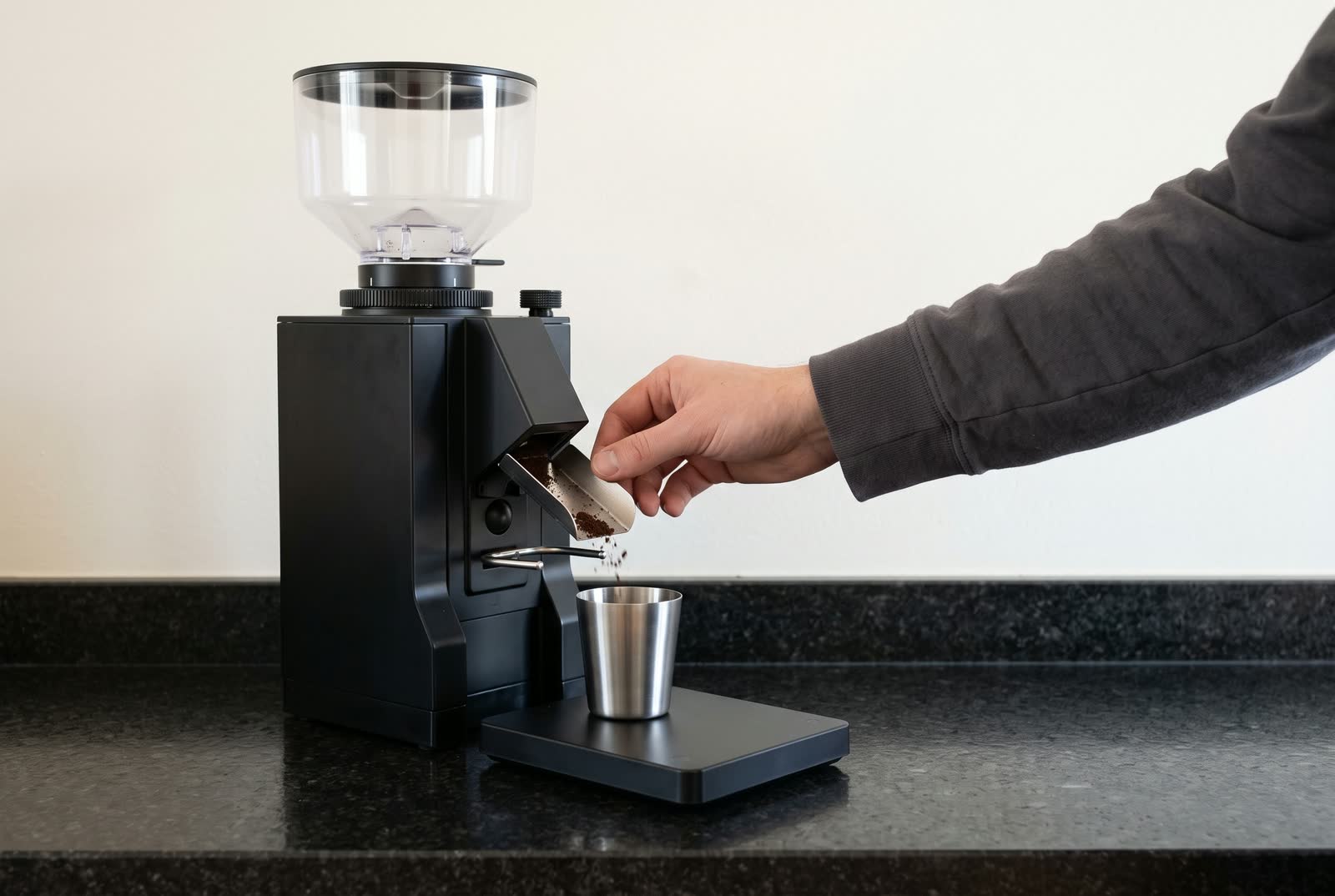
You weigh a dose of beans into the grinder, you grind, and you weigh what lands in the basket. It is less than you put in. Some of it is still inside: on the burrs, in the chute, under the exit flap. The next time you grind, some of yesterday's coffee comes out with today's, and the dose that reaches the basket is a mixture of two days' beans in a proportion nobody in the kitchen knows.
That is retention, and it is the only variable on the counter that changes the shot without changing anything you did.
Why dialing in cannot see it
The four handles are grind, dose, yield and time, and all four are things you set or measure. Retention is none of them: it sits between the dose you weighed and the dose you actually brewed, which means a retained gram reads as a grind problem, or a distribution problem, or an off day.
It also makes a change of setting slower than it looks. Move the grinder two steps coarser and the first dose out still contains coffee ground at the old setting, so the shot you taste is not the shot you asked for, and the natural response is to move the grinder further, which overshoots. The whole loop was caused by grounds that never left.
What we know about it, which is nothing
Retention is not something we track for any machine here at all. Not absent for thirty-six machines, the way the clearance figures are, but absent as a question: nobody built a column for it because no maker anywhere publishes one, so there is not even a count of silence to report. That is unusual on this site and it is the honest state of it.
So this page states no gram figure of any kind. Not for a grinder here, not as a typical range, not as a rule of thumb about conical against flat. Every number you will read elsewhere on this subject was measured by somebody, on one machine, usually without a stated protocol, and none of those measurements is something we have checked.
Four shapes, and what each one implies
What we do know is the design of each grinder, which tells you where grounds can sit even if it cannot tell you how many. The DF64 Gen 2 is built directly at the question: its maker states a 50 g bellows hopper for single dosing, and a bellows is a part whose only job is pushing retained grounds out of the chamber. The Encore is the traditional shape, 40 mm conical burrs with a bean hopper on top and a bin underneath, which is a longer path from burr to basket.
The Encore ESP sits between them: its maker ships it with a 54 mm dosing cup and a 58 mm adapter, which is grinding into the thing you will brew from rather than into a bin. And the JX-Pro S is a hand grinder with a grounds capacity its maker states as 30 to 35 grams, where the whole path is a chamber you unscrew and tip out. Those are four different amounts of place for coffee to hide and they are still not four figures, and what the burr geometries do is a separate question with its own page.
The instrument has to be named first
Before a protocol, an instrument, and this site has already had to be careful here. Of the three scales we have checked, readability is usable on two: the Acaia Lunar at 0.1 g with a selectable finer readability, and the Timemore Basic 3 at 0.1 g across a stated load range, both read on 6 September 2026. The third scale is the one this page actually lists, and its maker states no resolution at all, which is why no scale is linked on this page.
A tenth of a gram is the floor for this measurement, because the quantity being measured is likely to be small and a scale reading whole grams would report most retention as zero. Any published retention figure that does not name the scale that produced it is a figure you cannot check.
What a measurement would need
A scale reading to 0.1 g. A dose-in and dose-out protocol: weigh beans in, grind, weigh grounds out, and record the difference, with a stated purge rule saying whether the grinder was emptied first and how, because a purged grinder and a settled one give different answers and both are legitimate measurements of different things.
A stated number of doses per grind setting, because the first dose after a change carries the previous setting's grounds and the third does not. The setting recorded with every reading, since retention is not constant across a grinder's range. And every grinder run on the same beans at the same age, because an oily bean a few days off roast and a dry one months later behave differently in the same chute, and two grinders tested on two coffees have not been compared.
What to do without the number
Three habits cover most of it and none needs a figure. Single dose where the grinder allows it, which means weighing beans in rather than filling a hopper, so whatever is retained is at least the same coffee. Purge after changing the setting, meaning grind a small amount and discard it before the dose you will brew, which clears the old setting out of the path. And weigh the grounds, not the beans, because the only dose that matters is the one in the basket.
Do those and retention stops being invisible even though it stays unmeasured. It becomes a step you take rather than a number you look up, and there is no number to look up.



