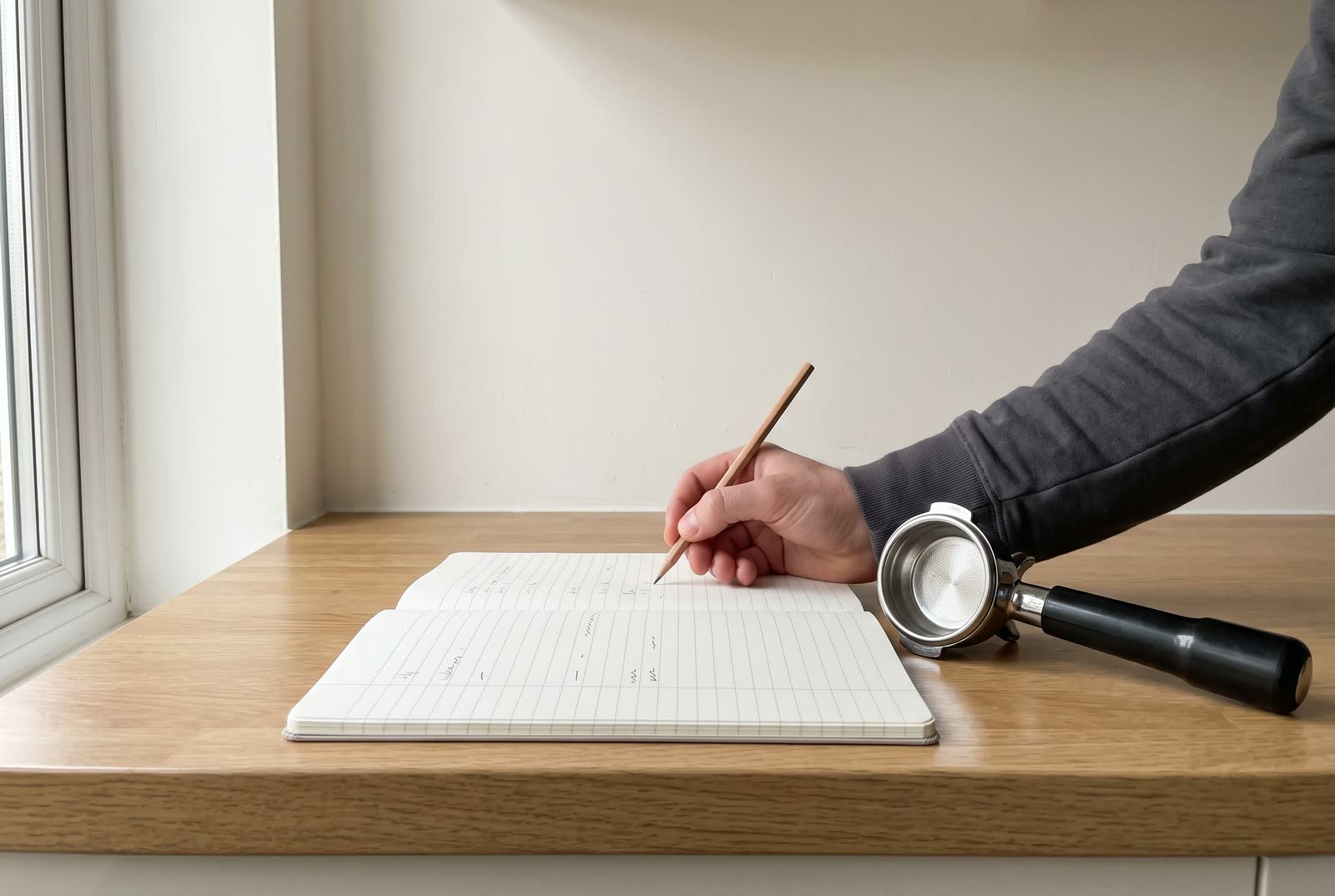
Every bag starts from nothing
You buy a new bag, the first shot runs too fast, you move the grinder, the second one chokes, and by the fourth you have a cup you are happy with and no idea what you did. Three weeks later the same bag comes round again and you start from the same place. That is not a skill problem. It is a record problem, and it is the only problem on a coffee counter that a sheet of paper solves completely.
A shot log is that sheet. It costs nothing, it takes less time to fill in than the shot takes to pull, and it is the one thing on this page with no product attached to it.
Four columns and a date
What goes on the sheet is the four things that decide the shot, and they are the four dialing in already turns on: the grind setting, the dose in, the liquid out, and how long it took. This page does not restate what each of them does, because that page does it properly. What it adds is the argument that writing them down is what turns four handles into a method.
Add two more things that are not handles. The date, because coffee changes as it ages and a shot pulled in the first week off roast is not the same shot in the third. And the bag, by roaster and name, because the next bag will behave differently and you want to know from what.
The column the grinder fills in for you
The grind setting is the column people skip, and it is the one the machine gives you for free. The Encore ESP is numbered: its maker states forty stepped settings, twenty of them on the espresso side and twenty on the filter side, so "espresso 12" is a sentence you can write down and repeat exactly. A stepped grinder is a grinder that has already done the record-keeping for you and is waiting for you to use it.
A stepless grinder has no numbers on it, and the answer there is a mark. A line of tape on the collar with a pencil stroke where the shot worked is the same column by other means. It is less precise and it is far better than nothing, which is what most people have.
Write the bad ones down too
The temptation is to record only the shots that worked. That gets you a list of results and no information, because a result on its own does not tell you which direction to move. The log earns its keep on the mornings you write down a setting, the word sour, and then two lines later the setting you moved to and the word right, because the sheet now holds the size of the correction as well as the answer.
One more column helps and it is one word: what the cup was like. Sour, bitter, thin, fine. Not a score, not a number out of anything, just the word you would use if somebody asked.
What a week of it tells you
After a week you can see three things that are invisible one morning at a time. Whether the same setting is drifting, which means the beans are ageing or the grinder is not returning to the same place. Whether your dose is wandering, which is a scale-and-technique question rather than a grinder one. And how far you actually have to move the grind to change the shot, which is the thing every beginner overestimates.
After a month you have something better: the setting you started on for the last four bags, which is where you start on the fifth. That is the whole promise of the sheet, and there is nothing clever in it.
What the sheet does not do
It does not measure anything. A log is only as good as the numbers you put in it, and a dose read off a scale that rounds to whole grams is a dose you have not really recorded. The one scale row this site carries is a demonstration of that rather than a recommendation: its maker publishes no resolution at all, which is the first thing a log needs to know about an instrument, so this page names no scale and tells you to check the back of whatever you own for the figure.
It also will not tell you what a good shot is. That is your mouth's job. The sheet's job is to make sure that when your mouth says yes, you can do it again on Thursday.



