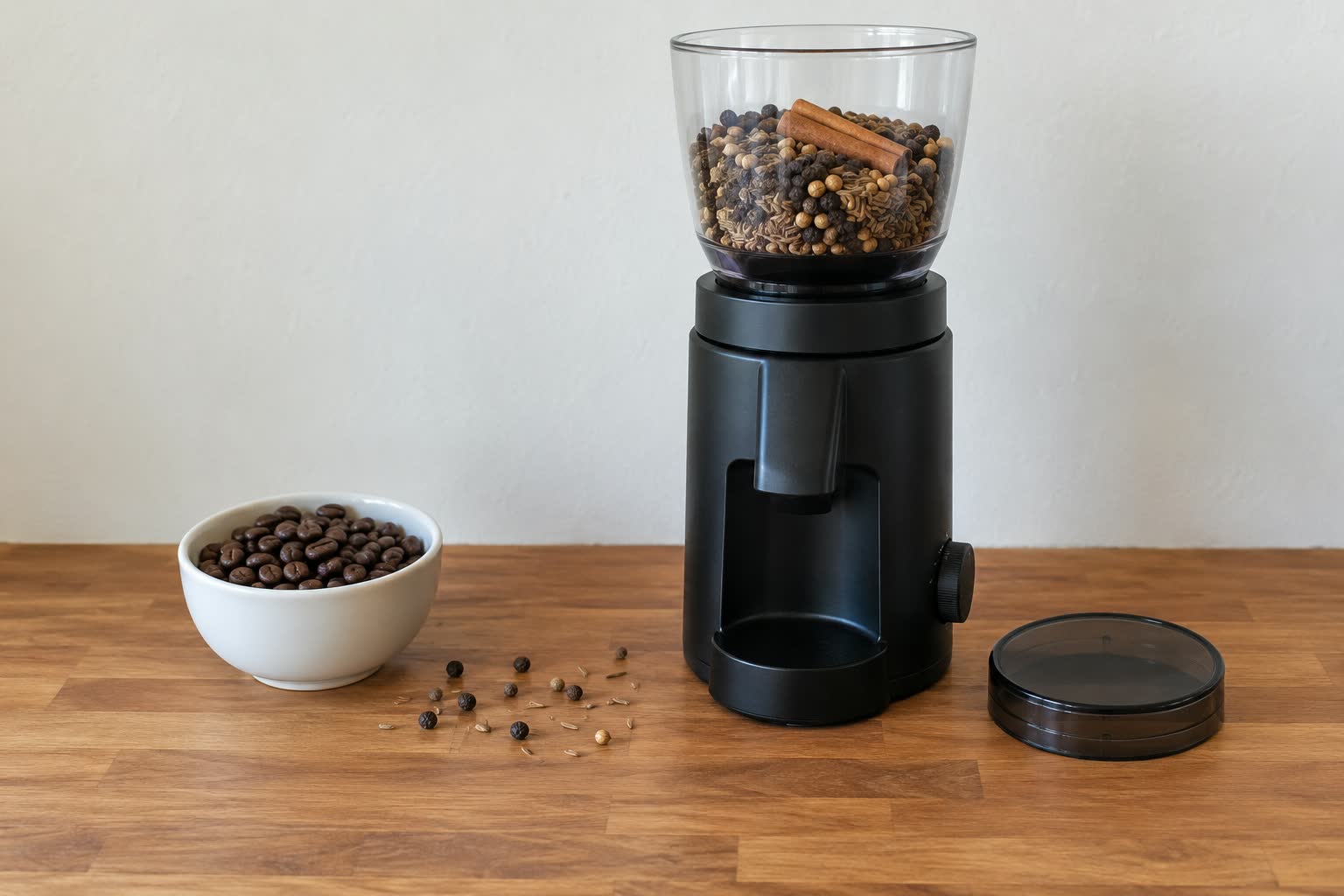
The risk is carry-over, not damage
The worry people have about putting spices through a coffee grinder is that it will break the burrs. That is the wrong worry for most of what is in a spice rack. Cinnamon bark, coriander, cumin, fennel, black pepper and allspice are softer than a roasted coffee bean and pass through a burr set without trouble.
The real risk is that the oils go in and do not come out. Cumin is the worst of them and cardamom is close behind: both leave an aromatic film on the burrs and in the chute that the next dose of coffee will carry straight into the cup. Nobody notices a ruined grinder. Everybody notices a cumin espresso.
So the whole of this piece is about the second job, the clean-down, and about which grinder in the house should volunteer for it.
What a burr set will and will not take
Take: seeds and barks. Coriander, cumin, fennel, mustard, black pepper, allspice, cinnamon sticks broken small, star anise broken small, dried chillies with the seeds shaken out.
Do not take: anything sticky, anything wet, anything that is mostly sugar. Nutmeg is dense and waxy and will glaze a burr rather than shatter on it. Vanilla pods, dried fruit, fresh ginger and anything candied are all wrong for the same reason, which is that they smear instead of fracturing. A burr grinder works by breaking things; if a thing will not break, it will coat.
Grind coarse and in small amounts. A spice grind wants the coarse end of the range, and a small batch clears the chute faster than a large one.
What the makers here state, and what they do not
The four grinders on this site publish their burr sets, which is the part that decides whether a grinder can do this at all.
- The Encore: 40 mm conical burrs, forty grind settings, a range the maker gives as roughly 250 to 1200 microns, and a 550 rpm direct-drive motor. The coarse end of that range is where a spice grind sits, and this is the one grinder here whose maker publishes the range as a number.
- The Encore ESP: 40 mm conical M2 steel burrs, forty stepped settings split twenty espresso and twenty filter. The filter half is the half to use; the espresso half is finer than any spice needs.
- The DF64 Gen 2: 64 mm stainless steel flat burrs, stepless adjustment, a 250 W motor. Flat burrs and a wider chamber, and the maker states a 50 g bellows hopper for single dosing, which matters more than the burr shape here: a single-dose grinder has no standing hopper of coffee for a spice to contaminate.
- The JX-Pro S: a hand grinder with a stated ten numbers, forty clicks per rotation and 12.5 microns per click, and a stated grounds capacity of 30 to 35 g.
What none of the four maker pages we have checked states is whether the burrs come out, or anything at all about how to clean them. That is an absence rather than a refusal on their part, and we are not going to invent an answer to it. What would close it is each maker's own manual read for a maintenance or disassembly section, which is a source we have not checked for these four grinders today. Until then: check the manual that came in your own box before you take anything apart.
The clean-down, in the order that works
Do it immediately. Oils set.
- Brush the chute out with a stiff dry brush while the grinder is still open from the spice run.
- Run a sacrificial dose of coffee through, coarse, and throw it away. Two doses if the spice was cumin or cardamom.
- Brush again, including the exit where grounds collect against the lip.
- Run a third dose of coffee and smell it before you brew it. If it smells of spice, go back to step two.
Nothing wet goes anywhere near a burr set. Water and a steel burr make rust, and rust is the one thing on this page that does break a grinder.
The sacrificial dose, and why it is not rice
The advice you will find elsewhere is to run uncooked rice through to clean a grinder. Do not. Rice is harder than coffee and harder than most of what is in a spice rack, and a burr set sized for a coffee bean is being asked to fracture something it was not designed for. Some makers say so explicitly on their own support pages; we have not read those statements, so take this as the reasoning rather than as a citation.
Stale coffee does the same job. The point of the sacrificial dose is that it is abrasive enough to scour and oily enough to pick up what the brush left, and coffee is both. Grinder-cleaning tablets exist and do the same thing again, with less mess.
The grinder that should volunteer
If there is more than one grinder in the house, the hand grinder does the spice work. On the JX-Pro S the return trip to the coffee setting is counted rather than guessed, because the maker states the adjustment in numbers and clicks, so moving to coarse for a spice run and back to the espresso number afterwards is a written-down move. Its stated 30 to 35 g capacity also happens to be about the right batch for a spice jar.
If there is only one grinder and it is the one that makes the morning coffee, the honest answer is that this is a job for a cheap blade grinder kept in a drawer for the purpose. A burr set that does two jobs does the second one at the cost of the first, and the first is the reason the grinder was bought.



