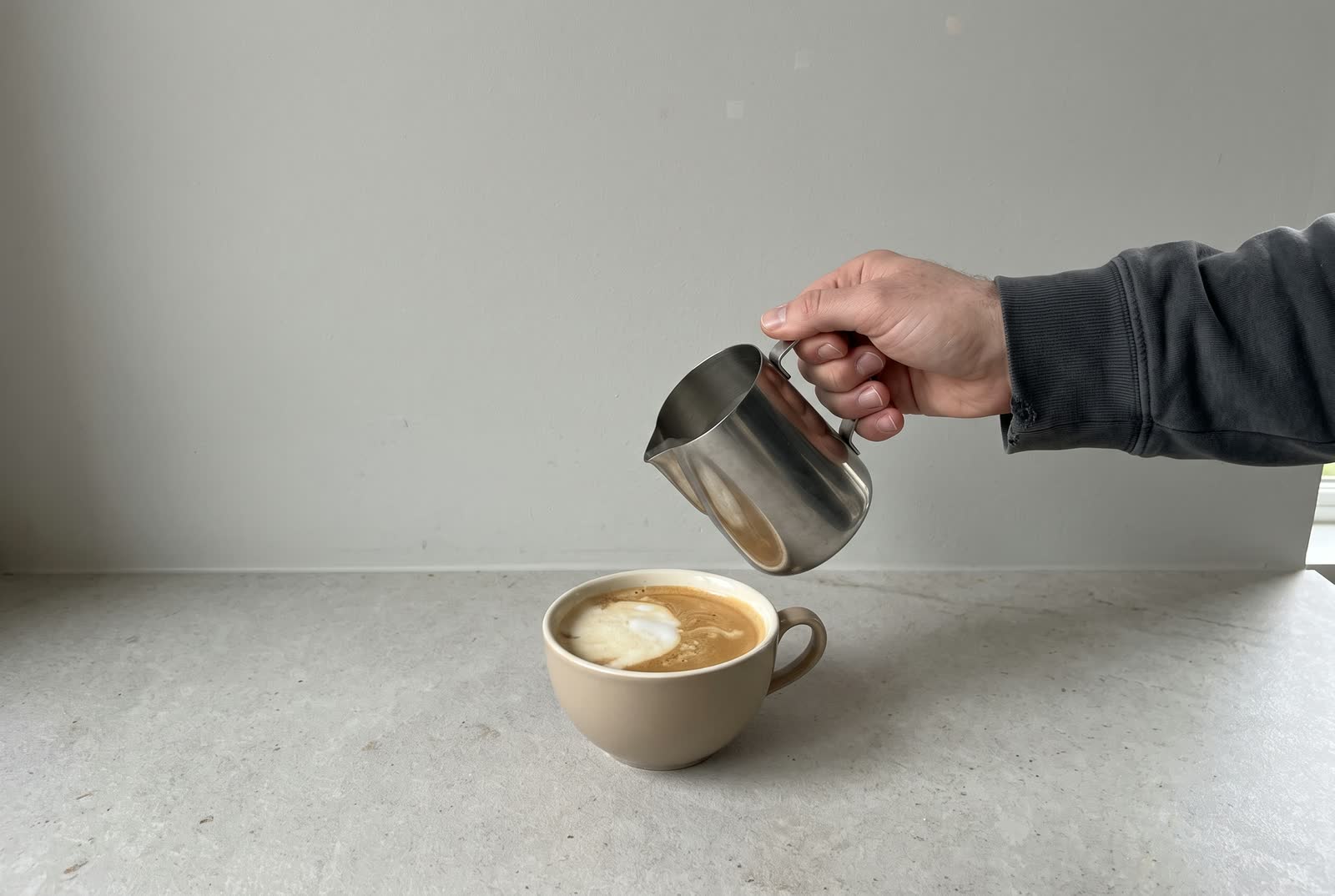
Five faults, three from the milk and two from the pour. The first three shapes covers how the pour itself makes a heart, a rosetta and a tulip; this page assumes that motion and only sorts which of the five faults below belongs to the milk and which belongs to the hand.
Art that comes out small: not enough microfoam to draw with
A small pattern, present but faint and cramped near the far edge of the cup, usually means the milk never built enough textured volume to draw a full shape with by the time the cup was nearly full. This is a milk fault, and the fix sits in steamed milk faults, one at a time, under the fault this site calls flat; this page only names the connection. It is worth separating from a genuinely small cup: a shape can be correctly sized for a small serving and still read as small on this list only because there was never enough milk in the jug to begin with, which is a dose decision rather than a steaming one.
Art that never forms at all: milk with no texture underneath
If the surface never separates into a lighter line as it's poured, the milk carried no texture to begin with, and the crema and the milk look the same because nothing about the milk is different from plain heated liquid. This is the same milk fault named above, and the same page carries its fix. It reads differently from a small pattern: a small shape is still a shape, just short of one; milk with no texture never produces a shape at all, no matter how the pour is handled from that point on.
Art that will not spread: foam too stiff to flow
A shape that holds its edge and refuses to widen across the cup, even with a slow, steady pour, points at foam stiffer than the pour can move. This is a milk fault too: foam this dense was over-textured before it ever reached the cup, and steamed milk faults, one at a time is where that half of the problem is named. A pour that is otherwise correct cannot fix milk this stiff; the wiggle and the tilt that make a rosetta happen only when the foam is loose enough to move with them.
A blob instead of a shape: the pour landed all at once
A blob is a pour fault: the jug tipped and stayed at one height and one speed, so the milk fell straight down into the same spot instead of being walked across the surface. The one change is in the hand, not the jug: start further back in the cup and let the stream travel as it pours, rather than holding the spout still over one point. A blob can happen with milk that would have made a clean shape from a different angle, which is the clearest sign that this particular fault sits with the pour rather than with anything steamed beforehand.
Bubbly art: the pour agitated milk that was already fine
Milk that looked smooth in the jug and comes out full of bubbles on the way into the cup was fine until the pour itself broke it. Pouring from too high, or restarting a stream that had already stopped, whips air back into milk that had finished texturing. The one change: keep the spout close to the surface for the whole pour and commit to one continuous stream rather than several short ones. This is easy to confuse with lumpy milk, covered on the steaming page, but the two are separable: lumps are already there in the jug before any pouring starts, while bubbly art forms during a pour that started from smooth milk.
What the machines and the gear change
Two machines in this cluster split the milk half of this list differently. The Bambino ships with a manual wand a person runs, per its maker, so all three milk faults above are decisions made by hand. The Bambino Plus states an automatic steam wand with three milk temperatures and three texture levels, per its maker, which takes the small and never-forms faults mostly out of a person's hands and leaves the will-not-spread fault as the one still worth checking, since that one is about how stiff the automatic wand leaves the foam rather than about anyone's technique.
A pitcher with etched volume lines, per its maker, is what tells a pourer how much milk is actually left partway through, which matters most for the blob and small faults, since both are about how much is poured and how it's paced. What the art lands in plays a part too: ceramic mugs in this category commonly run from about 4 to 8 ounces for espresso up to 18 to 22 ounces for lattes, per the marketplace listings this site reads, and a small cup narrows every one of the five faults above before the pour even starts.



