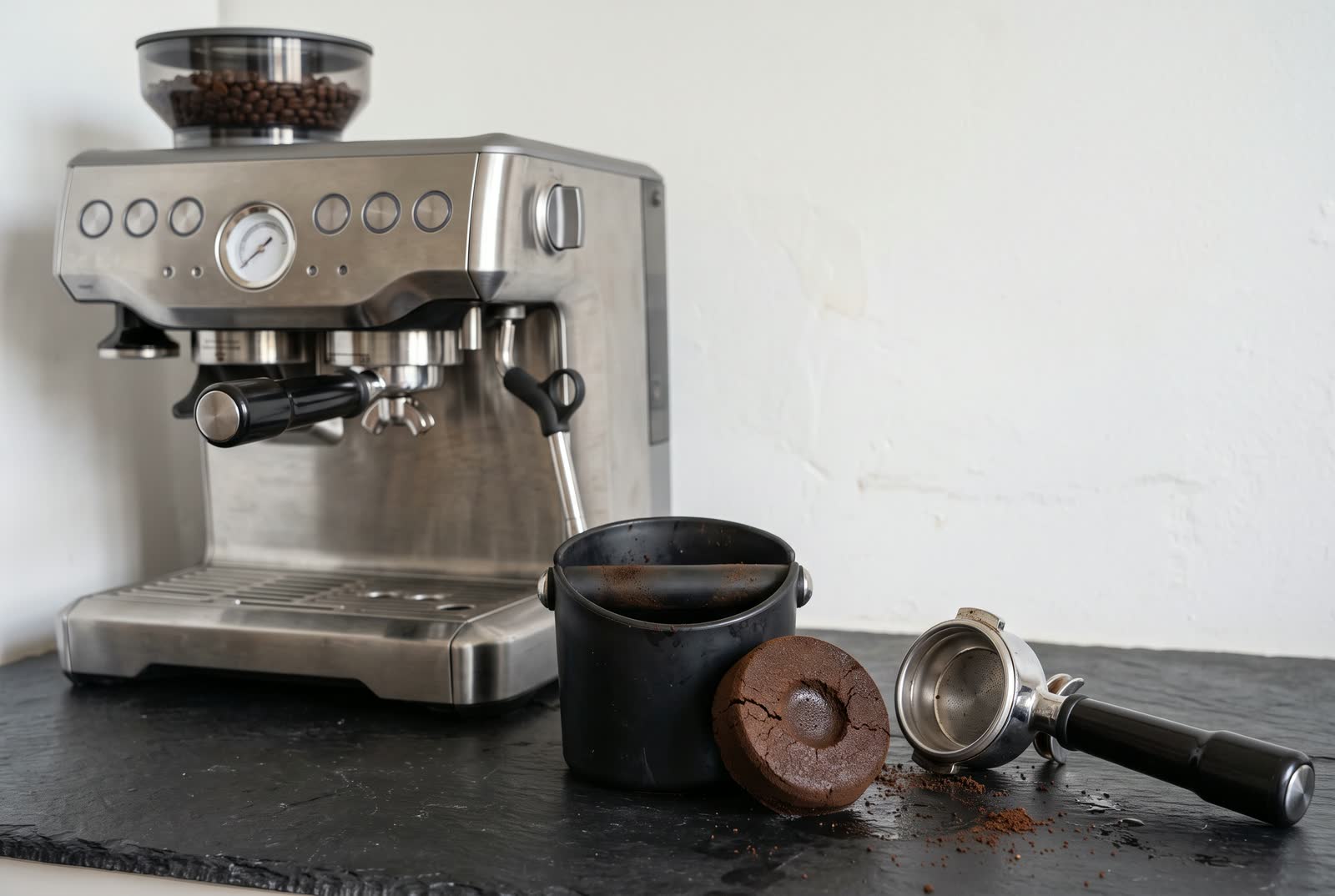
The puck is the only free instrument in the kitchen
Everything else that tells you about a shot costs money. A scale costs money, a pressure gauge costs money, a thermometer costs money. The puck costs nothing, arrives after every shot, and reports on the one that just happened.
It will not tell you what to do next. It will tell you what went on inside the basket, which narrows what to do next from four things to one or two. Knock it into your hand rather than straight into the bin, look at the top of it, and then push a thumb into it.
Both machines described below take a 54 mm portafilter on their makers' own pages, so the puck in your hand is a 54 mm puck and any basket bought to replace one has to be that size. Check yours before you buy anything.
A dry puck that holds its shape
Tip it out and it comes away in one piece, the top face flat and matte, and it holds together when you handle it. Push a thumb in and it resists a little before it gives.
This is the one you want. It says the water went through the whole bed at an even rate, the dose filled the basket properly, and the machine cleared the group at the end.
Nothing to change. Note the grind setting.
A crater in the middle
The face of the puck is dished, with a shallow bowl worn into the centre and a raised rim around the edge. Sometimes there is a print of the shower screen in the middle of the bowl.
This is an under-dosed basket. The bed is sitting too low, so there is headroom above it; the water fills that space, presses down on the centre and hollows it. The shot that came with it will have run fast and tasted thin.
The fix is more coffee, not a finer grind. How much more is a question of the basket, and one maker here answers it directly: the Bambino Plus is stated by its maker as a 54 mm stainless steel portafilter dosed for 18 g, which is the number that basket was built around. The same maker states a tamper, a Razor dosing tool and a milk jug in the box, and the Razor is that maker's own answer to this exact fault: it trims the bed to a set height so the headroom is the same every time.
If your basket has no stated dose, work up in one-gram steps until the crater goes. The gram is a convenient step rather than a measured one.
A soupy puck that will not knock out
The puck is wet through, sits in a slurry, and either falls apart on the way to the knock box or stays stuck in the basket and has to be scraped.
Two different causes, and the machine tells you which. On a machine with a three-way valve, the pressure behind the puck is released at the end of the shot and the puck should come out fairly dry; on a machine without one, a wet puck is normal and is not a fault at all. The Gaggia Classic Pro is described as carrying a three-way solenoid valve, though that description reaches us through retailer positioning rather than the maker's own page, so treat it as a strong indication rather than a stated specification and check the manual for your own machine.
Where the machine does release pressure and the puck is still soup, it is usually over-dosed and under-extracted together: too much coffee for the basket, so the water never gets through properly and sits where it stopped.
A hole straight through, and the ring around it
Look for a small round hole punched through the puck, or a channel running from the face to the bottom, often with the coffee around it noticeably paler than the rest.
That is channelling. The water found one easy path and took it, so part of the bed was over-extracted and most of it was hardly touched. The shot will have run in a thin stream on one side and tasted both sour and bitter at once, which sounds impossible and is exactly what channelling tastes like.
Channelling is a distribution fault before it is a grind fault. Level the bed before tamping, tamp flat rather than hard, and stop knocking the portafilter on the counter to settle it, which cracks the bed more often than it levels it.
What the puck cannot tell you
Temperature. It leaves no mark on a puck, and no reading of a puck will find it.
It also cannot tell you the difference between a grind that is slightly too coarse and a dose that is slightly too light, because both leave a bed that gave up too easily. When the puck is ambiguous, the timing of the shot separates them and the puck does not.
And it says nothing about taste. A perfect puck can sit under a shot that was pulled from stale beans. The puck reports on the passage of water through a bed, which is one of several things that decide what is in the cup.
Where they go after
The Knock Box 20 holds up to twenty espresso pucks on the maker's own page. Twenty is the maker's figure; the week is our arithmetic on it, at the two or three shots a day it assumes. The same page gives it as 6.4 by 6.3 by 6.3 inches, which is a cube about the size of a large mug, so it is a counter object rather than a cupboard one and it needs a place next to the machine rather than under the sink.
Emptied weekly, the pucks are the input for four uses for the used grounds, which is the other half of this.



