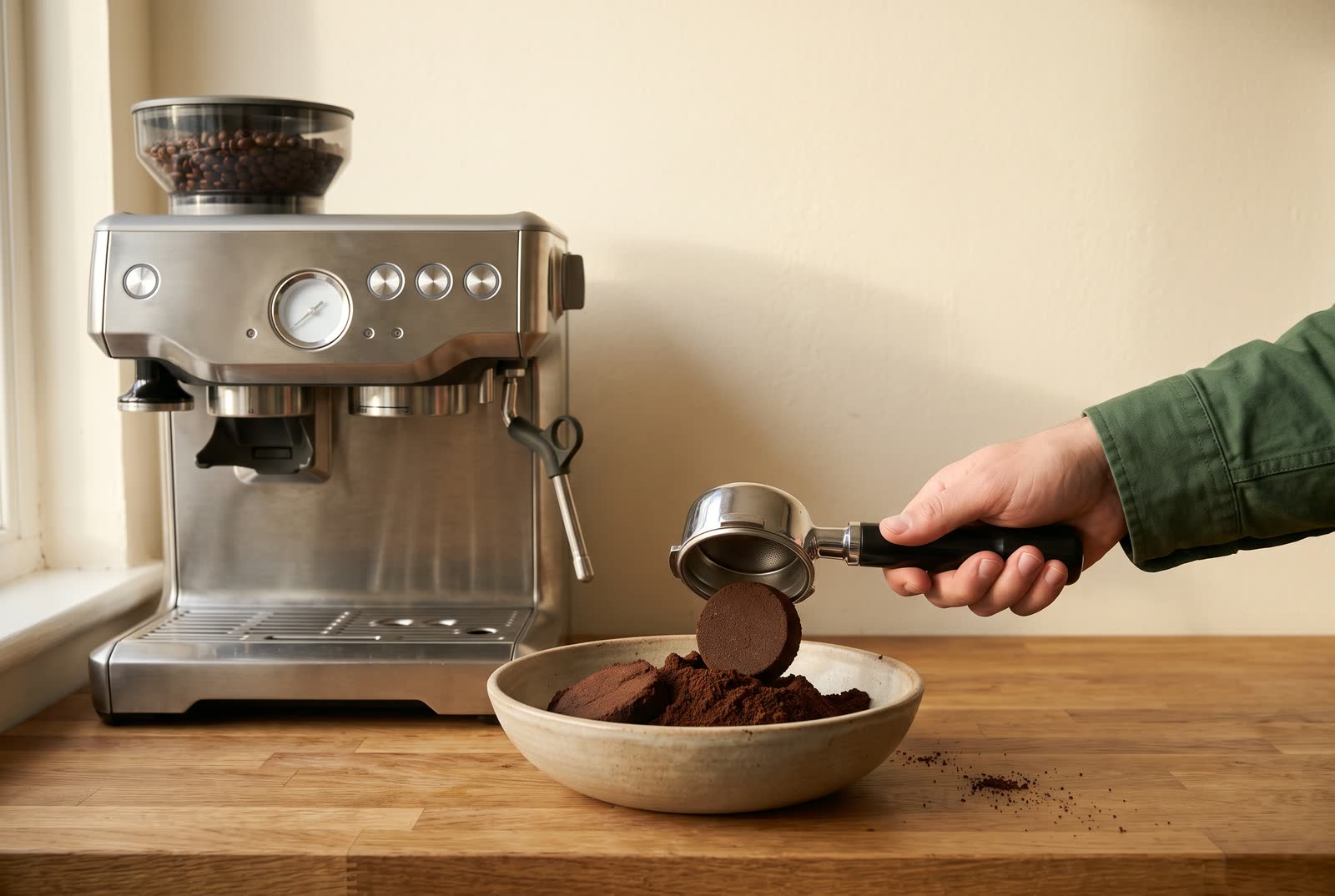
A puck a day is a small pile by the weekend
An espresso machine turns out a compacted disc of spent grounds every time it pulls a shot, and a household making a few a day fills a bin with them faster than it expects. A knock box exists because of that volume: the manufacturer states a capacity of up to 20 espresso pucks, which at two or three shots a day is most of a week before it wants emptying. The twenty is the manufacturer's figure; the week is our arithmetic on it, at a rate nobody measured. That collection point is also what makes any second use practical, because it keeps a week of grounds in one place instead of spread through a bin.
This piece covers four ways to reuse them, one to a section, and ends with the garden claim and what it would take to test it.
Use one: scouring a pan, while the grounds are still damp
Spent grounds are mildly abrasive and hold onto oil, which makes them a reasonable scrub for a cast-iron pan or a baking tray with something burnt onto it. Work a small handful around the surface with a cloth or the rough side of a sponge, then rinse. Damp grounds straight from the basket work better than dried ones here, because dried grounds scatter and do not hold to the cloth.
The obvious warning applies: do not do this in a sink without a trap you are willing to clean, and never put a large volume of grounds down a drain.
Use two: taking a smell out of a fridge
A shallow open container of dried grounds in a fridge or a cupboard works the way an open box of bicarbonate does, holding onto the smells around it. Dry them first, spread thin on a tray until they are dry through, or the container grows mould and becomes a worse smell than the one it was there to fix. Replace them every couple of weeks, which is a working interval rather than a tested one, because there is no sign that tells you when they have stopped.
This is the use with the clearest household benefit and the least ceremony around it.
Use three: a hand scrub after cooking
Grounds mixed with a little liquid soap take garlic, onion and fish off hands better than soap alone, for the same abrasive reason they work on a pan. A small amount is enough, worked between the fingers and rinsed off. People with sensitive skin should try it once on a small area first, because the abrasion is real and not everyone likes it.
This one costs nothing and uses a spoonful, which is the appropriate scale for it. It is not a way to get through a week of pucks.
Use four: something to bulk out a compost heap
A compost heap wants a mixture of wet green material and dry brown material, and spent grounds go in as a green even though they look brown. That means they need balancing with dry material rather than adding on their own, and that a heap already heavy with kitchen waste does not want a large volume of them. Add them in layers with torn cardboard or dry leaves, and turn the heap afterwards.
This is a use for a heap you already keep. Starting a compost heap in order to use up coffee grounds is not a saving.
The claim we could not source: grounds on the garden
The most repeated use of spent coffee grounds is spreading them straight onto soil around plants, usually with a claim attached about acidity, or nitrogen, or slugs. We have not found a published source for any of those three, and we are not going to repeat them on the strength of how often they appear. The three claims are also not one question: acidity, nutrient content and pest deterrence would each need their own evidence, and a source for one would settle nothing about the other two.
What would close it is a controlled measurement, reported by a named institution, of soil treated with spent grounds against untreated soil on the same site. That is the standard the rest of this site's figures are held to, and this claim has not met it here. Until it does, the honest version is that a compost heap is a known route for grounds and bare soil is an open question.
Can used coffee grounds go on a garden, a lawn or around tomato plants
That is the claim above, asked four ways, and the answer is the same for all four: we have not found a published source for it and will not repeat it. Acidity around a plant, nitrogen in the soil and slugs kept off a bed are three separate questions with three separate answers, and a garden bed, a lawn and a tomato plant are three different places with three different soils underneath them. What the compost section says still stands, and it stands without any of those three claims being true: a heap is a route for grounds because a heap is asking them to break down, not asking them to do a job. Bare soil is where the question sits open, and the measurement that would close it is named above.
Can used coffee grounds go down the sink
They should not, and this is the one instruction on the page worth following exactly. Grounds do not dissolve, they settle, and they settle into the grease already lining a waste pipe, so what collects is not a layer of coffee but a plug of coffee and fat that water runs over rather than through. A spoonful rinsed off a cloth is not what does this; a knock box emptied into the sink is. Put them in the bin, in the compost, or into one of the uses above, and keep the drain out of it.
What to keep, and what to just bin
Not every puck needs a job. Four uses cover a spoonful, a handful, a shallow tray and a compost layer, and a household making espresso daily produces more than that. Sending the surplus to the bin is a fine answer, and the knock box that holds up to 20 pucks makes the surplus easy to move in one trip rather than a wet spoonful at a time.
The one thing worth not doing is the drain.



