The short answer
If you drink from tall mugs, buy the Bambino Plus. Its manual lists extra-tall cup clearance for tall mugs as a feature of the machine, and it is the only one of the four machines here whose maker names tall mugs at all. For milk, the 20 oz Rattleware jug is stated by its maker at 20 ounces with etched graduations inside, so the fill line is printed on the jug.
Then put a ruler on your own drip tray with the portafilter fitted and read the gap. It takes a minute, and the last section of this page walks through it.
The cup that does not go under
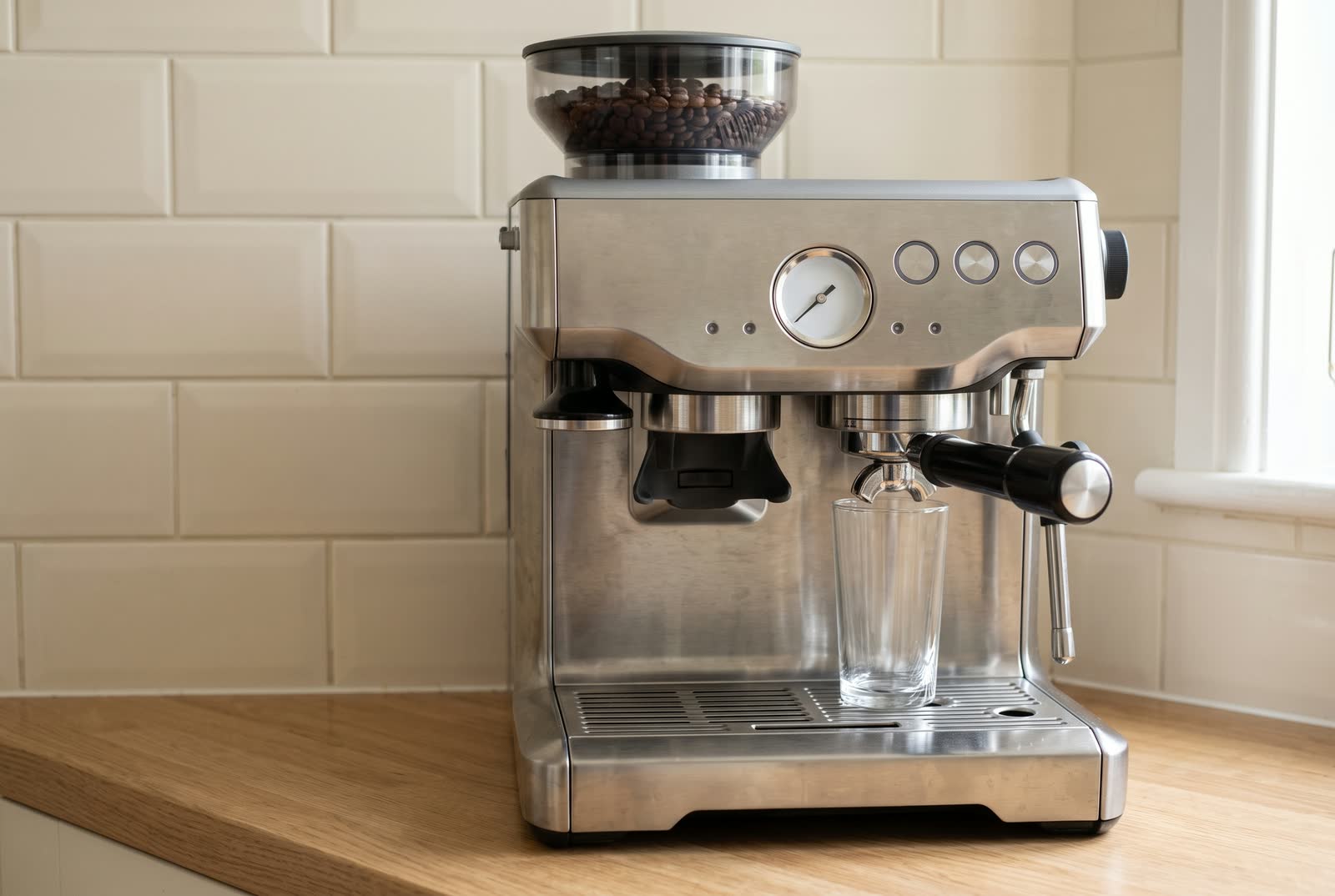
The travel mug arrives, you put it on the drip tray, and it does not go under the spouts. Or the jug goes under the steam wand and the wand will not reach the middle of it, so you texture milk at an angle with one hand holding the machine steady. Both of those are clearance problems and both of them are decided by a figure the maker did not print.
There are three of them, and they behave identically across every machine here.
Three fields, the same shape
Across the machines this site covers, the cup clearance from drip tray to group is absent at source on thirty-three and not checked on three. The steam arm's swept reach beyond the body is absent on thirty-three. The room needed in front of the machine to work the portafilter is absent on thirty-three. Three different questions, three different fields, and the same answer nearly everywhere: nobody publishes it.
That is not this site failing to look. Each of those absences is recorded against a named document that was downloaded from the maker and text-searched in full, which is a different state from a blank cell.
The two makers who nearly say it
Two of the four machines here come close enough to be worth quoting, and the other two do not. The Bambino Plus manual lists extra-tall cup clearance for tall mugs as a feature of the machine, and prints no figure for it anywhere in seventy-two pages. It is a selling point about a measurement, without the measurement. The Bambino and the Classic Pro print nothing on the subject at all.
The Stilosa, and a figure with no unit on it
The fourth machine, the Stilosa, is the near miss. Its product page carries a maximum cup height of 4.29, with no unit label that could be read, and the sweep of 6 September 2026 flagged it and did not record it as a figure. Four point two nine inches is a plausible reading and so is something else, and a number whose unit is a guess is not a number. It is left out for the same reason the same page's unlabelled dimensions are.
The vessel side, which does have figures
So measure from the other end. The vessel is a published object, and its figures exist. The 20 oz milk jug here is stated by its maker at twenty ounces with etched graduations inside it, which is a capacity you can rely on. On the drinking side, the handmade mug category commonly lists capacities from about 4 to 8 ounces at the espresso end up to about 18 to 22 ounces for a latte, which tells you the range of things a reader is actually trying to fit under a group head.
That range is the useful finding: a machine that takes an 8 ounce cup and a machine that takes a 22 ounce travel mug are being asked two very different questions, and the drink decides which one you are asking. The ratios that decide the drink and the cortado's own glass are where the vessel sizes come from.
And a jug measurement that reads as a placeholder
The jug has a published dimension too, and it is a good demonstration of why this page trusts the capacity and not the size. Its maker's page prints the jug as 5 by 5 by 5 inches with no axis labels and a weight of 25 ounces. The physically different centre-post version of the same jug carries identical figures on the same site, which is the signature of a default rather than a measurement.
So the capacity is used here and the dimensions are not. A figure that is the same on two different objects is a field somebody filled in, and repeating it would make this page the third place it is wrong.
What a measurement would need
For the cup clearance: the machines in hand, a protocol that measures to the lowest point of the group with a loaded basket in the portafilter rather than with the head empty, because the basket and the handle change the answer and a reader will always have both fitted. A stated instrument and tolerance, and a repeat count.
For the wand: a swept-arc measurement with the arm at both of its stops, taken from the body rather than from the drip tray, because the arm's useful reach is the distance it can put its tip away from the machine. For the working reach in front: a definition of what the hand has to do, which is lock and unlock a portafilter, and the room that movement needs with the tray in place.
All three of them measured the same way on every machine or not published at all, which is the rule the whole family of these pages is written under.
Measure the vessel and the gap yourself
This is the one clearance question you can settle in your own kitchen in a minute, and that is the page's actual advice. Stand a ruler on the drip tray with the portafilter fitted, read the gap, and write it on the sheet where you keep your shot notes. Then measure the cup you use most and the travel mug you want to use, and you have the whole answer permanently.
Do the same for the jug: fill it to the graduation you use, put it under the wand, and see whether the tip reaches the middle. If it does not, the answer is usually a shorter jug rather than a different machine. Steaming milk by the sound of the jug is the page for what to do once it reaches.



