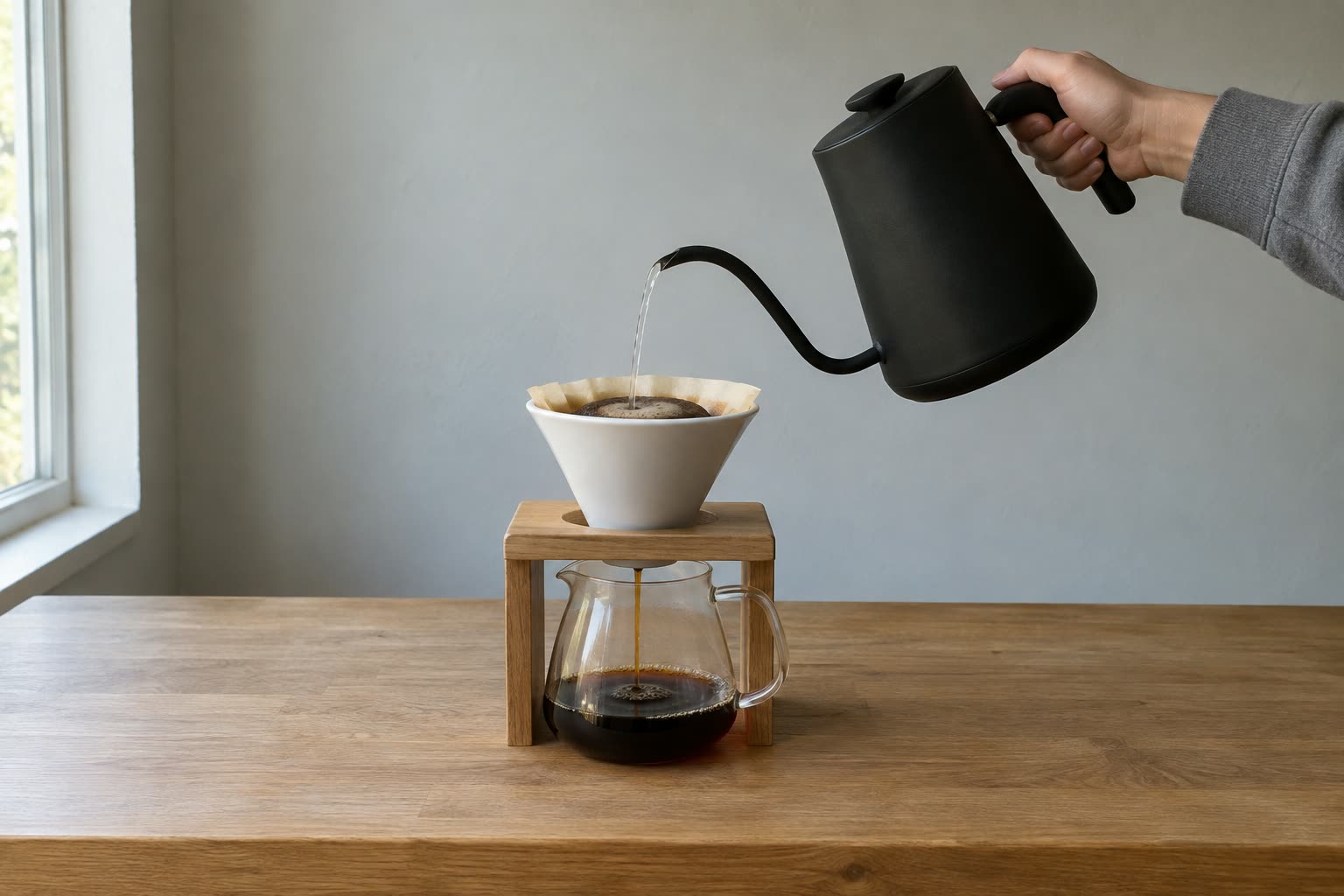
A gooseneck kettle is two purchases in one object
The spout controls where the water lands and how fast. The dial controls what temperature it lands at. They are sold together and they solve different problems, and a reader who knows which problem they have can stop paying for the other one.
The question this piece answers is not which kettle. It is which of the two features the brewer already on your counter actually needs.
The spout does one thing, and it is a real thing
A gooseneck is a narrow curved spout that leaves the kettle near the base, so the water arrives as a thin column you can aim. A kitchen kettle pours in a wide sheet that arrives wherever gravity takes it.
On a pour-over cone that difference decides the brew. The cone's job is to hold a bed of grounds that the water passes through evenly; a wide pour digs a channel in one side of the bed, and the water runs down the channel instead of through the coffee. A thin, aimed stream wets the whole bed.
The maker of that kit states what is in the box: the ceramic dripper, a glass server and a hundred paper filters, as product number XVDD-3012W. The dripper is porcelain, the server is heatproof borosilicate glass holding 600 ml, and the whole set stands 210 mm tall in a footprint of 140 by 121 mm.
If you are brewing in anything other than a cone, the spout matters much less. A French press, a moka pot and an espresso machine all take their water in a container rather than onto a bed, and a wide pour is fine.
The dial answers a different question: doing it the same way twice
A variable-temperature kettle holds the water at a set point instead of taking it to the boil and letting it fall. What that buys is not a better cup on any one morning. It is the same cup on two mornings, which is the only way to tell whether a change you made to the grind did anything.
The kettle covered here, the Stagg EKG Pro, states variable temperature control with presets, a one-hour keep-warm and an automatic shutoff. Its page also states a capacity of 30 oz, or 0.9 litres, a body of 304 18/8 stainless steel, and a weight of 1,400 g including its base.
And here is what its page does not state: a temperature. No recommended brew figure, no range, no number attached to any preset. So this piece states none either. The degree figures that circulate for pour-over are conventions rather than published instructions, and the source for the one your kettle was built around is the kettle's own manual.
The electrical rating is worth a word for the same reason. The page prints it as a range, 1000 to 1200 W at 110-120 V, and this site carries it as a range rather than picking one end of it. A kettle that prints a range is telling you it draws different power in different states, and the single figure that gets quoted in listings is somebody choosing the larger half.
Which brewer needs which
A pour-over cone needs the spout. This is the one case where the narrow stream is doing work no technique replaces, and it is the case the whole category was built for.
A pour-over cone with a scale beside it also benefits from the dial, because once you are controlling the dose and the time, the temperature is the last variable left moving on its own.
A French press needs neither. Water off the boil, poured in, lid on. A gooseneck makes filling it slower.
An espresso machine needs neither, and this is the mistake worth naming: the machine heats its own water from its own tank, so a kettle beside it is for a second brewing method, never for the espresso.
A drip machine needs neither, for the same reason.
What a kettle on a small station actually costs you
Counter, mostly. The kettle covered here measures 282 by 172 by 196 mm, and its base has to sit where a plug reaches. That is a real footprint on a station that is already holding a brewer and a grinder, and the kettle is the item most often bought before the space for it was found.
The one-hour keep-warm is the feature that decides whether it lives on the counter or in a cupboard. A kettle that holds temperature for an hour earns its place if your mornings are in stages; a kettle that is boiled once and put away does not need to be on the counter at all, and a stovetop gooseneck with no dial and no base is the smaller answer to the same question.
The honest summary
Buy the spout if you brew in a cone. Buy the dial if you are trying to repeat a result rather than reach one.
And read your own kettle's manual for the temperature, because the maker's page for the kettle above states presets and states no degrees, and a number invented to fill that gap would be worth less than the gap.



