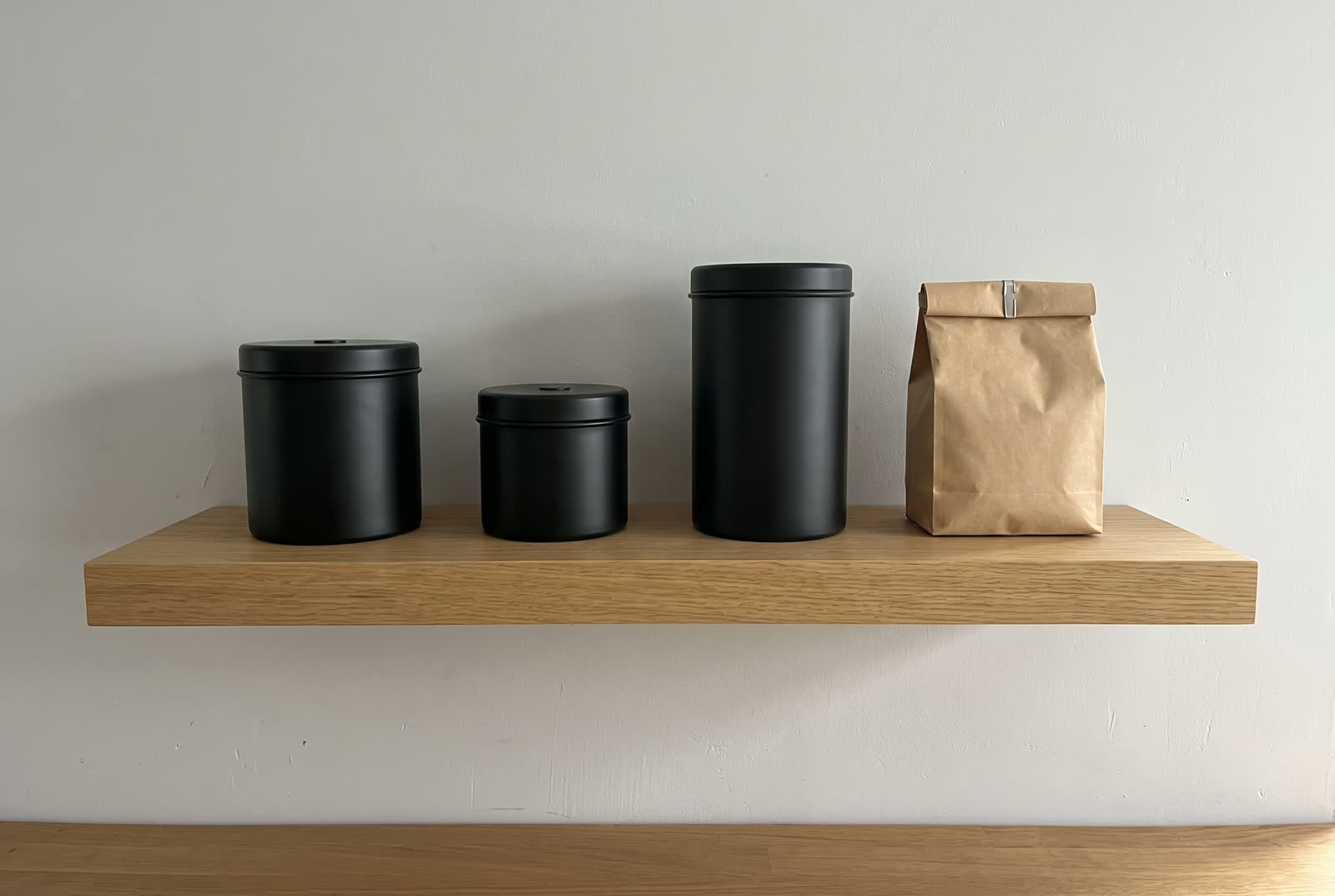
The bag the beans came in
Coffee arrives in a bag with a one-way valve in it, and that bag is a decent container for about as long as it stays rolled shut. What goes wrong is not the bag: it is that the bag gets opened twice a day, gets folded rather than sealed, and ends up holding as much kitchen air as coffee. The question this page answers is what a jar does about that, and what it cannot do at all.
What a container can do, and what it cannot
Four things degrade roasted coffee: oxygen, moisture, light and heat. A sealed opaque container standing away from the hob deals with all four of them as well as any domestic object can, and that is the whole of what it is for. What it cannot do is reverse anything. Coffee that was already flat when it went in the jar comes out flat, and no lid has ever put carbon dioxide back into a bean.
That is the boundary, and most pages about bean storage blur it. A container holds a condition; only a roast date tells you what condition you started with.
The set covered here
The POP canister set is the one storage product we have maker figures for. Its page, read on 6 September 2026, prints a three-piece graduated set with push-button airtight lids: one container of 5.2 quarts, which the same page gives as 4.9 litres, one of 3.3 quarts or 3.1 litres, and one of 1.5 quarts or 1.4 litres. The same maker sells a steel-lidded glass version of the same three-piece graduated set, which is worth knowing because glass is transparent and light is one of the four things on the list above.
The page is also interesting for what it does not print. Its specifications block carries a weight field with no number in it, a published empty field rather than a missing page, and it prints no dimension, no material, no warranty term and no manual anywhere across its four panels. So this page states no weight and no dimension for it.
The number this page will not give you
Somewhere in every article about storing coffee there is an interval: beans are good for so many days after roasting, or peak at such a day, or should be finished within some window. We have not found a published source for any such interval. Not a roaster's statement, not a standards body, not a measured study, nothing dated and nothing citable.
So no interval appears on this page, in days or in weeks. The number is not ours to give, and an article that prints one without a source has borrowed somebody else's confidence.
What would settle it
The shape of the thing that would close this is not complicated, which is part of why the absence is annoying. One roast date, recorded. One variable changed between arms and everything else held: the same beans, the same grinder setting, the same dose, the same water, the same machine, with one arm in a sealed opaque container and one in a folded bag. A measured cup at fixed intervals, tasted blind, repeated enough times to mean anything.
That is a research programme rather than a paragraph, and until somebody here runs it or finds a published one to cite, this page stops at what a container does. A single citable source, carrying its own date, would be enough to change that.
Which one to buy, and when the bag is fine
If you buy one bag at a time and finish it before the next one arrives, the bag with its valve rolled and clipped is genuinely fine, and a jar is a tidiness purchase rather than a coffee one. If you buy more than you drink, or you buy two kinds at once, a sealed opaque container standing out of the light is the thing that keeps the last of it like the first. The three sizes above are one answer to that; any airtight opaque jar is another, and we have no figure that says one of them beats the other.
What matters more than either is the date on the bag. Buy from somebody who prints one. The page on where a small station puts its things is where the jar goes once you have it.
No price on this page is checked at a seller. The set sits in the band this site draws, which is a range of its own framing rather than a figure read at a shop.



