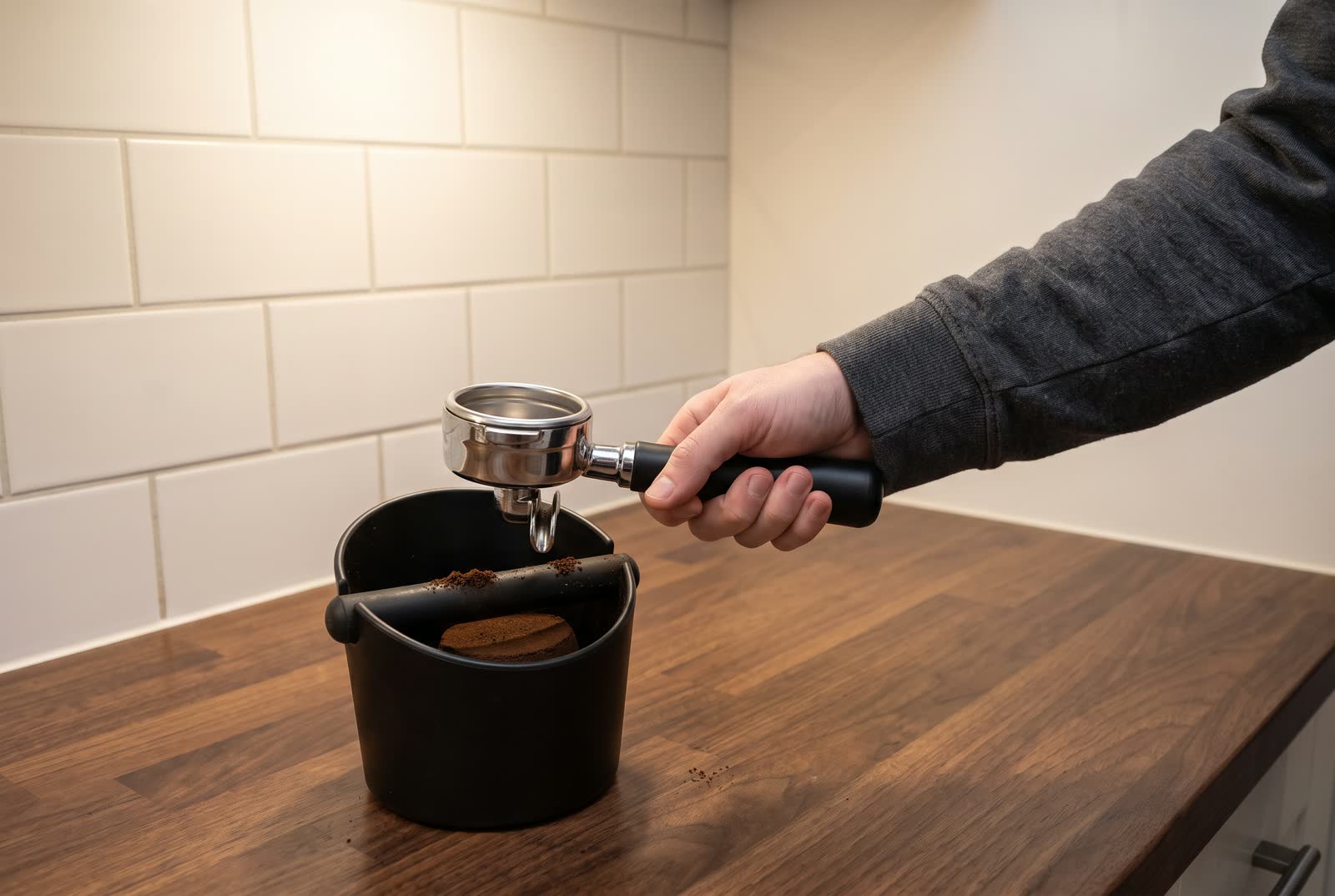
Three places a spent puck can go
Pull a shot and you are left with a compressed disc of wet grounds in the portafilter, and it has to come out before the next one. There are three places it can go: a box made for it, the kitchen bin, or the sink. Most people start at the sink because it is the nearest, move to the bin when the sink complains, and buy a box only after the counter has been wiped down one time too many.
This page is about whether that box earns the space it takes, and about one claim made constantly on the way there that this site cannot support.
The box covered here
The Knock Box 20 is the one knock box we have figures for. Its maker states capacity for up to 20 espresso pucks, stainless steel and plastic construction and a one-year warranty, and on Breville's own page, read on 6 September 2026, its envelope is 163 mm wide, 160 mm deep and 160 mm high, which the same page prints as 6.4 by 6.3 by 6.3 inches. That is a cube roughly the size of a large mug, and the number that matters most is the first one: twenty pucks is somewhere between a week and a fortnight at a shot or two a day, which is this site's own arithmetic rather than anything the maker states, and it is how often the box gets emptied.
What a box does is take the knock out of the sink and put it somewhere the grounds are contained while they dry. The bar across the middle is the part doing the work; the rest of it is a container.
The bin, which is free and mostly fine
A spent puck goes into a kitchen bin without any equipment at all, and for a household pulling one or two shots a day that is a complete answer. The two costs are real but small: the puck is wet, so it wets whatever it lands on, and knocking a portafilter against a bin edge is how bin edges get dented and how grounds end up on the floor. A box is the purchase that fixes the second of those and not the first.
The grounds themselves are not waste, and if they are going anywhere other than a bin, what to do with spent grounds is where that goes. A box makes collecting them tidy, which is a better argument for it than tidiness on the counter.
The drain, and the claim this page will not make
You will read everywhere that coffee grounds down a sink will block the drain. It is probably true. We have not found a published source for it at all: no plumbing authority, no water utility, no manufacturer statement, nothing dated and nothing citable. So this page states no figure of any kind about grounds and drains, because the number is not ours to give and a confident sentence with nothing behind it is worse than an absence.
What would close it is one published statement from a water utility or a plumbing standards body, carrying its own date and cited by name, the same way every maker page here is cited. That is the same shape the spent grounds page already used when it reached the garden claim and found nothing to stand on. Until such a source has been published, the honest sentence is the one this section is: the advice is everywhere, the evidence is not here, and the sink is the one destination this site will not tell you is safe.
Whether the box earns its footprint
Two things decide it. If your counter run is tight, 163 by 160 millimetres of permanent footprint for a container is a real cost and a bin is free; the page on what a counter run has to be is the arithmetic for that. If you pull more than two shots a day, or you are keeping the grounds, the box stops being a tidiness purchase and starts being the thing that makes twenty knocks happen in one place.
There is a third case and it is the common one: the box is what stops a beginner knocking a hot portafilter against something that will dent. That is not a figure and this page will not dress it as one, but it is why the box tends to arrive early rather than late.
No price on this page is checked at a seller. The box sits in the band this site draws, which is a range of its own framing rather than a figure read at a shop.



