The short answer
Under a wall cabinet, buy the Classic Pro. Gaggia's manual tells you to lift off the tank cover and fill the tank to its MAX mark where it stands (page 17, read 6 September 2026), and Gaggia's own page gives the Classic Pro a height of 355 mm (14.0 in), so it is the one machine here with both a published height and a fill-in-place instruction.
For the grinder beside it, buy the DF64 Gen 2. Its maker states a 50 g bellows hopper for single dosing, so each fill is one dose poured from a jar and the space above it only has to take a scoop.
The lift a tank needs above the machine is unpublished for all four machines here, per their makers' manuals read on 6 September 2026, so measure your own counter-to-cabinet gap once, with a tape, before you buy.
The machine that has to come forward
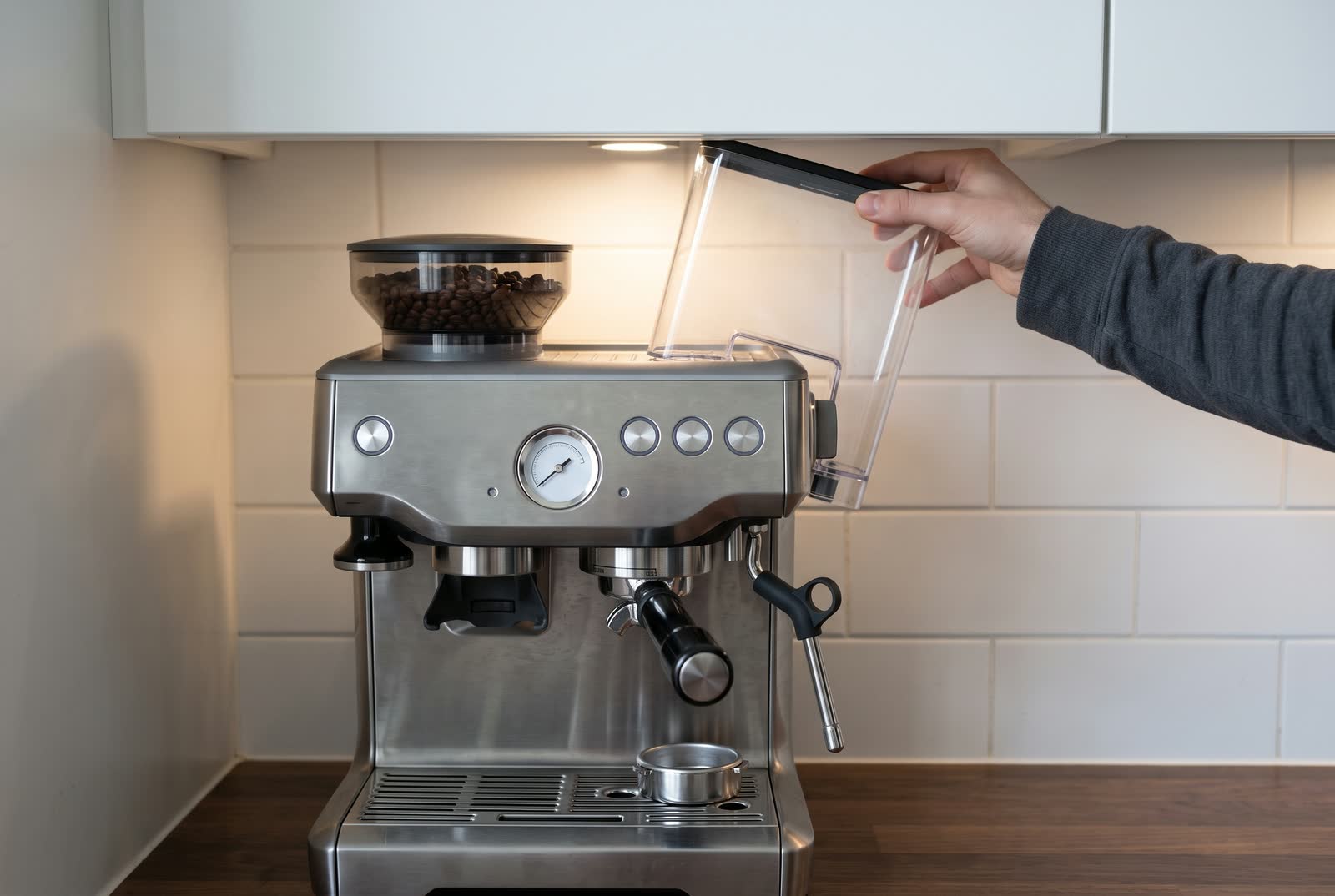
Under a wall cabinet, the daily job is not making coffee. It is filling the tank, and on most counters that means sliding the machine out, lifting the lid, filling, and pushing it back with a wet hand. Do that for a week and the corner stops being a corner and becomes a thing you set up each morning.
The question is a clearance one and it has two halves: which direction the tank travels when it leaves the machine, and how much room that travel needs. The makers' manuals answer the first half, and the sections below give each machine's answer.
The direction, which the manuals do state
A tank-removal direction is published for eleven of the thirty-six products we cover, and every one of them comes from the maker's own manual rather than from a photograph. Three of the four machines here are among them and all three are the same answer. The Stilosa manual says to open the lid and remove the tank; the Bambino manual says to lift the water tank from the machine; the Bambino Plus manual says the same on its own page. All three were read on 6 September 2026.
Upward is the worst direction a wall cabinet can be given, and that is the practical finding on this page. The Bambino stands 12.0 in tall (305 mm), per Target and Williams Sonoma, and its tank lifts straight up out of the top, so it needs more than 305 mm of air above the counter; Breville does not say how much more.
Two of the four can be filled where they stand
The escape from the whole problem is filling without removing, and two of the four makers here say in their own manuals that it is allowed. The Stilosa's manual states that the water tank can also be filled without extracting it, by pouring the water directly from a jug. The Classic Pro manual instructs the owner to remove the water tank cover and fill it with cold water to the tank's maximum level, which is a fill-in-place instruction on the machine itself.
Breville's two Bambino manuals do not say whether the tank can be filled in place, which leaves it unstated rather than forbidden. With either Bambino, plan on lifting the tank out, and try a jug before you rely on one.
The Classic Pro: a front tank you fill in place
The Classic Pro is the fourth machine here. Its manual removes a cover and fills in place, and the maker's own page locates the tank at the front without describing a motion, so no removal direction can be assigned, and the daily refill does not need one: the tank stays in its seat while you pour.
The hopper, and the two shapes it comes in
The other refill is the grinder. A hopper-access distance is absent at source for all thirty-six products, so the room needed above a hopper to fill it is a figure you measure yourself.
Two shapes on the counter, and they are opposite cases. The Encore is the hopper machine: beans live on top and you fill it occasionally, which makes the height above it a real constraint and its stated capacity a matter we cannot settle cleanly, because the maker has published two different readings for it and we have not chosen between them. The DF64 Gen 2 is the other answer: its maker states a 50 g bellows hopper for single dosing, which is a hopper you fill one dose at a time from a jar, so the height above it matters for a scoop rather than for a bagful. What the two grinders each buy you is the page that compares them properly.
The distance you measure yourself
The direction is known for eleven products. The tank-access distance is absent at source on thirty-three products and not checked on three, and the hopper-access distance is absent on all thirty-six. So this site can tell you which way the thing moves and cannot tell you how far, for any product it covers.
That distance is the number a kitchen actually needs. A tank that lifts clear in a finger's width and a tank that needs a forearm are different machines under the same cabinet, and both of them can be published at the same height.
What a measurement would need
The machines in hand, first, because this one cannot be read off a photograph. Then a protocol that defines the access distance from the tank's own travel rather than from the cabinet: the vertical distance from the machine's top surface to the point where the tank clears its seat, which is a property of the machine and stays true in every kitchen. Measuring to the cabinet instead would produce a number about somebody's kitchen, which is the mistake that makes published clearance figures useless.
Then a stated instrument, its tolerance, and a repeat count per machine, because a tank that catches on its seat gives a different reading on the second try. And the same protocol for the hopper, measured to the point where a scoop or a bag can be inverted over it, which is a harder definition and has to be written down before anybody starts rather than argued about afterwards.
Planning the corner from the one figure you have
Use the direction, because you have it. If the tank lifts out of the top and the cabinet above is low, plan the machine somewhere the counter is open, or plan on filling in place with a jug; the Stilosa's and the Classic Pro's manuals both allow it. If you cannot move either, the machine on a shallow rolling surface is the usual answer, and the corner where the counter run is the constraint is where that arithmetic lives.
Then measure your own gap, once, with a tape: counter to cabinet. That number takes ten seconds and belongs to your kitchen, and two people on one counter is the page for what to do with the result.



