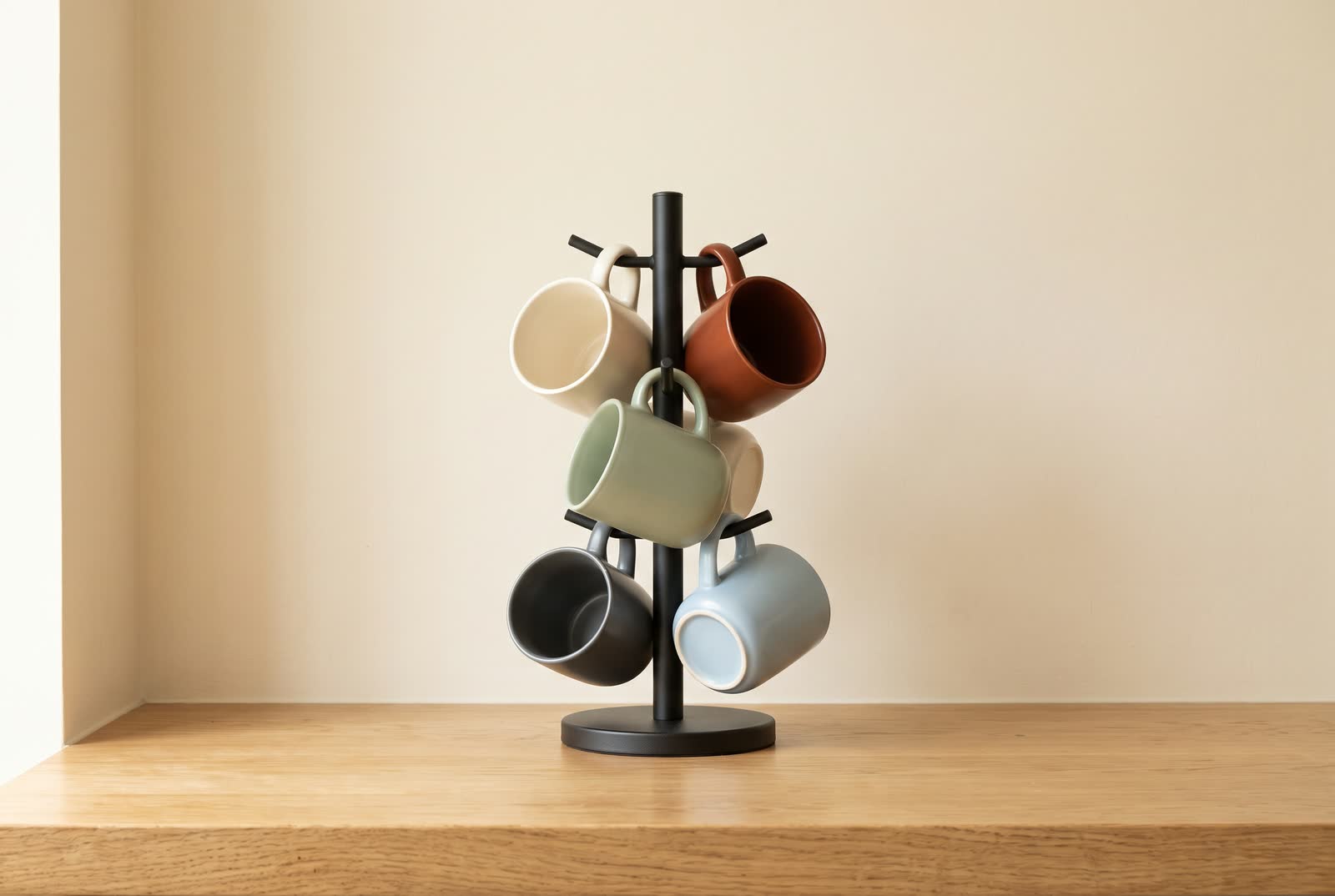
Eight mugs and one counter
Mugs are the thing that beats a coffee corner. They come out of the cupboard faster than they go back, and a counter run that was planned around a machine and a grinder ends up with four mugs on it by Thursday. There are three ways to get them off it: a tree that stands on the counter, a rack that goes on the wall, and a shelf they sit on. This page is about the first two, because those are the two we have found figures for.
Neither of them stores mugs better than a cupboard does. What they do is put mugs where a hand already is, which is the only reason to give up either counter or wall for them.
The tree, and a gap in what the maker's page states
The rotating mug tree is the counter answer. Its maker's page, read on 6 September 2026, lists a rotating mug tree in iron that holds 8 mugs and stands 15 inches high by 8 inches in diameter. Eight inches of diameter is a small footprint for eight mugs, and that is the whole argument for a tree: it trades height, which a counter has plenty of, for width, which it does not.
There is a gap here too, and it belongs in the same breath as the figures. The maker's page prints neither the line name this item is sold under nor the merchant's own product code, so the correspondence between the page those figures were read from and the item in the listing is unverified. The figures are real and they are the maker's; whether they describe exactly the tree in the listing is not something this site can confirm.
The rack on the wall, which is a category and not a product
The wall-mounted mug rack on this site is a category, not a single product. That means it is a category rather than one product: a family of wall-mounted racks in wood or metal, typically with three to twelve hooks and on some models a small shelf on top. Nothing here is a specification of an item you can buy, and nothing below should be read as one.
What the listings in that category state is worth naming carefully. One wooden model combining hooks and a display shelf is advertised as holding up to 17 mugs; a separate metal listing describes 12 hooks and is marketed for emptying a cabinet. Those are two listings inside a category, read on their merchant pages, and they are the range the category covers rather than figures for any single product this site sells. The page on the wall above the counter is where the fixing, the depth and the reach of that wall get decided.
What neither one states, and it is the one you want
No load rating is published for either of them. Not for the tree, not for the rack, not for any hook on either. A mug weighs little empty and rather more full, a rack holding a dozen of them is carrying real weight off two fixings, and the number that would tell you whether a plasterboard wall is enough is simply not published anywhere we have looked.
So this page states none, and the practical consequence is the honest one: a wall rack is a fixing question before it is a mug question, and the person who knows what your wall will take is whoever put it up, not this page.
Choosing between them
The tree wins where the wall is not yours to drill, where the mugs move around, or where eight is the real number. It costs eight inches of counter diameter and gives back the cupboard shelf those mugs were on. The rack wins where the counter is already full and the wall above it is empty, which is the common shape of a small kitchen, and it costs holes.
There is a third case worth naming: if the mugs in question are the good ones you actually like, a rack puts them on display and a cupboard does not. That is a decor argument rather than a storage one, and it is a perfectly good reason as long as it is the reason you are choosing.
No price on this page is checked at a seller. Both the tree and the rack sit in the bands this site draws, which are ranges of its own framing rather than figures read at a shop.



