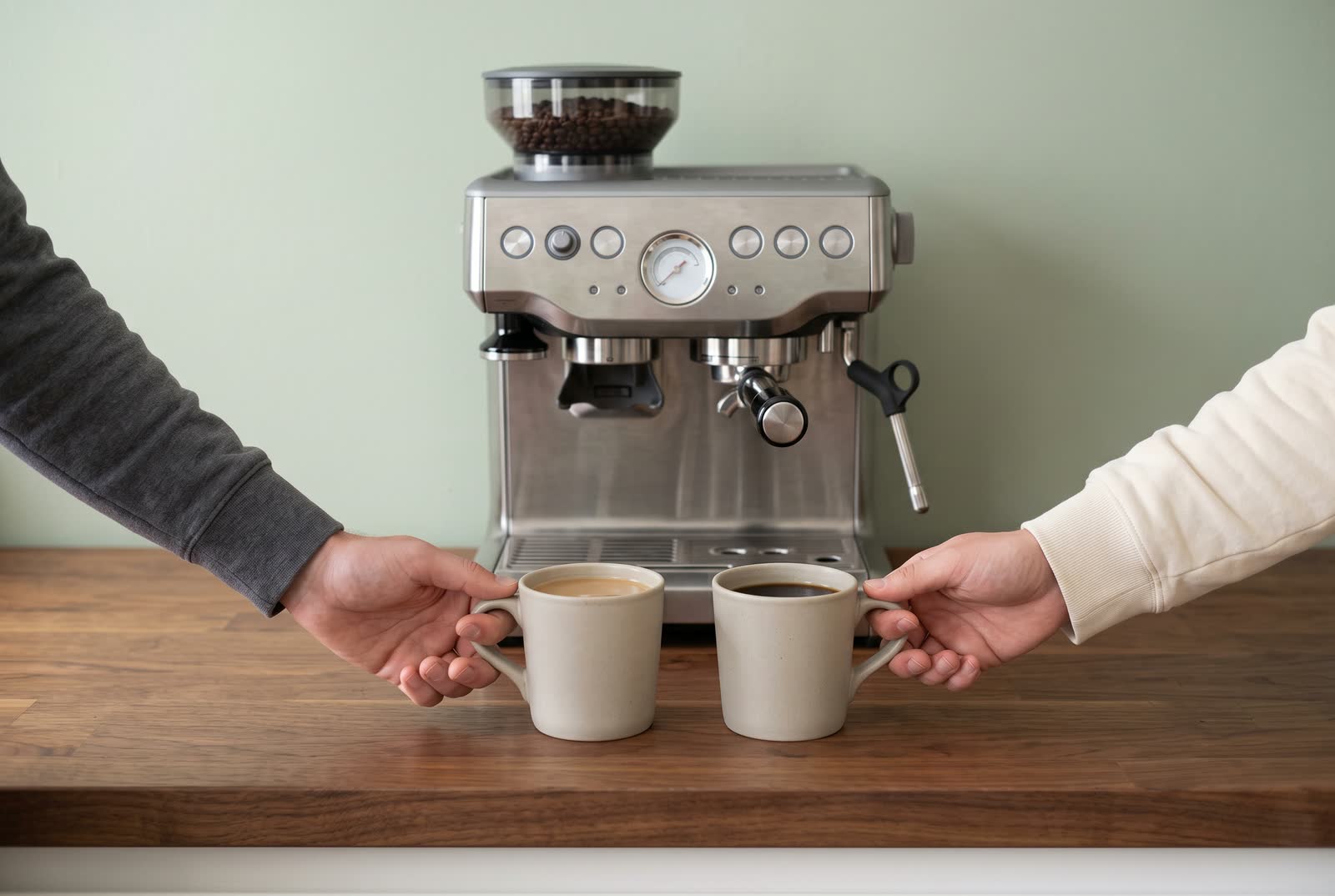
Two people at once is a question about one minute, not about storage
A counter two people share is usually treated as a storage problem, and it is a timing problem. Nobody is short of cupboards at twenty past seven. What both people want in the same five minutes is the same three things: the grinder, the thing that heats the water, and the patch of counter directly in front of them. A station that works at the same time is one where each person's sequence can run start to finish without stopping to wait on the other's, and that is arranged by deciding which objects are duplicated, which are shared, and in what order the shared ones are touched.
Two lanes, and only one object in the middle
The cheapest way to buy simultaneity is to stop making the same drink. An espresso lane and a pour-over lane overlap almost nowhere: one needs a group head, a portafilter, a tamped bed and a wand, the other needs a kettle, a dripper and a server, and the only object both of them need is the grinder. So the station is two lanes with one thing in the middle, and every decision after that is about where the middle sits and who reaches it first. Laid out that way, the two people are never in the same place at the same moment except once, which is a queue of one object rather than a queue of a whole counter.
The second lane is the deep one, and both halves publish a width
The pour-over lane is two objects and both of their makers print a size. The Hario V60 ceramic set states overall dimensions of W140 by D121 by H210 mm with a 600 ml server, and the kit is the dripper, that server and a hundred filters in one box, which is the whole lane apart from the water. The Stagg EKG Pro's own page prints 11.10 in (282 mm) by 6.77 in (172 mm) by 7.7 in (196 mm), read on 6 September 2026, and the sheet here reads that as 172 mm across and 282 mm front to back. Added up, and the addition is this page's rather than any maker's, the second lane's published width is 312 mm, and the surprise in it is which direction it eats: at 282 mm deep, the kettle reaches further back than the espresso machine beside it does, so a shallow counter runs out of room in the pour-over lane first.
The shared object is the grinder, and it is where the queue actually forms
One grinder cannot hold two settings. The Encore states 40 mm conical burrs with forty grind settings across a range of roughly 250 to 1200 microns, and a station running espresso in one lane and pour-over in the other needs two of those settings at once, which is the one thing forty settings cannot give. That is the real constraint on two people at the same time, and no amount of counter solves it: either the second lane grinds first and waits, or the beans for one lane are ground the night before, or there are two grinders. The Encore's own width is the one figure on this page that cannot be used, because two readings from its maker disagree and neither was chosen over the other, so no width is summed for it here. Its hopper capacity is in the same state, published twice with two different dates, and the Encore and Encore ESP piece sets out why neither reading is allowed to overwrite the other.
The espresso lane runs unattended for part of its own sequence
The lane that can afford to be interrupted is the espresso one, and the reason is the wand. The Bambino Plus states an automatic steam wand with three milk temperatures and three texture levels, which means the milk runs without a hand on it while the other person is pouring water over a filter. Its published footprint is 11.9 by 7.4 by 14.3 inches, 302 mm across and 188 mm deep on its own page, so it is the widest thing on the counter and not the deepest. The box also carries a 54 mm tamper, a dosing tool and a 16 oz jug, which is three more objects that have to land somewhere and are the reason a station with nothing but appliances on it still fills up. A tray with a drawer and three tiers is where those go: a drawer for the small tools and tamper, and tiers so the jug and cups do not compete with the machine for the same six inches of counter.
What the counter cannot tell you, and what to set yourself
Add the published widths of everything above and the station's floor is 614 mm, and that figure is missing one of its four items, because the grinder in the middle is the item whose width is in dispute. It is also missing every gap. No maker page states a side clearance, a rear clearance or a top clearance for any product here, so the distance between the two lanes, and the elbow room each person needs inside their own, are numbers a reader has to set by standing at the counter rather than by reading anything here. Two things are worth setting before the layout: put the shared grinder at the end of the run rather than between the two people, so one person reaching it never crosses the other; and give the deeper lane the deeper stretch of counter, because the kettle is the object that runs out of depth first. Everything else on this page is a published figure with a date, and those two are judgement.



