The short answer
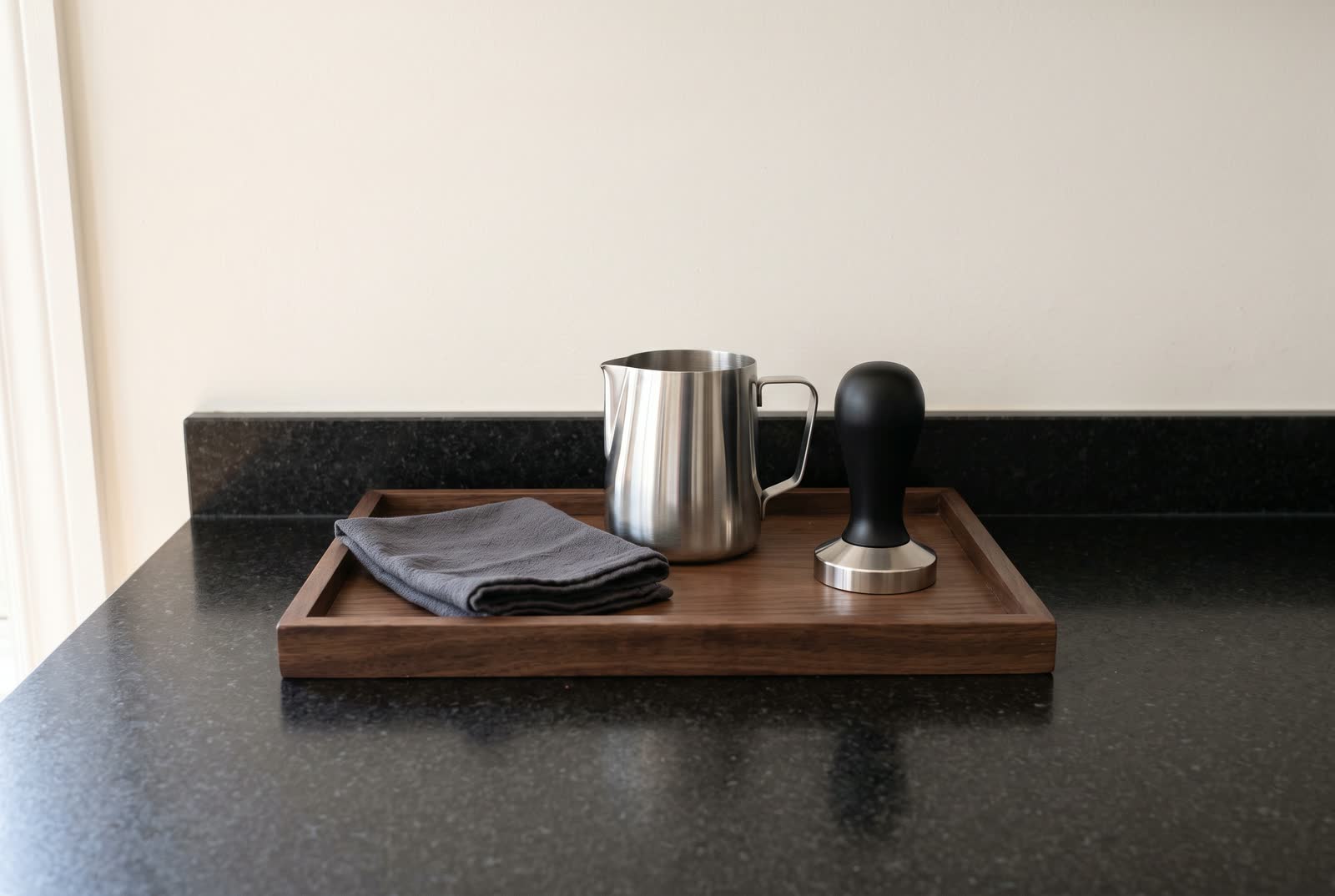
Buy a tray at least 303 millimetres wide and 160 deep, plus the gaps you want between things. The knock box's maker states it as 163 millimetres wide and 160 deep, and the pour-over cone kit's maker states it as 140 wide and 121 deep, so those two alone fill that floor. A flat wooden tray is the pick where the point is the boundary, because you can lift it and carry the whole corner with it.
What a tray is for, which is not storage
A coffee corner goes wrong in one particular way: the things that belong to it stop having a place and start being wherever they were put down. A tray fixes that by drawing a boundary. Inside the tray is the coffee corner; outside it is the kitchen. It holds nothing that a counter does not already hold, it saves no space at all, and it is still the cheapest thing that turns a scatter into a station.
That is why the size question matters more than the material one. A tray too small pushes things off itself and stops working within a week.
Two shapes for a landing zone, and what neither one specifies
A drawer-and-shelf organizer is the other shape a landing zone can take: a countertop unit that closes over what sits inside it and adds a shelf tier a flat surface does not have. That closed-storage shape has no specification sheet worth quoting here, so the sizing question below is answered from the tray instead.
One style worth knowing is the wood tray with brass handles: a family of decorative wood trays, commonly described as mango wood, sold for coffee tables and counters, with hammered all-brass options in the same style.
This page names no dimension for either shape: no length, no width, no depth for either. So it states none for them, which leaves the size question to be answered a different way.
Sizing the tray from your own objects
The things a coffee corner lands on a tray are objects with maker-stated sizes, so the tray can be sized from them instead. The knock box's maker states it as 163 millimetres wide and 160 deep, and the pour-over cone kit's maker states it as 140 wide and 121 deep. Stood side by side with no gap between them, those two need 303 millimetres of width and 160 of depth.
That sum is this site's own arithmetic and not anybody's published figure. It is a floor rather than an answer: a tray at exactly 303 millimetres would hold two objects touching each other, and a tray you can actually lift things off needs the gaps, which are quantities no page here will supply.
What the arithmetic cannot tell you
The floor above covers two objects, and a corner lands more than two on a tray. Measure your own milk jug, tamper and scale and add them to the sum.
So the honest instruction is to measure the things you own rather than trust a tray listing. Put them on the counter in the arrangement you want, put a tape across the lot, and add the gaps you want between them yourself.
Choosing one
A closed, drawered organizer is the better shape where the corner has small things that get lost, since a drawer is the only closure this page has discussed. The flat wooden tray is the right answer where the objects are large and the point is the boundary rather than the storage, and it is also the one you can lift and carry, which a closed, tiered unit is not.
If the counter is already full, neither of these is the move and the wall is: the page on the wall above the counter covers that, and the page on what a cart holds covers the case where the corner needs to leave the counter altogether.
No price on this page is checked at a seller.



