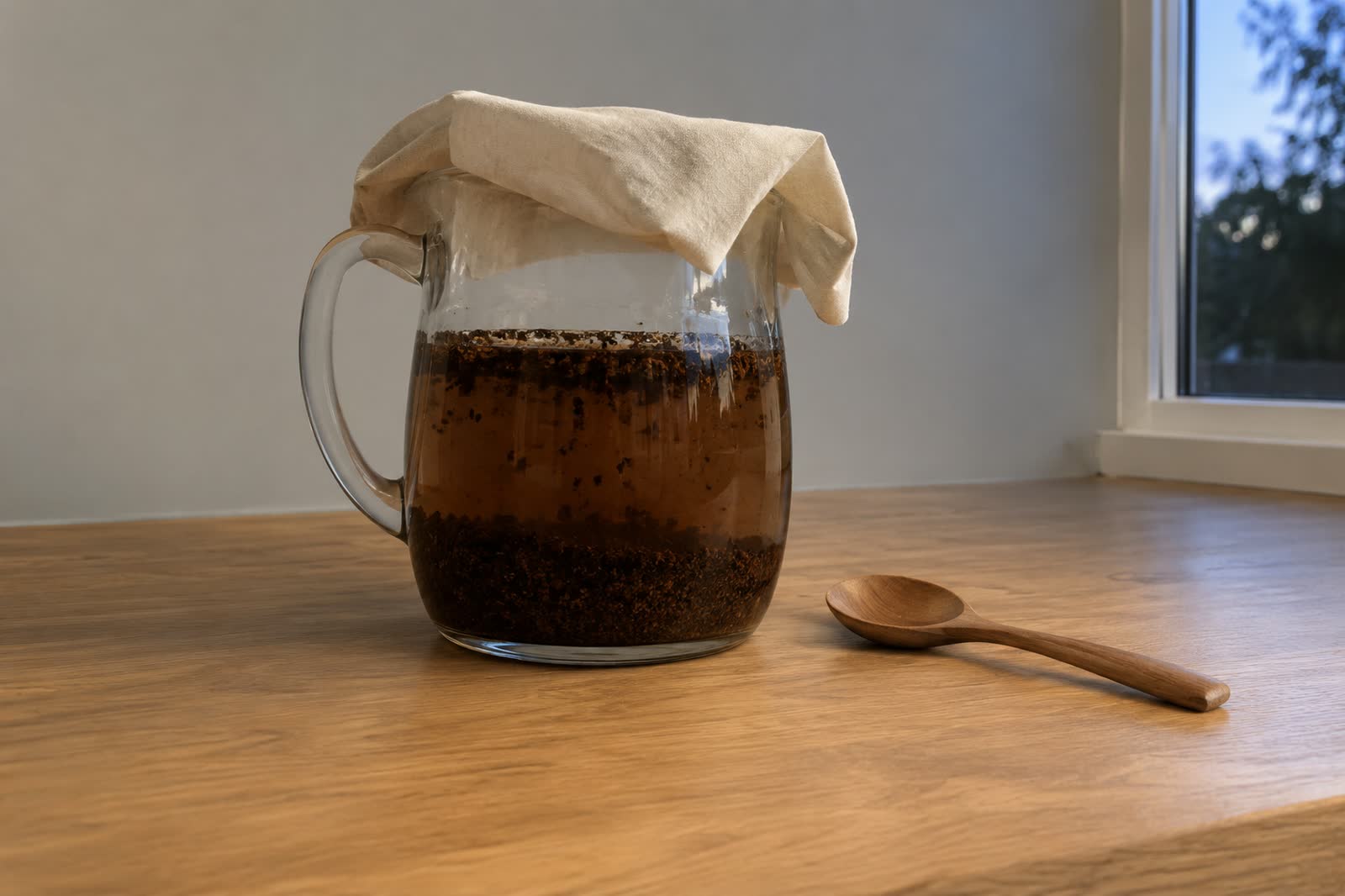
Cold brew is a jug, some coffee and a night
Cold brew is coffee steeped in cold water for a long time and then strained. There is no equipment in that sentence, which is the point of this piece: a jug from the cupboard, a sieve, and something to filter through do the whole job, and a dedicated cold-brew vessel is a convenience rather than a requirement. A batch made on a Sunday night gives days of iced coffee from the same beans already on the counter.
What it asks for instead of equipment is a coarse grind, a long steep and patience with the straining. Those three are where it goes right or wrong.
The grind is the one thing that has to change
Coffee ground for espresso will not work here. Cold water extracts slowly, so a grind that fine turns an overnight steep into something muddy and over-extracted, and it makes the straining almost impossible. Grind coarse, coarser than for a pour-over, so the bed behaves like a sieve rather than a paste.
On a stepped hand grinder this is a long way from the espresso end of the range. The JX-Pro S hand grinder adjusts from its top dial across ten numbered turns, forty clicks per rotation at 12.5 microns per click, which is a fine enough scale that finding a repeatable coarse setting is a matter of counting rather than guessing. Write the number down the first time so the second batch is the same as the first.
Ratio, vessel and time
Use one part coffee to eight parts water by weight for a concentrate that gets diluted in the glass, or one to fifteen for something drinkable straight from the jug. Both are common starting ratios rather than measured ones, and a second batch is where you move them. Any jug with a lid works, and a glass one lets you see whether the grounds are still floating on top rather than wetted through. Stir once after the water goes in, because a dry cap of grounds floating on the surface is coffee that never brewed at all.
Twelve to eighteen hours on the counter, which for most people means overnight, or up to a full day in the fridge, and then strain. Those hours are where home recipes settle rather than a measured limit, and it is the far end that matters: past it the steep stops extracting anything pleasant and starts extracting the woody flavours that the cold water was supposed to leave behind.
Straining twice, because once is never enough
A sieve takes out the grounds and leaves the fines, which are what make a cold brew taste gritty and turn cloudy in the glass. Strain once through a sieve to get the bulk out, then a second time through paper. Paper filters for a pour-over are the easiest thing to reach for: the V60 ceramic kit ships with its dripper, its glass server and a hundred paper filters, and the filters are the part being borrowed here.
Pour slowly on the second pass. A paper filter loaded fast with concentrate clogs and then drips for a very long time, which is the one part of this that tests patience.
Where it is kept
Keep the strained brew in a sealed jug in the fridge, and label the jug with the day it was made. Serve it over a full glass of ice with water or milk to taste. A half-filled glass of ice melts faster and waters the drink down sooner.
How long cold brew keeps in the fridge
Treat a week as the outside limit, which is a cautious working limit rather than a tested shelf life and not a figure anybody here has measured. Undiluted concentrate keeps its flavour longer than a ready-to-drink batch, which is a reason to make the stronger ratio and dilute in the glass instead of in the jug. What goes first is the flavour rather than anything dramatic: a batch past its best reads flat and woody rather than announcing itself, so the date on the jug does the job your nose will not. Brew left sitting in its grounds is a different question, and the steep section above answers it: past the far end of those hours the coffee is still extracting, and what it extracts is the part the cold water was there to leave behind.
What this is not
Cold brew is not the same drink as espresso poured over ice, and the difference is not strength. Cold extraction leaves behind most of the acidity and much of the aroma, which is why cold brew reads as smooth and slightly flat next to a shot chilled fast. If the smooth one is what you want, this is the method; if the aromatic one is, four drinks without milk covers pulling a shot straight over ice.
Neither is the better drink. They are different extractions and it is worth owning both methods, since between them they cost a jug and a glass.



