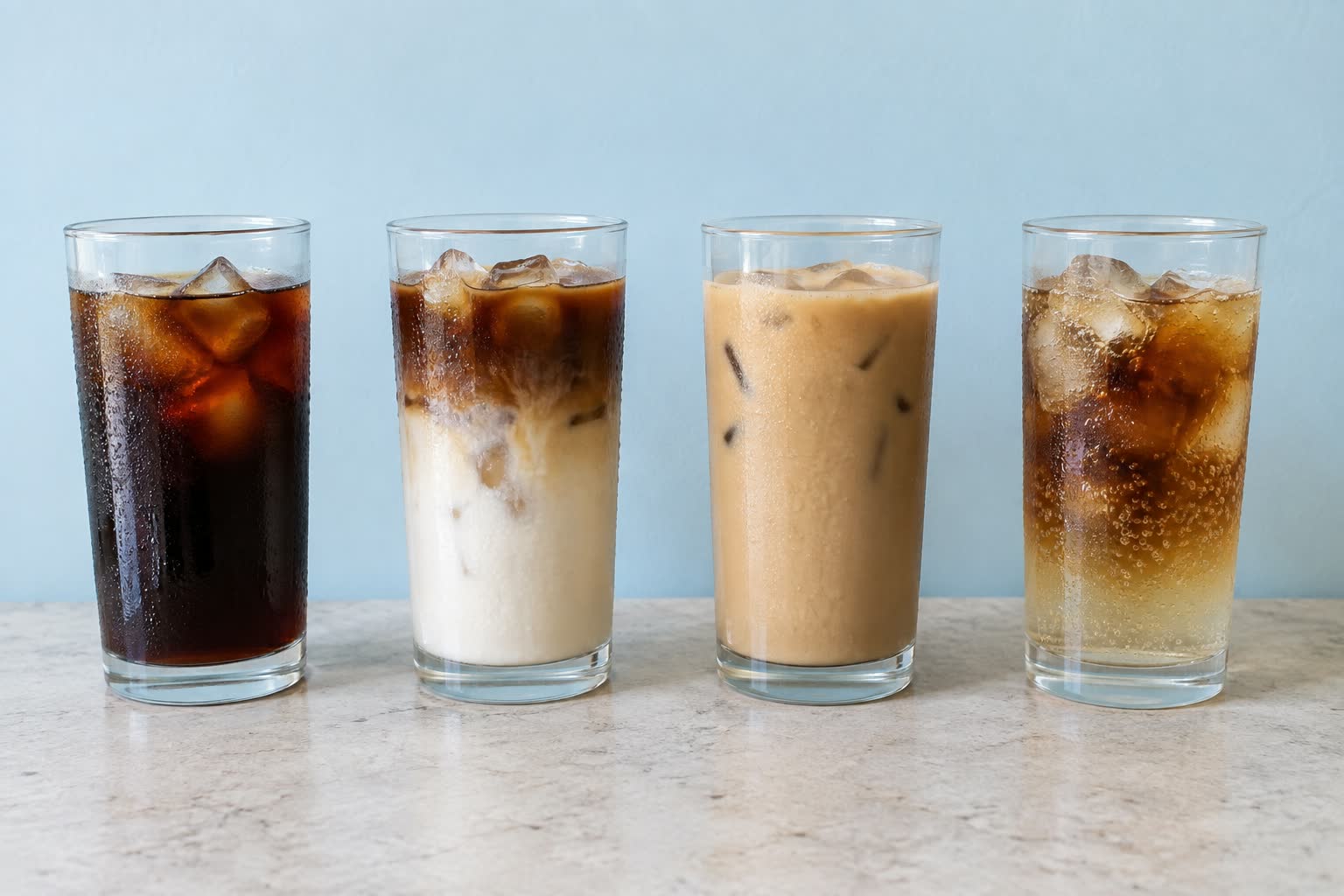
Four ways, and the only thing they disagree about
There are four ways to get cold coffee into a glass at home, and the argument between them is not flavour. It is dilution: how much water the ice puts into the drink, and when. Every method below is a different answer to that one question, and the equipment each one needs follows from the answer rather than the other way round.
Sorted by what they ask of a counter, they run: espresso over ice, which needs a machine and nothing else; the shakerato, which needs a jar with a lid; the Japanese method, which needs a dripper and a scale of some kind; and cold steeping overnight, which needs a jug and a night. Three of the four need no purchase at all if there is already a machine or a brewer on the counter.
Espresso over ice: the shortest route
Fill a tall glass with ice, pull a shot straight onto it, and top it with water for an iced americano or with milk for an iced latte. The shot hits the ice, drops from brewing temperature to cold as it lands, and the melt that happens while it does is the dilution. It is not a fault, it is the recipe.
The one thing this method wants from a machine is that the shot arrives quickly and hot. The Bambino's maker states a heater that reaches extraction temperature in three seconds and a manual steam wand on the same body, which is the shape that suits a single cold drink: you are making one shot, not a round of six, and the machine that is ready first is the one that gets used at four in the afternoon. Any machine that pulls a shot makes this drink. Nothing about the iced version asks more of the pump than the hot version does.
Use more ice than looks sensible. A glass with a scatter of ice in it is a glass of warm, weak coffee by the time it is drunk; a glass packed to the rim melts slowly and the drink is still cold at the bottom.
The shakerato: the same shot, with air in it
A shakerato is one shot, ice, a little sugar if you want it, shaken hard in a sealed jar for ten to fifteen seconds, which is a common starting count rather than a measured one, and poured through a strainer into a chilled glass. What comes out has a head of foam on it and a texture the poured version does not have, because shaking whips air into the crema instead of letting it collapse.
This is the method with the lowest equipment bar of the four. A jam jar with a lid does it. The cost is that it makes one drink at a time and it is loud.
The Japanese method: brewed hot, onto ice
The Japanese iced method brews hot coffee directly onto ice, so the dilution is designed in from the start rather than arriving later. The usual proportion is to replace part of the brew water with ice in the server and brew the rest over the bed as normal, which gives a cup that is cold, aromatic, and not watery.
It is the only one of the four that needs a pour-over set rather than an espresso machine. The Hario V60 ceramic set is the whole kit in one box on the maker's own listing: the ceramic dripper, the glass server and a hundred paper filters. The number that matters here is the server: the maker states a capacity of 600 ml, and the ice you put in it before you start comes out of that 600 ml, not on top of it. Plan the batch as ice plus water together and the server will not overflow halfway through the pour.
A gooseneck helps, because the pour is what controls the bed and a wide-lipped kettle dumps. The Stagg EKG Pro is the one we hold with a stated variable temperature control and a gooseneck spout; a kettle without either still works, it just asks more of your wrist.
Cold steeping: a night instead of a technique
The fourth way is to stop brewing altogether and steep coarse grounds in cold water overnight, then strain. It is the only method that makes more than one drink at a time, and it is the only one that needs no heat, no skill and no timing. It gets its own piece, because the variables are different from all three above: cold brew in a jug you already own covers the grind, the steep and the strain.
The grind moves, and it has to move back
Three of the four methods want a different grind from the one the machine is set to. Espresso over ice wants the espresso grind untouched. The Japanese method wants a medium pour-over grind. Cold steeping wants the coarsest setting on the machine.
That matters more than it sounds, because moving a grinder for one iced drink and then failing to put it back is how the next morning's espresso goes wrong. A grinder with counted steps makes the return trip exact rather than approximate: the JX-Pro S states ten numbers with forty clicks per rotation and 12.5 microns per click on its own page, which means the move from espresso to cold-steep coarse is a number you can write down and reverse. On a grinder with unnumbered settings, write down where the mark was before you touch it.
Which one your counter already does
If there is an espresso machine on the counter and nothing else, make the first two. If there is a pour-over set, the third is the one worth learning, because it is the only method that keeps the aromatics a hot brew makes. If there is neither, the fourth needs a jug and a sieve.
The summer upgrade most people imagine is a second machine. On these four methods it is a jug and a bag of ice.



