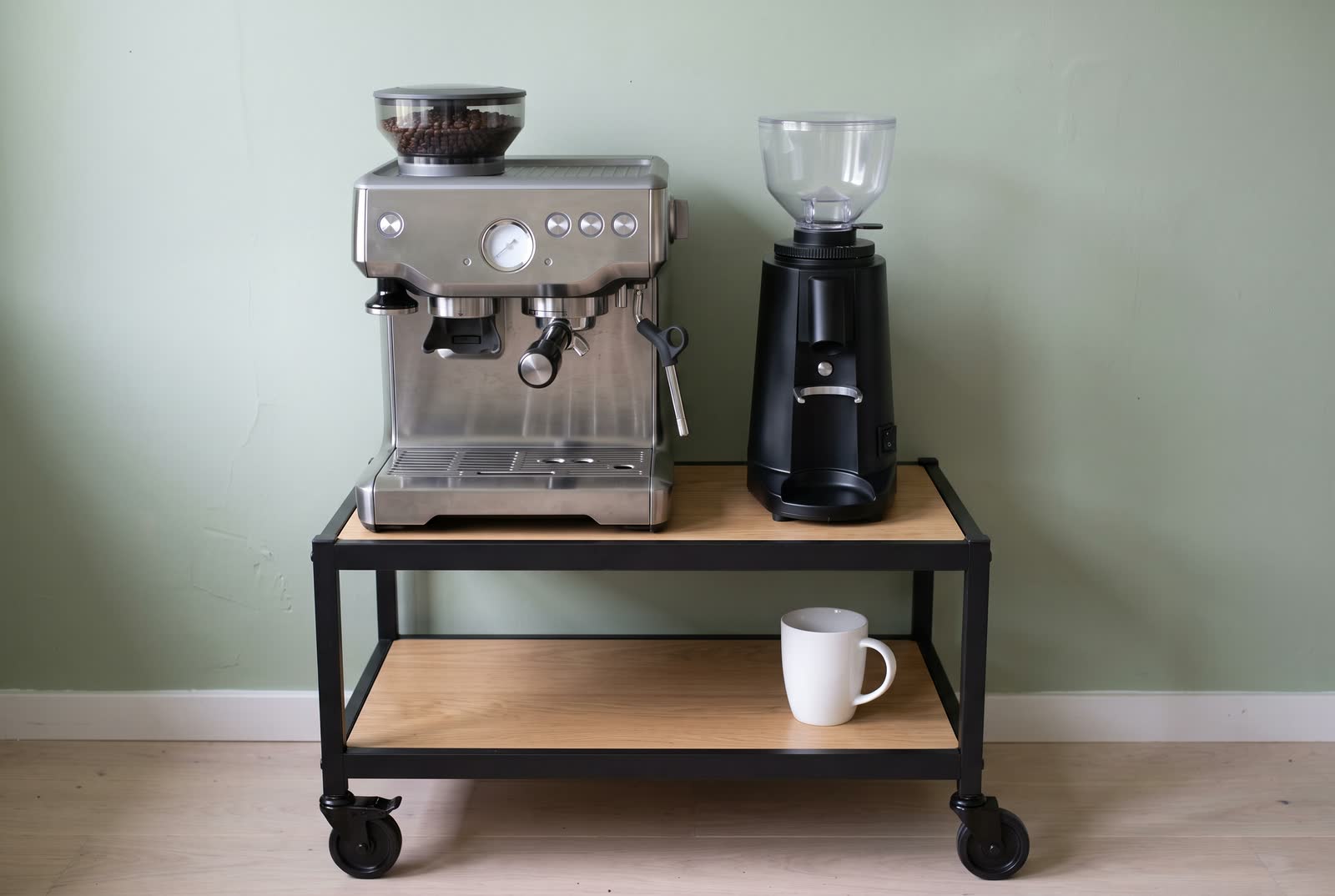
A station that exists
The kitchen with no free counter does not get a coffee corner by waiting for one. It gets a cart: a shelf on castors that holds the machine and the grinder, rolls to the socket in the morning and rolls out of the way after. This page is about what a cart has to be to do that, and it is written from what the makers state, which for the carts themselves is less than for the machines they carry. Whether a cart, a cabinet or a wall shelf suits the unit in the first place is the layout guide.
What a cart has to be measured against
A cart is a category rather than one measured product, and this page names none. What it has to do is set by the machine and the kitchen: its top shelf has to take the machine's footprint, its overall width has to fit the wall run, and it has to roll through the doorway to get there. Measure those three first, then read each cart's stated shelf size, overall size and wheels against them. This page treats a bar cart and a coffee cart as one thing: the shelf and the wheels count, not the name.
No shelf load rating is carried here for any cart, and this page states none. A listing may print one; we do not carry it as a figure this site checked, and a cart's shelf holding a machine full of water is precisely the claim that should not rest on a category average.
What the machine states about itself
The cart's job is to carry a footprint, and the footprint is the figure the makers do publish. The Bambino measures 6.3 in (160 mm) wide, 13.8 in (350 mm) deep and 12.0 in (305 mm) tall, per Target and Bi-Rite Home Appliances, at 4,725 g read on 3 September; Breville's own page, read on 6 September 2026, prints its dimensions without saying which figure is which, so this article uses the retailers' measurements. The depth is the figure that decides a cart: a 350 mm machine needs a shelf deep enough to hold it, with room left in front for the cup.
The Encore is the grinder we have the most figures for, and its envelope is the one figure this page will not state: Baratza's own page carries two readings of its width, depth and height in dispute, so no dimension is given for it here. Its weight, 3,100 g, comes from a retailer's page read on 1 September 2026 and is named as such. What the grinder's own page states is 40 mm conical burrs, 40 settings and a 550 RPM motor, and a hopper whose capacity the maker has stated twice, as 8 oz and as 300 g, both published with their own dates.
What a shelf has to be
The height is what a shelf above the machine has to clear: 305 mm of machine needs its tank lid to open and the cups to come out from under whatever is over it. What no maker gives is a rule. The Bambino's manual, read in full on 6 September 2026, carries no instruction against use inside a cabinet or an enclosed space, and that is recorded as an absence rather than as permission, so it cannot stand as the rule a shelf over the machine has to respect. The clearance above the machine is the owner's judgement, with no maker figure behind it.
So the shelf the machine stands on is the top one, or the one with nothing above it. The grinder can go beside it or below it, because a grinder has no lid to lift and no steam to vent. The beans, the cups and the jug go below.
Where it parks
The morning position is at a socket, and this page states no figure about the socket: what a machine and a grinder draw against what a kitchen circuit carries is the socket page and it is not this one. What can be said without a figure is that a cart parks where its cable reaches, that the cable is the leash, and that a cart which has to roll across the kitchen to plug in has not solved the problem it was bought for.
The resting position is wherever the castors take it, and the one thing to check before buying is whether the castors lock. A machine that weighs nearly five kilograms does not want to be on a shelf that moves when the portafilter is locked in.
What this page cannot tell you
A load rating for any cart. A dimension for the grinder. A price for anything: the machine and the grinder sit in the bands this site draws, which are ranges of its own framing and not a figure read at a shop. What this page does give is the machine's own footprint, from its maker, and a manual that says nothing at all about what may be built over it. What a lease adds on top of the cart, nothing drilled and nothing plumbed, and the closed cabinet the same two rules allow, is a rented kitchen's whole corner.



