What this page can source, and what it cannot
We have not verified any history here. There is no patent, no archive, no catalogue and no book on file here, so not one date in this story can be traced to anything we have checked. Every date below therefore carries a mark in the sentence that states it, saying it is a date commonly given rather than one read from a source we have checked. What we have checked, with the page and the day it was read, is the machine end of the story: what the machines on this site are made of, what pushes their water, and what stops it. Everything sourced on this page comes from those pages, and everything else is marked.
Two answers to the same problem
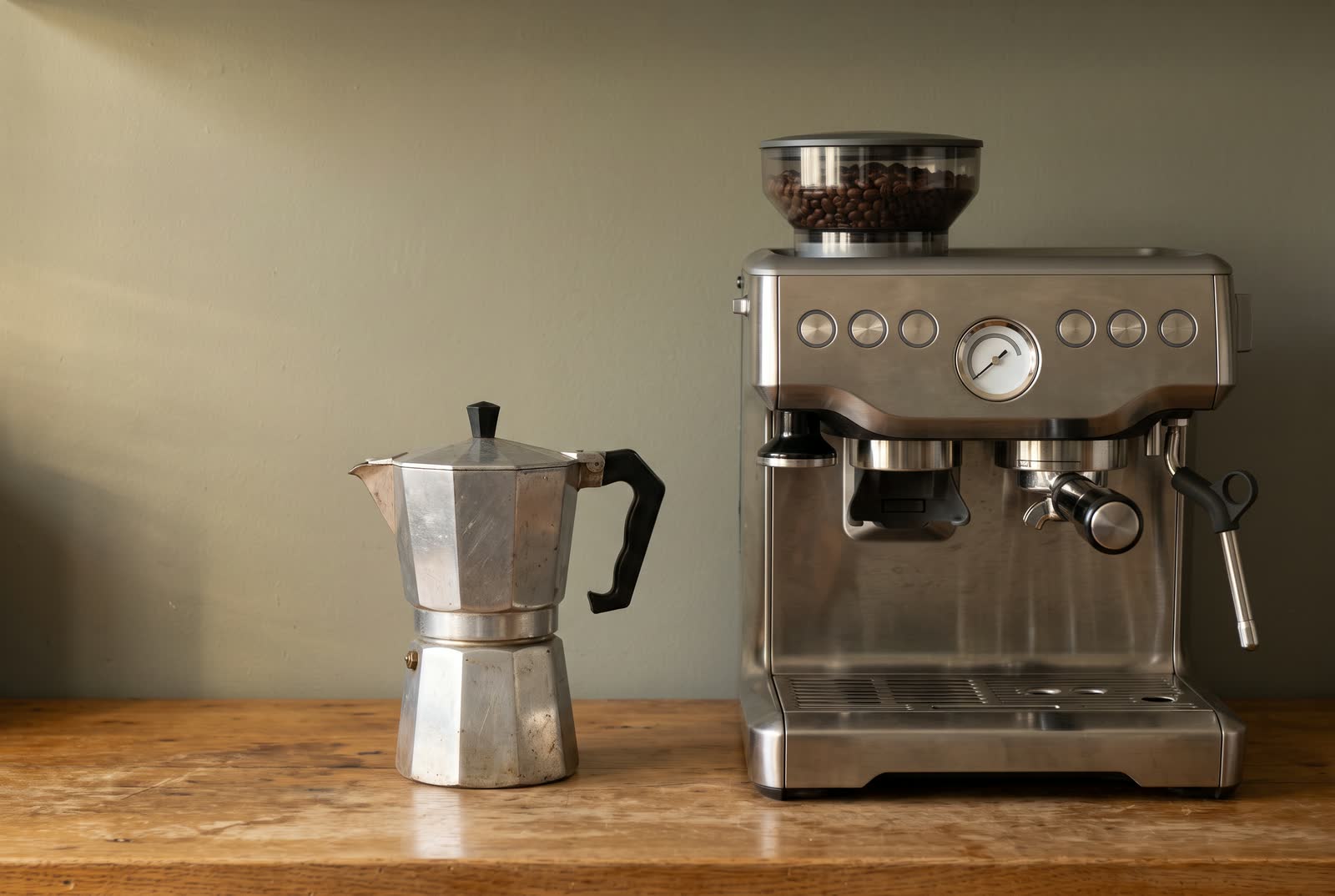
The pot and the machine solve one problem. Ground coffee gives up very little to water that merely sits on it, so the water has to be driven through, and both objects exist to drive it. What separates them is where the push comes from. The moka pot makes its own pressure out of heat, in a vessel closed tightly enough to hold it. An espresso machine has a part whose only job is to make pressure, and then a second part that throws most of it away before the coffee sees any. That difference explains more about how each one behaves than any date does.
The pot: steam, and the ceiling it comes with
Water in the bottom chamber is heated with the pot closed, the vapour above it expands, and the pressure that builds pushes the water still below it up a tube and through the bed of coffee. The pressure a moka pot reaches is commonly given as somewhere around one and a half bar, a figure widely quoted for the type and not one measured here, and the important thing about it is that it is a ceiling rather than a setting. The pot cannot push harder without getting hotter, and getting hotter is the same as cooking what is already in the cup. That is why the only control on one is the knob under it, and why what comes out is its own drink rather than a small espresso.
The machine: one part for pressure, and another for letting it go
An espresso machine splits the job in two, and the split is the whole invention. A pump raises the water, and a valve downstream of it decides what the coffee actually meets. The Stilosa's page states fifteen bar of pump pressure beside a stainless steel boiler; the Classic Pro's pressure line, read on 6 September 2026 from its distributor's storefront rather than from Gaggia's own page, reads fifteen bar at an Italian-made Ulka pump with a nine-bar over-pressure valve. Fifteen and nine are not two grades of one thing, and nine bars, and what the number means works that through properly. The same machine is described, on a third party's specification page rather than by Gaggia, as carrying a three-way commercial solenoid valve, which is the part that lets the pressure above the puck go the instant the shot ends: a pot has no equivalent, and when it comes off the heat what is still inside it has nowhere to go but back through the coffee.
The dates, and why none of them is printed as settled
Three dates get quoted whenever this story is told, and we have a source for none of them. The moka pot's design is commonly dated to 1933. The first machines to force water through coffee with steam pressure are commonly placed at the turn of the twentieth century. The spring-lever machine, the one usually credited with putting something like nine bar within a cafe's reach, is commonly dated to 1948. Each of those is a date commonly given and not one read from any record here, and none of them will be printed on this site as settled until a named published source, carrying its own date, is on file beside it. What would close that is unglamorous and small: one citable source per claim, held the way every maker page here is held.
What the century actually moved, and what stands in a corner today
The sentence this page can stand behind without a date is about the mechanism rather than the calendar: over roughly a century, the making of the pressure moved out of the fire and into a part, and once it was a part it could be set independently of the heat. Every step of that is visible in what the machines on this record are made of rather than in any year. The Classic Pro is described across the current Classic line as carrying a brass boiler and group head, which is a third party's description rather than Gaggia's own wording and is the clearest case of an old material still doing a job on a current machine. Beside it, vintage and antique grinders are listed across several overlapping category pages spanning manual mills, cast iron, wooden and porcelain examples, and those are what most vintage corners are really built from. So the honest shape of a vintage coffee corner here is a modern machine borrowing an old idea for its insides, standing next to old objects that grind nothing at all.



