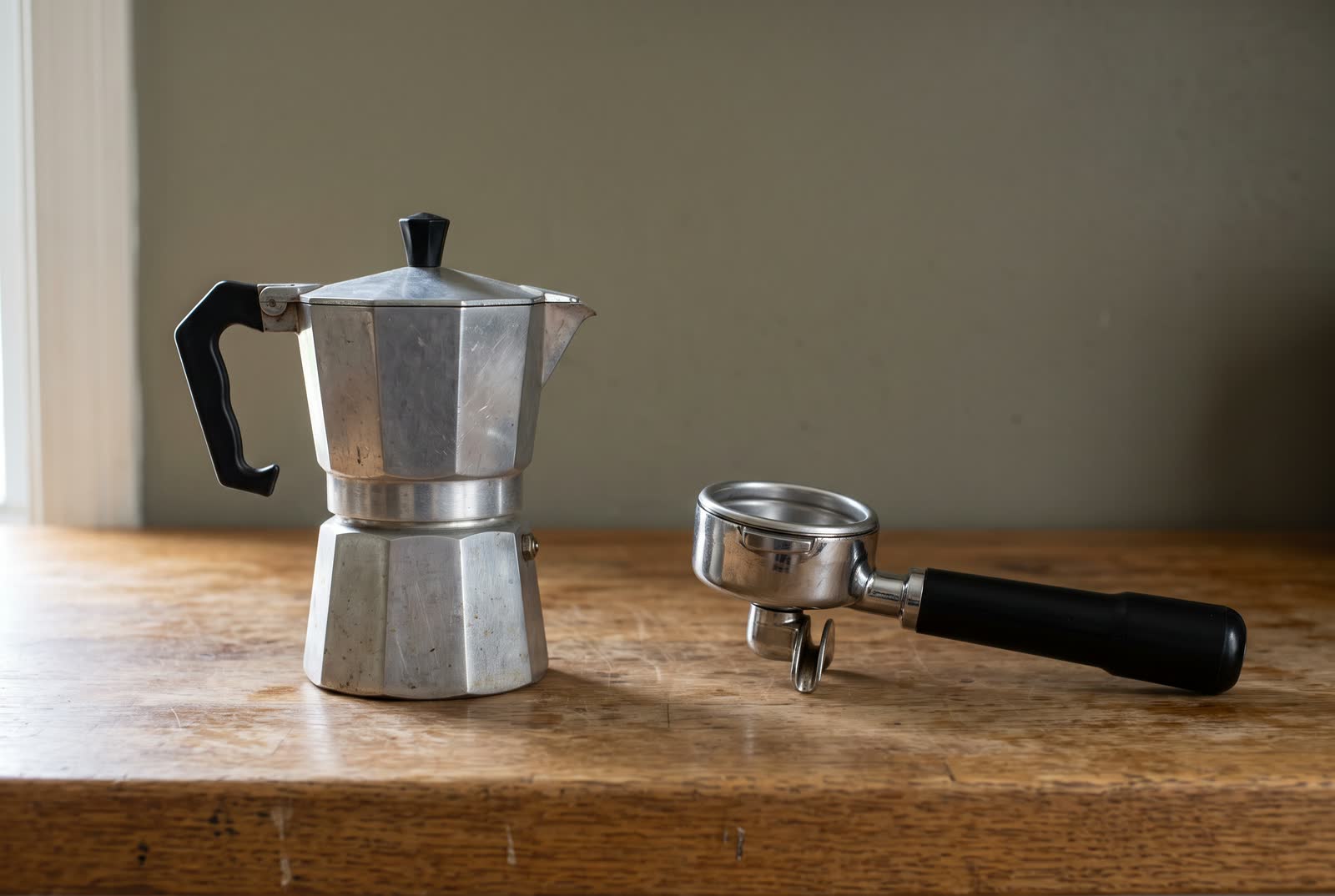
One word, two drinks
A moka pot is sold as a stovetop espresso maker, and the drink it makes is dark, strong and small, so the word sticks. It is not espresso in the sense a machine makes it, and the difference is worth understanding before spending a machine's worth of money to change it.
This page is about what each one makes and why. It is not about where the moka pot came from or how it got onto every stove in Italy; that story is the century between them.
What a moka pot does
A moka pot has three chambers: water at the bottom, ground coffee in a funnel above it, and an empty top chamber for the drink. Heat turns some of the bottom water to steam, the steam raises the pressure, and the pressure pushes the remaining hot water up through the coffee and out into the top. The pressure it works at is a fraction of what a pump makes, and it is a ceiling the pot's own physics set rather than a number anything holds it to, which the century between them works through.
What comes out is concentrated, because the ratio of water to coffee is small, and it is bitter more easily than a filter cup, because the water arrives hot and keeps arriving until the bottom chamber is empty. It has no crema. The foam on top of a machine shot is gas coming out of solution as the pressure drops at the spout, and a pot never gets the coffee under enough pressure to dissolve the gas in the first place. A thin froth sometimes appears on a pot; it is not the same thing and it does not last.
No moka pot is on this site's record. None has had its maker page read and none has been measured, so this page states no figure for one, not a capacity, not a pressure, not a size. What is written above about how a pot works is how every pot works; what any particular pot states is not something this site can quote.
What an espresso machine does
A pump machine pushes water through a tightly packed puck of finely ground coffee at a pressure the machine holds. The makers on this record state the figure: the Bambino page states a 15 bar Italian pump with low-pressure pre-infusion followed by 9-bar extraction, the Stilosa page states 15 bar pump pressure, and the Classic Pro's pressure line, read on 6 September 2026 from its distributor's storefront rather than from Gaggia's own page, which we could not confirm live for this SKU, states a 15 bar Italian-made pump with a 9 bar valve. Nine bar, held for the length of the shot, is what a pot cannot do, and it is what makes crema and the thick body that goes with it.
The other thing a machine has that a pot does not is a boiler, and the makers state what kind. Every one of the fifteen machines we checked, read on 6 September 2026, states its boiler type, one of two fields read from a maker or distributor page with no gap in it, the other being the tank volume now that the last two Breville listings state a figure; the built-in grinder detail is filled in for all fifteen too, as a yes or a no. The Stilosa states a stainless steel boiler. The Classic Pro's brass boiler is stated on the distributor's page read on 6 September 2026, and its group head is confirmed only by a third-party review. The Bambino states a thermocoil heater its maker markets as ThermoJet, which its page says reaches extraction temperature in 3 seconds. What the boiler type changes across a morning of drinks is its own page on this site; what it changes against a pot is simpler. A pot heats its water once, on the way up, with no control over the temperature it arrives at. A boiler holds water at a temperature and delivers it at that temperature, which is why the same beans taste consistent from a machine and vary from a pot depending on the stove and the morning.
What the money changes in the cup
Crema, first, and the body that comes with it. A shot from a machine is thicker and heavier in the mouth than anything a pot makes, and it carries the foam a pot cannot make.
Control, second. A machine with a boiler delivers water at a temperature; a pot delivers it at whatever the stove made. A machine with a valve delivers pressure at a number; a pot delivers whatever the steam made. The owner of a machine can change one thing at a time and taste the difference. The owner of a pot can change the heat and the grind, and the two are hard to separate.
Milk, third. The Stilosa's page states a manual wand for frothing and the Bambino's states a manual wand beside its heater. The Classic Pro's record carries no steam-wand statement. A pot has none, and milk for a pot drink is heated in a pan or a separate frother.
What the money does not change is the strength of the drink. A pot already makes a concentrated cup, and a reader who drinks pot coffee for its strength and does not miss the crema is not buying much with a machine. The reader who has tasted a shot with crema and wants that at home is buying exactly the thing a pot cannot make, and no amount of care on the stove will make it.
Which is which, in a sentence
A moka pot makes strong, hot, concentrated coffee with steam pressure, on any stove, with no figures to hold it to. A machine makes espresso with a pump at nine bar and a boiler at a temperature, with the figures printed on its page, and it costs a grinder as well as a machine, because the grind a pot forgives a machine does not.



