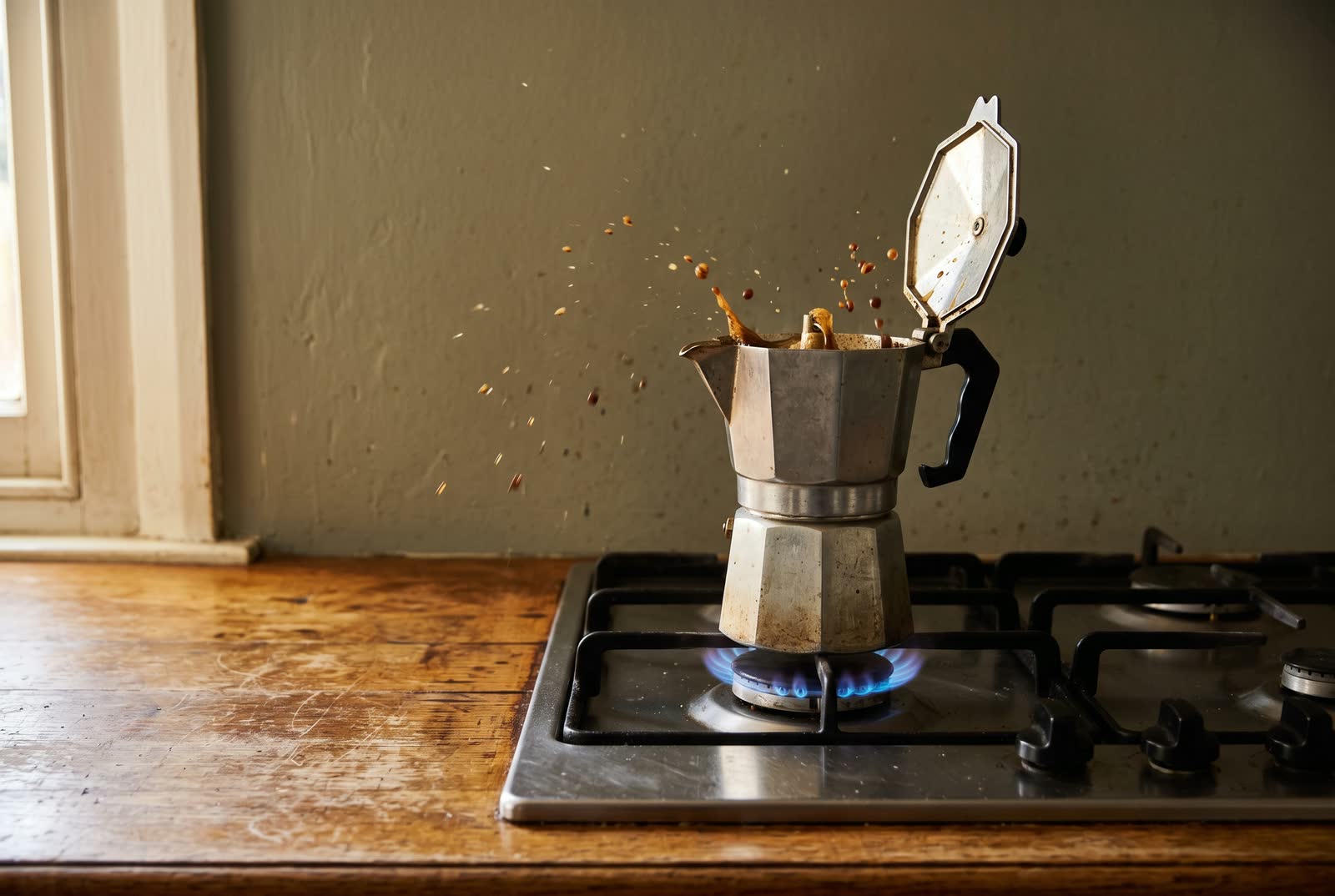
A moka pot fails in three ways that all trace back to the same three-chamber mechanism, not to three unrelated mistakes. What each one makes lays out those three chambers, the lower water chamber, the basket and the upper collecting chamber; this page assumes that shape and only names where each fault starts.
We have not checked a moka pot for this page, and none appears anywhere else on this site. Nothing below states a fill line, a stovetop setting or a size as though it were read off a box; what follows is the pot's own mechanism, plus this site's own working rule for running one, marked as such wherever it appears.
Sputtering: the lower chamber ran dry
A moka pot pushes water up through the grounds using steam pressure building in the sealed lower chamber, and it only works while there is still liquid water down there to be pushed. Sputtering starts the instant the last of that water flashes to steam, because the same passage that carried coffee now carries pressurised air with nothing left to carry gently. That pressure has a ceiling built into the pot's own safety valve rather than a dial anyone turns; the century between already marks that ceiling as fixed, and this page does not restate the figure, only the fact that sputtering happens well under it, not because of it. This site's own working rule, not a maker's instruction, since no pot here has one to state: take the pot off the heat as soon as the sound turns from a steady gurgle to a hiss, not after. A pot that sputters every single time, rather than only on an overfilled or rushed run, is more often a fill-line habit than a fault to chase with the burner; the working rule above assumes the water chamber was filled correctly to begin with.
A burnt taste: the heat stayed on too long
A burnt taste from a moka pot is rarely about the grind and almost always about the heat staying on after the pot finished doing its job. The upper chamber keeps collecting liquid that is now sitting against hot metal with nothing left to extract, and what continues to happen at that point is scorching, not brewing. This site's own working rule again, not a maker's instruction: pull the pot off the burner the moment the sound changes, and let the last of it finish off the heat rather than on it. A burnt taste that shows up even when the pot comes off right on time usually points at the burner rather than the pot: a flame allowed to wrap around the sides rather than sit under the base heats the metal itself rather than the water inside it, which is a difference in the stove, not in the pot's own mechanism.
Coming out thin: the basket never got full
A thin result usually means the basket was not filled the way the pot's own design expects: a moka basket is meant to be filled level and left untamped, and a half-full basket lets water find the easiest path through instead of the whole bed of grounds. Grind matters here too: coffee ground too coarse for the basket lets water rush the same way a light fill does. A manual grinder like the JX-Pro S, which states 40 clicks per rotation at 12.5 microns per click, per its maker, gives fine enough steps to correct this without an electric grinder on the counter. Thin results and sputtering can share a cause, too little water at the start relative to how full the basket is, which is why the fill line and the basket fill are worth checking together rather than one at a time.
Once it is fixed
None of the three faults above are about how the corner looks once the coffee is right. A wood tray with brass handles and a set of handmade ceramic mugs, both styled from listings in this site's decor records rather than from any pot-specific source, are what carry a fixed pot to the table; they change nothing about sputtering, burning or thinness, which is exactly why they come last on this page and not first.
Why this page names causes instead of a pot
Every other machine on this site's pages traces back to a maker's own figures we have checked. A moka pot has nothing like that here, and the three faults above are written from how the pot works rather than from any single model's manual. That is a narrower kind of page than the rest of this site carries, and it is written that way on purpose: naming a fill line or a burner setting without a source behind it would read as more certain than this site can back up, for a piece of equipment nobody here has checked.



