The two rules a lease writes into the plan
A rented kitchen sets the same two conditions almost everywhere: nothing goes into the walls, and nothing goes into the plumbing. Both leave a mark that outlives the tenancy. Work forwards from them and the corner designs itself: it stands on the floor or the counter, carries its own water, and leaves with you.
Which layout family suits which apartment is small apartment coffee bar layouts, and the cart as a piece of furniture is the coffee cart. This page is the rented kitchen's whole corner, and what may not be done to it.
The shelf, and where it belongs instead
The floating shelf is the piece this page rules out, and it is worth saying why rather than leaving it off the list. The listings run from about 23.6 to 60 inches wide and roughly 5 to 11 inches deep, some of them stating pine-board construction with per-bracket load ratings up to 75 lb, and those load and dimension figures are per-listing claims collected across a category rather than a single verified product. A rating of that size is exactly the kind of claim that has to rest on the bracket in your wall, not on a category.
More to the point, every one of those brackets goes into the wall with a drill, which in a rented kitchen is the end of the conversation. What a wall does for a corner when you are allowed to drill into it is the wall above the counter.
The cart, and the cabinet
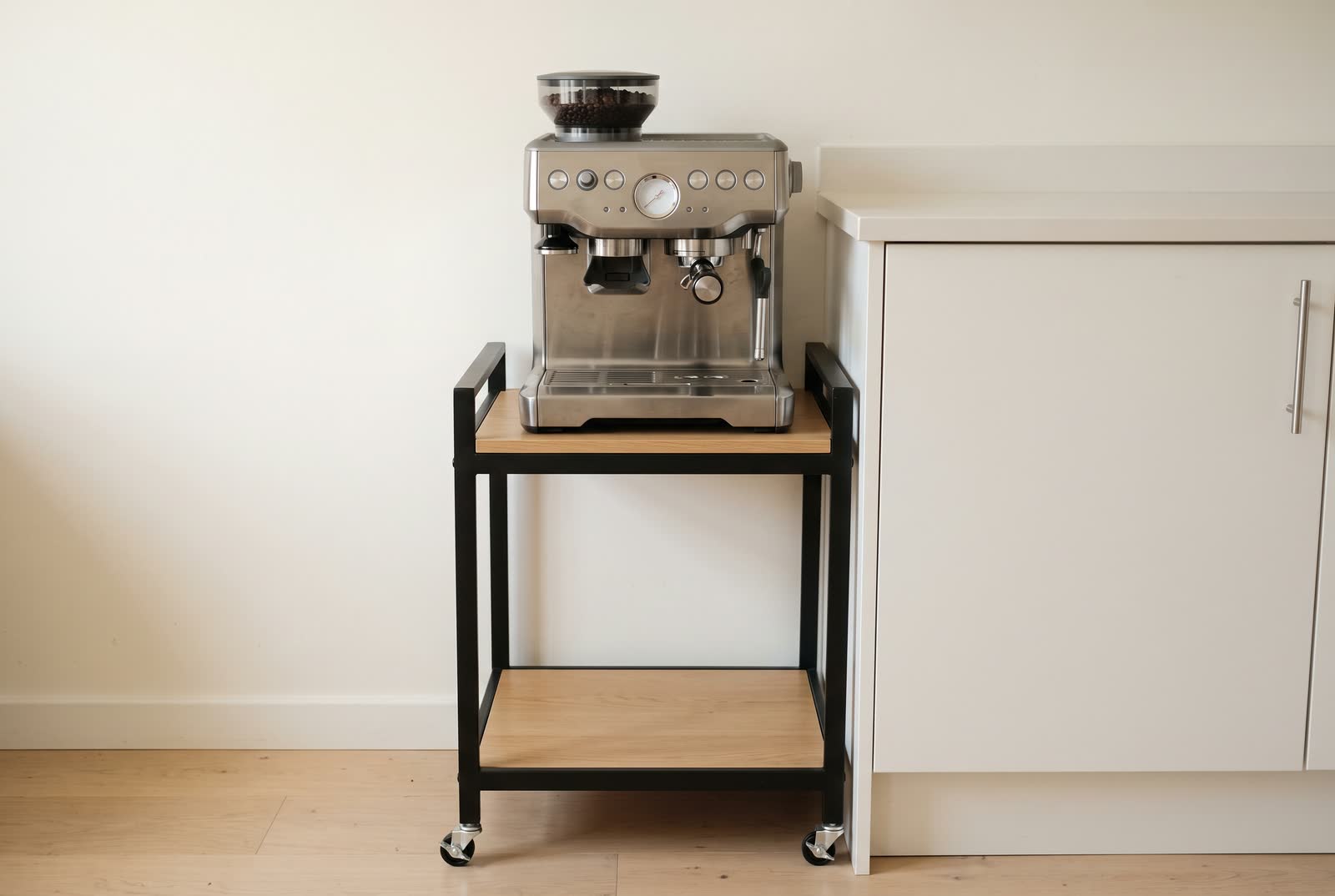
The metal and glass cart is a retailer category rather than one measured product: metal-frame carts with glass shelves, caster wheels and built-in handles, listed at roughly 24 to 34 inches wide and 29 to 35 inches tall depending on the model, and marketed as bar, coffee, kitchen and drink carts in the same breath.
A closed cabinet on casters is the closed version of the same idea: storage behind a mesh door instead of open shelves, still mobile enough to roll into place rather than needing to be drilled into a wall.
Both take floor rather than counter, which is the point in a kitchen whose counter is already spoken for, and both are on casters, so both move out on the last day of a lease with no filler behind them.
The door, and the sentence that decides it
A closed cabinet raises a question a cart never does, and one maker on this record answers it in writing.
The Classic Pro's instruction manual, read on 6 September 2026, states on page 13: "The machine shall not be placed in a cabinet when in use." That is not advice about ventilation, it is the maker's own instruction, and it settles the arrangement where the machine lives behind the door. The cabinet still works, with the machine standing on the top and the door hiding the beans, the filters and the spare jug. It does not work as a cupboard the machine is shut inside.
The Bambino's manual was read in full on 6 September 2026, and its placement warnings carry no instruction against use inside a cabinet or an enclosed space. That is recorded on this site as an absence and not as an allowance: a manual that never raises the subject has given no permission, and this page will not convert one into the other.
If the door is open while the machine runs, the door needs room to be open in. A working rule of this site's own, rather than a figure read anywhere, is to leave the door's own width clear in front of the cabinet before the cabinet is bought.
Footprints, in the units each source prints
The Bambino measures 6.3 in (160 mm) wide, 13.8 in (350 mm) deep and 12.0 in (305 mm) tall, per Target and Bi-Rite Home Appliances, who agree within 5 mm on each measurement; Breville's own product page prints 11.9 by 6.1 by 13.5 inches without saying which figure is which, so this article uses the retailers' measurements. The Classic Pro, read for the same sheet on 11 September 2026, is 200 by 270 by 355 mm.
A cabinet top needs to be at least as deep as whichever machine stands on it, with a few inches left in front to reach the tank and the portafilter. Of the two, the Bambino is the deeper machine at 13.8 in against the Classic Pro's 270 mm (10.6 in), so the Bambino is the tighter fit under a cabinet.
Height is where a cabinet differs from a counter. A cabinet top typically stands lower than a standard counter, so a machine of 305 or 355 mm tall works out to a working height rather than chest level on top of it, though that depends on the specific cabinet's own height, which is worth checking before buying.
The water, carried rather than plumbed
The plumbing rule is the easier of the two, because every machine at this end of the market is tank-fed already. The Classic Pro's manual states the refill in its own words on page 17: "Remove the water tank cover (Fig.2) and fill it with cold water up to the MAX level of the tank (Fig.1-13)." A tank filled from the top of the machine is a tank filled from a jug at the sink, carried four steps, and poured. That one instruction is why a rented corner works at all: the corner carries its own water, and a line into the wall was never part of it.
What the corner costs, and what leaves with you
Neither the cart nor the cabinet buys counter depth back, because neither is on the counter. What they cost is floor: a closed cabinet's own width and depth, or a cart somewhere in the category's 24 to 34 inches of width, whose depth no listing on this record states. What they give is a station in a kitchen that had room for none. The pieces here sit in this site's own bands, which are its framing rather than a price read at a shop, and the furniture is the smaller half of the money.
On the last day, everything rolls out. That is the one specification a rented kitchen really asks for.



