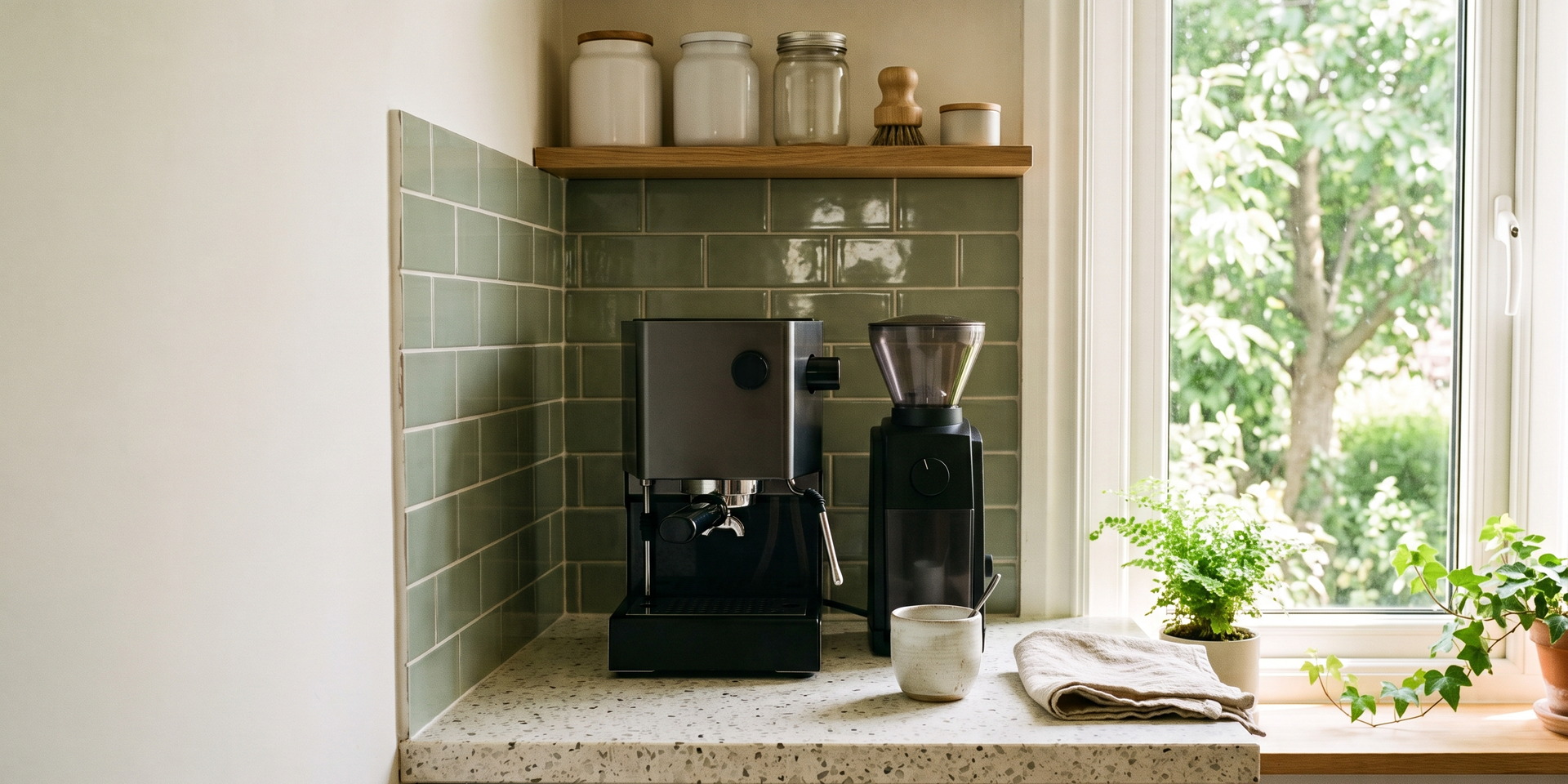
A rental with no spare counter still takes a coffee bar. Three things decide which kind: the floor you can give it, the wall you are allowed to drill, and whether the machine you want may stand inside a cabinet. Settle those in that order and the shopping list follows.
The short answer
Start with a cart. It rolls out of the way, needs no drilling and leaves with you on the last day of the lease. Choose a closed cabinet only if the machine will stand on top of it: the manuals for the Gaggia Classic Pro and the De'Longhi Stilosa both forbid running the machine inside one. Choose the wall only when floor space is gone and the lease allows anchors, and keep the espresso machine off it, as the depth check below shows.
Pick the layout by what the unit gives you
- Floor to spare, drilling not allowed: the cart.
- Floor to spare, equipment kept out of sight: the cabinet, with the machine on top and the door hiding beans, filters and a spare jug.
- Little floor, drilling allowed: the wall, for a hand grinder, a pour-over kit and the mugs.
- Little floor and no drilling: the narrowest cart whose top shelf still takes the machine's footprint.
Three layouts
The mobile cart
A cart works as a coffee station when its top shelf is at least as deep and as wide as the machine that stands on it and its wheels roll it out of the way. What to look for in a cart: caster locks so it stops rolling once positioned, and a bottom shelf deep enough for a kettle rather than just glassware. What a cart holds and where it parks is the coffee cart.
The closed cabinet
A cabinet trades the cart's visibility for containment: grounds, filters, and mugs sit behind a door instead of on open shelves. The width that matters for an apartment is the wall segment it will sit against, and the depth that matters is the machine's: measure both before ordering anything, and leave room in front of the cabinet for the door to open. The machine stands on top, never inside, for the reason in the next section.
The vertical wall
When floor space is the scarcest resource, the layout gives it up entirely. Measure what will stand on the shelf, in width and in depth, before choosing one: the shelf has to be at least that deep, and the depth check below puts two real depths side by side. What to look for in a floating shelf: a width that clears your equipment without crowding a wall stud, and a stated bracket rating rather than a shelf that omits one.
Mugs are a separate decision. Count the mugs you use; that sets how many hooks the rack needs. What to look for in a wall-mounted mug rack: hook spacing wide enough for your mug handles, whether the mount depends on hitting a stud or ships with anchors for the drywall between studs, and whether an integrated top shelf comes with it or you're getting hooks alone. A wall-mounted rack and a countertop mug tree solve different problems even though they look similar in photos, so treat them as distinct fixtures. Splitting mugs from equipment across two mounts keeps mug weight off the shelf that already carries the coffee gear.
Where the machine stands: on top of the cabinet, not inside it
Two of the three machines named on this page come with a written ban. The Classic Pro's manual, read on 6 September 2026, states on page 13: "The machine shall not be placed in a cabinet when in use." The Stilosa's manual, read the same day, states: "The coffee maker must not be placed inside a cabinet or kitchen unit during use." The Bambino's manual, also read in full on 6 September 2026, carries no instruction against it. Silence is not permission, so treat a cabinet as a stand for the machine with a door for everything else. The cabinet door and the rest of the lease rules are worked through in a rented kitchen with nothing drilled and nothing plumbed.
Measure before you order
- Cart size. Measure the wall run and the doorway it has to roll through, then the machine's width and depth against the cart's top shelf.
- Shelf depth. Read the depth a shelf states against what goes on it. The pour-over kit below is 121 mm (4.8 in) deep; the espresso machine needs the depth in the last point, so a shelf that states less than that is for the grinder, the kettle and the kit, and does not fit an espresso machine.
- The cable. A cart parks where its cable reaches. Check the outlet before the cart, not after.
- Machine depth. The Bambino measures 350 mm (13.8 in) deep, per Target and Bi-Rite Home Appliances; Breville's own page prints 11.9 by 6.1 by 13.5 in without saying which figure is which, so the retailers' labelled measurements are used here. A cart shelf or cabinet top needs at least that depth, plus room in front for the tank and the portafilter.
Noise and outlets: a second layer to check
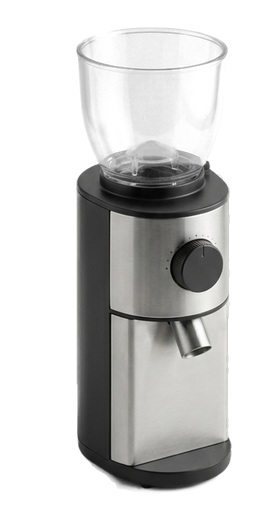
Once you've picked a layout, noise and electrical access are the next constraint. A manual grinder removes the outlet draw and the motor noise. The JX-Pro Manual Coffee Grinder uses a top-adjustment dial with 10 numbers and 40 clicks per rotation at 12.5 microns per click, per the manufacturer, and carries a one-year manufacturer warranty against material and workmanship defects. Its grounds capacity and body size are left out here. Brewing can skip the outlet too: the Hario V60 Ceramic Pour Over Coffee Set bundles a porcelain size-02 dripper, a heatproof borosilicate glass server, and 100 paper filters, with the server holding 600 ml and the whole kit sized at roughly 5.5 x 4.8 x 8.3 in (140 x 121 x 210 mm). Neither needs power, which matters more in a cart or wall layout than in a kitchen with a dedicated appliance circuit.
An electric espresso machine is the bigger outlet question: it can take most of a shared 15 A kitchen circuit, and the socket page works the arithmetic for three machines and a grinder.
Storage that matches the footprint
Whatever cabinet or shelf holds the grounds, container shape decides how much of that footprint actually gets used. OXO's 3-Piece POP Round Canister Graduated Set stacks three sizes with push-button airtight lids that double as carry handles, and the same line also comes in a steel-lid glass version. The OXO Good Grips 3-Piece POP Round Canister Set is priced editorially in the mid tier here based on OXO's general kitchenware positioning rather than a stated figure, so treat that band as a starting expectation, not a quote.
Renter-friendliness is the tiebreaker
A cart and a cabinet both move on casters and leave nothing behind when the lease ends. A floating shelf and a wall mug rack need anchors in drywall, which is exactly the tradeoff for reclaiming floor space: less to store on the ground, but a patch job at move-out. If the lease is short or the walls are already a landlord's biggest complaint category, the cart is the lower-friction default. If wall space is free and floor space isn't, the vertical layout is worth the drilling.
Budgeting across the three layers
Nothing here needs an exact price to plan around. The pour-over kit sits in the under-$50 band. The canister set lands in the $50-100 band. The grinder and the cabinet fall in the $100-250 band. The cart and the wall pieces are left unpriced here: measure first, then price what fits. A workable order is layout first (cart, cabinet, or wall), grinder and brewer second, storage last, since the storage pieces are the easiest to swap without redoing the rest of the setup.