The short answer
On a 15 A kitchen circuit at 120 V, run the espresso machine and the grinder together and put the kettle on a different circuit. The Bambino draws 13 A, which is 1560 W divided by 120 V, both figures from Breville, read on 1 September 2026. The Classic Pro draws 11.3 A, which is 1350 W divided by 120 V, both from Gaggia's own page. The Encore ESP grinder adds 0.8 A, a current Baratza states on its own page, read on 10 September 2026.
A Bambino and that grinder come to 13.8 A, which leaves 1.2 A of the circuit, room for nothing else with a heating element in it. Both machine currents are this site's division of two figures on the maker's page, done in the open below.
The constraint that arrives before the counter does
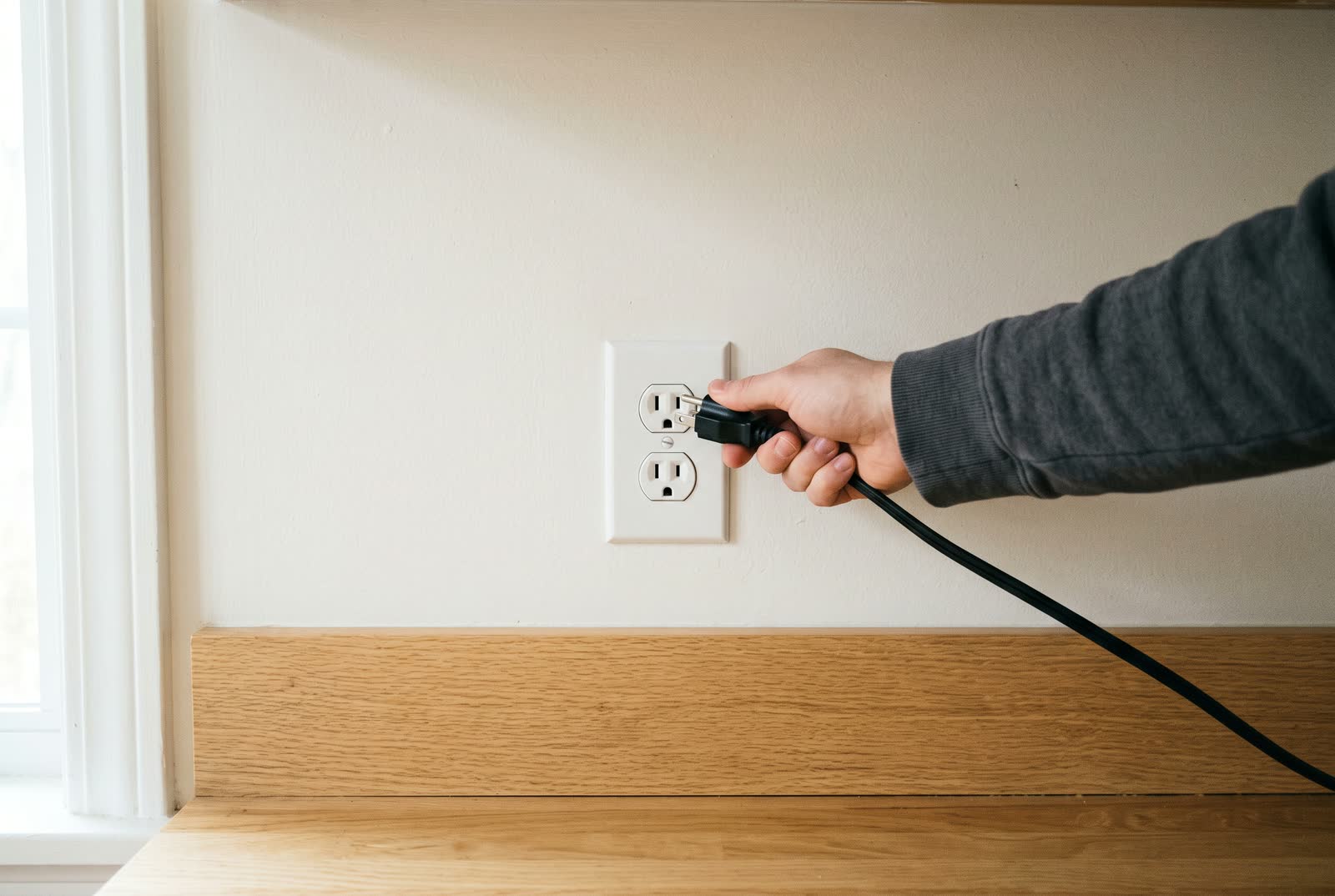
Most coffee corners are planned around depth. The constraint that actually stops people is behind the machine, in the wall, and it announces itself by tripping a breaker on a Sunday morning with a portafilter locked in.
This page sets what a machine and a grinder draw against one reference circuit, based on the manufacturers' own wattage and voltage figures and not on hands-on testing, and it does the arithmetic in the open so you can redo it with your own numbers.
Where the cart parks is the coffee cart; this page is about the socket it parks at. Which layout the corner takes is the layout guide, and what a lease allows around the socket is the rented kitchen page.
The reference circuit, and whose framing it is
Throughout this page the reference is a 15 A shared kitchen circuit at 120 V. That is this site's own framing, chosen because a shared circuit is the honest case: the coffee corner is rarely alone on it. It is not a reading of your panel: your kitchen may be on 20 A, on a different voltage, or shared with a room you have not thought about. Replace the number with yours and the arithmetic still works.
What three of the machines draw
Of the thirty-six products this site keeps maker figures for, twenty carry a wattage, a voltage on twenty-six and a current on twenty-one. Eleven of the fifteen espresso machines carry all three, and on all eleven the current is watts divided by volts, done by this site from two figures on the same page rather than stated by a maker.
The Bambino states 1560 W at 120 V, both read on 1 September 2026. Divide one by the other and the draw is 13 A. That is this site's arithmetic rather than a figure Breville prints, and it is what the ThermoJet heating system its maker says reaches temperature in three seconds is doing.
The Stilosa states 1100 watts and 120 V 60 Hz on its US page, read live on 6 September 2026, alongside its weight, its dimensions and a 33.81 fluid ounce tank. Divided out, that is 9.2 A. One caution travels with those figures: a direct fetch of the maker's page returned a 403, and the values here come from search-engine-cached copies of the same URL rather than a live page read, which this site treats as an assumption rather than a clean reading.
The Classic Pro carries 1350 W read on 11 September 2026 and 120 V read on 3 September 2026. Divided out, 11.3 A, and both figures come from the maker's own page.
What a grinder draws, and where that figure comes from
Grinders are the small number here, and the place where the figures are better than usual: four Baratza grinders carry a current the maker actually states rather than one this site worked out. Those four readings come from each grinder's own Baratza product page, read on 10 September 2026 from its own specification block: the Encore, the Encore ESP and the Virtuoso+ at 0.8 A, and the Sette 270 at 2.6 A.
Where a maker states a current, this site uses it and sets its own division aside. The Encore ESP, whose maker states 40 mm conical M2 burrs and 40 stepped settings, carries 70 W at 120 V on its own page, read on 6 and 3 September 2026, which divides out below the stated figure; the stated 0.8 A is what this page uses.
The Encore, whose maker states 40 mm conical burrs, 40 settings and a 550 RPM direct-drive motor, is the case where a figure is withheld. Its wattage cell carries two readings with neither chosen, and only one of the two is recoverable here, so no wattage for it appears on this page. Its stated current, 0.8 A read on 10 September 2026, is printed instead.
The two together, against fifteen amps
Added together, the Bambino and an Encore-class grinder come to 13.8 A of a 15 A circuit, the Classic Pro and the same grinder to 12.1 A, the Stilosa and the same grinder to 10.0 A. All three additions are this site's arithmetic on the figures above.
The grinder is almost never the problem: under one amp, running for seconds. The machine alone is most of the circuit, and the 1.2 A of headroom left beside a Bambino is room for nothing else with a heating element in it.
That is the real failure. Grinding while the machine heats is fine; a kettle or a toaster on the same circuit is what trips it. No single wattage figure exists for the kettle, because the maker's page prints a range of 1000 to 1200 W rather than one figure, read on 6 September 2026.
The four figures in dispute
Four of the thirty-six wattage cells carry two readings with neither chosen, and two of them are not really disagreements.
The Profitec GO is the clearest. Its product page and its own manual, both read from Profitec's own site on 11 September 2026, print the power twice, once per market, and they do not name the same markets. The page gives 230 V and 1300 W for the EU, UK, Switzerland and Australia and 115 V and 900 W for the US. The manual gives the same 230 V and 1300 W for the EU, UK, New Zealand and Australia, and 900 W at 110 V for the US and Japan. Two figures, two machines.
The Barista Express is one of them. Its own page states 1750 W, read on 3 September 2026; its own specification block prints 1600 Watts, read on 10 September 2026. Both readings stand. For the Ascaso Dream PID and the Encore, only one side of each dispute is recoverable here, so this page prints neither figure: a number without its counterpart reads as settled. The Dream PID is also the one machine on this page named without a link, because its product page here has neither a picture nor a checked price.
Checking your own kitchen before the corner is built
Find the breaker that feeds the counter and read its number. That replaces the 15 A framing above.
Find out what else is on it. Kitchen circuits are shared more often than people assume, and the other socket on the same run usually decides this.
Then add the machine and the kettle rather than the machine and the grinder. The pair that runs at the same instant is the pair that matters, and dividing the watts on your own plate by your own voltage takes less time than resetting a breaker.



