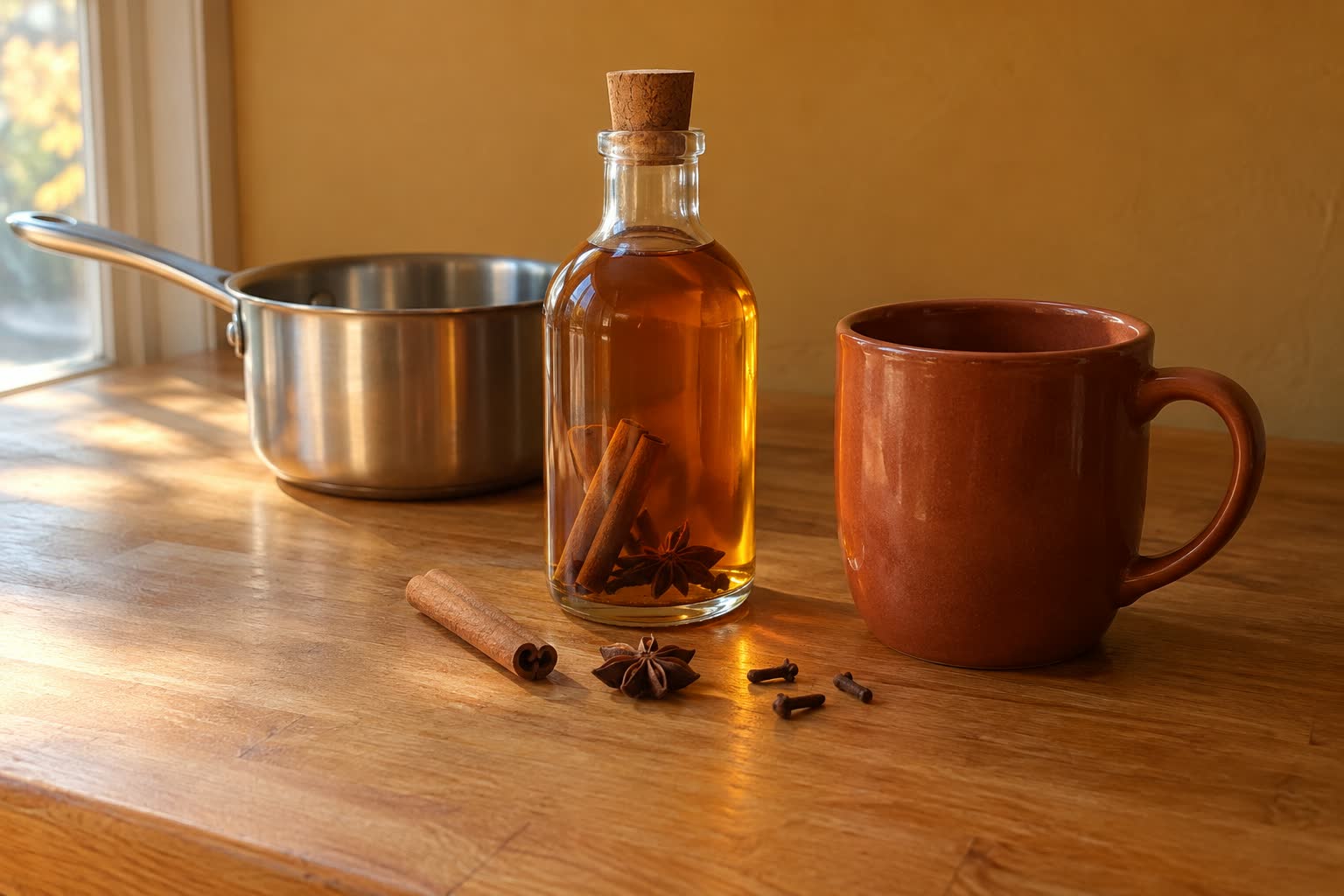
One syrup, and the drinks come free
A season of spiced coffee drinks is usually sold as a season of purchases: a bottle for one flavour, a can of something for another, a sachet for the third. It is one syrup. Make a jar of it on a Sunday afternoon and the autumn drinks a cafe charges a premium for are a pour away from a shot you were making anyway.
The four drinks are the same four every year. Spiced latte: syrup in the cup, shot on top, steamed milk after. Spiced cold brew: syrup in the jug, stirred, over ice. Spiced cortado: a smaller pour, because the drink is small and the milk is thin. And a spiced steamer with no coffee in it at all, for whoever in the house does not drink coffee.
What goes in the pan
Equal weights of sugar and water, warmed until the sugar is gone and no further. Equal weights is the common convention rather than a measured ratio. That is the syrup. Everything after it is the spice.
The autumn set is cinnamon, ginger, nutmeg, clove and allspice, and the proportion that works is heavier on the first two than a recipe card usually says: clove and nutmeg run away with a jar if you let them. Add the spice to the pan when the sugar has dissolved, take the pan off the heat, and let it steep with the lid on while it cools. The steep is where the flavour comes from; boiling the spice gives a syrup that tastes stewed.
Vanilla, if you want it, goes in at the end and off the heat. Heat drives it off.
Whole spice or ground, and why the strainer decides
Ground spice gives a stronger syrup faster and leaves a sediment that never fully settles. Whole spice gives a cleaner syrup, takes longer, and strains out completely through a fine sieve or a square of muslin.
Take whole where you can. A syrup with sediment in it blocks a pump top, and the bottle you are about to put it in probably has one.
Whole spice also keeps better than ground, which is the argument for buying it whole and grinding what you need for baking rather than the other way round. Airtight storage is what makes that true: the OXO POP canister set is three graduated containers with push-button airtight lids on the maker's own listing, and the maker prints the three sizes as 5.2 quarts, 3.3 quarts and 1.5 quarts. The smallest of the three is the spice jar in that set; the two larger ones are bean-sized and are doing another job on the same counter.
Bottling it, and what the bottle has to do
A bottle for syrup has three jobs: it pours a measured amount, it seals, and it says on the outside what is in it, because a second syrup arrives before the season is over.
A pump top does the first job better than a spout, since one push is one dose and your hand is not the measure. Glass syrup bottles with pump tops are a category rather than a single product: the merchant listing we have read describes glass-bottle syrup dispenser sets with pump tops and removable labels, sold in packs of two and of four. That is a shape to buy by and not a model we have handled. There is no single confirmed product behind that listing, so treat everything here as a description of a kind of bottle, not a recommendation of one.
If you make more than one, the bottles need somewhere to stand. The same merchant lists a two-tier rack for syrup bottles at roughly 16.5 inches long, 7 inches wide and 7.95 inches tall, holding up to ten bottles, which is a useful number to hold against your own counter before you decide a rack is the answer rather than a shelf.
A clean glass jar with a lid does all three jobs except the measured pour. It is what most people will actually use.
How long it keeps, and what would settle it
A sugar syrup keeps in a fridge. How long depends on the sugar concentration, on whether the spice was whole or ground, and on how clean the bottle was when it went in, and we have not found a published source that puts a number on it for a home-made spiced syrup. So we do not state one.
What would close it is a food-safety authority's own guidance on refrigerated sugar syrups, or a published figure from a manufacturer of the same kind of product. Until we have checked one of those, the honest instruction is the one anybody can act on: make a jar you will finish before the season is over rather than a bottle that will stand into next year, keep it cold, and pour rather than dip.
Cloudiness, a smell that has changed, or anything growing means it is finished. That is not a timer, and it is the only test this piece will claim.
Pouring it, and how much
Start at less than you think. A syrup made at equal weights is sweeter than a cafe pump, and the drinks it goes into are smaller than a cafe cup.
In a latte, the syrup goes in the cup first so the shot mixes it on the way through. In cold brew, it goes in the jug and gets stirred, because cold liquid will not dissolve a syrup sitting on the bottom. In a cortado, use half a pour, which is a working rule rather than a measured dose: the drink is small and the milk is thin, and a full measure buries the coffee under a spice cabinet.



